After breakfast, I sit with my tea next to an old fireplace in a renovated ancient cottage.
The small log burner under the chimney is redundant on a summer day. Once, I muse, there would have been an open fire for heating and cooking. A kettle and pot would have hung from trammel hooks over the flames, a small oven might have stood to the side.
It’s hard to imagine this tiny house with more than two people inside. Downstairs, there’s barely room for a table, two chairs, two armchairs, a dresser, a two burner hob, fridge (with microwave atop) and large sink. A large, low double bed fills the attic upstairs. A pleasant shower room has been built, adjoining the lower floor.
My husband and I, our laptops, tablets, phones, leads and books fill the place.
I sip tea, and scroll through reels on social media, musing. This cottage would have been home to a poor family once. Now it’s for holiday makers. Where I sat idle in an Ikea armchair, a woman would have bent, stirring the pot in the fireplace, sweating because even in August, food still needed to be prepared, a family still needed to be fed.
Surely she’d only have had a dresser, table and chairs. No armchairs, no labour-saving devices, no sink. Apart from the river, where was her water supply? A long early morning walk perhaps? Maybe she cared for an elderly relation who watched as she worked with children at her feet, a baby in her belly while a husband waited to be fed.
I scroll and come across a video.
Someone is reconstructing ‘mud cookies’ also called ‘bonbon tè’. I unmute my phone. It’s a Haitian famine recipe made of mineral-laden mud mixed with salt and a little fat then baked in the sun.
Appalled, I watch the maker taste them.
‘They’re so salty,’ she says. ‘They suck all the moisture out of your mouth.’
The fireplace rattles.
I look at it. Nothing is moving. But the noise is there.
Shaking myself, I scroll on and come across a thread about secrets. Some are appalling. Some need reporting. One says ‘My husband works all the hours but doesn’t make enough to feed us all. I pretend I’ve eaten when we have dinner. I don’t want to make him feel a failure. Sometimes I’ve had nothing to eat but toast and black coffee all day.’
How can it be that a woman in a developed country in 2025 is doing what women did a hundred years ago and more – try to survive on next to nothing so that her husband, children and dependent elders can eat?
The fireplace rattles again.
There is no wind to come down the chimney. There is no traffic on the narrow country road to vibrate the house.
There is just an old fireplace and the ghosts of women who stirred the pot in the fireplace beside me while their stomachs rumbled.
And they have not forgotten.
Words and image copyright (c) Paula Harmon 2025. These are not to be used without the author’s express permission including for the purposes of training artificial intelligence (AI).
Trigger warnings in books, films and TV are contentious.
I’m often irritated when I’m watching TV after 9.30pm and a sombre announcement warns me about what might offend or upset me in the programme I’m about to watch. I’ve usually enough knowledge of what I’m about to see to anticipate it, and if I didn’t want to watch, I wouldn’t. (And often don’t even if the drama is going to be excellent.) Other times, if I wasn’t aware there might be a particular scene, I’m glad of the warning beforehand so I can make a choice about whether I watch.
I admit I don’t think I’ve ever seen a trigger warning a book. However, I have a question for you.
But here’s a quick trigger warning about this blog post if you want one before you read down and find out what I’m asking: it refers to human trafficking, slavery and obliquely to prostitution.
The image below may look fun, but it very much isn’t. It’s from a larger image that was printed in the Illustrated Police News on Saturday 17 June 1899 with the description: ‘Alleged Immoral Traffic in Chinese Girls – they are packed in crates and treated as freight on the railways’. The article (on page 3) says ‘An investigation has been ordered into the recent revelations regarding the sale and shipment of Chinese girls, a practice which, it is alleged, has been customary for months. The climax was reached a week ago, when two girls, aged fifteen and sixteen years respectively, were bought at Vancouver. It is asserted they were placed in a crate and shipped as freight over the railway, the train hands giving them food and water. The car containing them was placed on a side track one night, and the girls, being each clad only in a wrapper, caught cold. The man who purchased one of them demanded damages from the railway company for the injury thus done to his property. The girls, it is alleged, were sold for immoral purposes.’
This small picture is in the corner of a larger one depicting what looks like a rough (presumably Canadian) bar with two (possibly supposed to be Chinese) girls in low cut mid-calf dresses, sitting on the laps of two bearded men, watched by a crowd of other men.
If you saw the larger image without context, you might be reminded of an archetypal scene from a Western where everyone – including the girls – is having great fun in a saloon, in contrast perhaps to the stuffy citizens of a frontier town.
However, when you include the other image and what it’s describing (and a cockroach of a man who’d purchased two girls and had the face to publicly sue the railway company for their damage because he might not be able to profit from what damage he did to them afterwards) you might wonder how many if any of the girls in that bar/saloon (or any equivalent) chose to be there and were happy with what they had to do. Some did/do choose that job not simply out of desperation, but because they want to and they keep their own earnings. But many, many didn’t and still don’t.
There’s a prevailing view that refined Victorian and Edwardian women would faint if any reference to sex came into their hearing. Maybe it was true for some, but evidence suggests that there were plenty for whom it wasn’t.
In the UK at least, women fighting for suffrage in the 1800s did not simply want the vote. They also wanted better treatment for women and girls – not just in terms of educational opportunities but also their personal, moral and mental safety. And they weren’t afraid to tackle the subject head on.
Josephine Butler for example, had long campaigned for the raising of the age of consent to be raised from thirteen to sixteen. Why this was such a battle is mind boggling, but eventually, working with journalist W.T. Stead and Bramwell Booth of the Salvation Army, she was involved in the infamous Eliza Armstrong case. They proved to a horrified Victorian general public how easy it was to buy a child for immoral purposes, conspiring to purchase a thirteen-year-old girl for £5 (six months salary for a maid) from her mother who provided proof of her purity plus some chloroform to drug her, knowing that she would be destined for a brothel on mainland Europe. Instead, Eliza was rescued and subsequently had a safe and good life. W.T. Stead was, believe it or not, subsequently prosecuted for abducting a child from her parents, despite what they’d been happy to do to their own daughter. But ultimately, the case raised awareness of what was happening, and the age of consent in England and Wales being raised to sixteen in 1885.
By the 1910s when ‘The Suffragette’ was also campaigning about what they called ‘the traffic in humans’, the international White Slave Traffic Act (also called the Mann Act) had some into force, as had the International Agreement for the suppression of the White Slave Traffic (also known as the White Slave convention). Legislation was also introduced in the UK to allow for any procurer to be publically flogged if convicted, though whether any were I’m not sure. There were certainly plenty of procurers, some more sophisticated than others, from strangers posting apparently innocent advertisements for legitimate jobs, through mothers of young girls making money out of their innocence, to coercive husbands/boyfriends who just had one little job for them to do ‘if you really love me’.
‘The Suffragette’ and other papers however, were willing to point out that although the term ‘White Slave’ had been coined in the mid 1800s to refer to trafficked people of European descent where the perpetrators weren’t of European descent, by the early 20th Century there was a recognition that the race of the victim was irrelevant to perpetrators who were more likely than not to be white, and simply wanted to make money.
It was also recognised that victims weren’t only forced into ‘immorality’ but into illegally run factories, mines, farms etc etc; often abducted and/or imprisoned, sometimes a long way from home. The good old days huh?
So what about my question? The fifth Margaret Demeray book ‘A Justified Death‘ is coming out in the Autumn.
It’s November 1913 and while Margaret’s personal life involves being under pressure to work more days at the hospital and wrangling her unpredictable elderly father, the political world around her is still edging towards war. Britain and Germany are having a ‘my torpedo/canal/warship/zeppelin is bigger than yours’ contest under the guise of friendly demos. The ‘Irish Question’ is bigger news for once than suffragette militancy, with the leader of the Conservative Party, Andrew Bonar Law, hinting at major trouble from Unionists if the Home Rule Bill goes through.
But as I said in How What When – it’s not just politics which affect my characters. In ‘A Justified Death’, a young girl runs out into a foggy street and is knocked down more or less in front of Margaret. Before long, Margaret suspects that the girl was not only running from traffickers but is afraid her friend will get caught up in the same ruse. As Margaret and Fox try to find the girl’s friend and close down the operation, they start to wonder if everything is as depressingly simple as it looks or is something else going on too.
So here’s my question, assuming you’ve got this far. If you were considering buying this book, would you want a trigger warning?
Within the book there is reference to trafficking, but there is NO description of what physically happens to anyone trafficked, it is only hinted at and suggested. I don’t want the book to be gratuitous, or (heaven forbid in context) titillate, but I’m quite happy if it makes the reader angry on behalf of the characters.
The book is not just about trafficking of course, as I say, Margaret’s got a whole lot of other things going on as usual, and it’s not all dark and dreary either. The twins are getting more mischievous, her nephew may be suffering from first love, and Margaret’s father has found another bookshop to get lost in.
But I’m conscious that from a book description which refers to procures and trafficking, potential readers may be worried they’ll get more than they bargained for.
Some authors deal with this by including a statement to say: ‘Trigger Warning; please be aware that this book includes…’ Others have a link to a place on their website which readers can access if they’re at all concerned. Others put nothing and assume that the potential reader should guess what the book is likely to include by the description.
If you’re in favour of trigger warnings, what sort of things do you want warnings about? And how do you think I should approach it in this instance?
If you’re against, why?
I’d love to know.
(NB: Sadly human trafficking is still alive and well and often invisible – cheap clothes, cheap food, cheap goods, cheap services – they’re often cheap for one reason only. Please find some websites about modern slavery/human trafficking – how to recognise it, how to help, how to find help below.)
Words copyright 2024 by Paula Harmon. All rights belong to the author and material may not be copied without the author’s express permission.Image courtesy of the British Newspaper Archive and taken from page six ofIllustrated Police News – Saturday 17 June 1899.
The other evening my husband went out cycling. Yes, it’s November. Yes it was dark. But he and his friends do this weekly after work whenever they can. At nine-thirty, it started to pour with rain as forecast. At ten p.m., just as he returned, the whole town had a power cut.
I heard with relief (since he’s the only one of the cycling group who hasn’t broken a bone on one of these jaunts) the screech of our garage door and went to look out for him, shining my phone torch into the rainy darkness.
My drenched husband said it was like being guided into the house by Florence Nightingale.
My nursing skills boil down to ‘here’s a kiss and an aspirin and/or a plaster and/or a blanket and/or soup and I’m sure you’re fine really’, so this was the first time I’ve been likened to any medical professional let alone a nursing heroine, and got me thinking.
Did Florence Nightingale really did carry a lamp? Or was this a myth long since debunked along with Napoleon being short and Marie Antoinette saying ‘Let them eat cake’? (He wasn’t and she didn’t, and for other historical myths click here.)
At a talk a while ago I was asked if I was ever tempted to write a novel based on a real character. So far my answer is no.
The first reason why I haven’t is that doing so is complex and can be controversial.
With real historical people a novel can only capture the elements of their life that the author wants to focus on, and since real lives don’t follow a story arc, or narrative pattern, real events might have to be moved about or omitted. Then readers complain about inaccuracy or bias.
Going back to Florence, yes she did have a lamp, but surely the nurses working for her in that Crimean hospital carried them too? Yet the image of the Lady with the Lamp popularised by the Times, and Longfellow’s poem ‘Santa Filomena’ turned Florence Nightingale into a celebrity. In the 1970s, I was taught that she was the only pioneering nurse in the Crimean War. But in the 2010s, my children were taught about Jamaican born Mary Seacole who was also there nursing injured soldiers, but without government support or newspaper fame presumably because of views on her race (which may have been a factor in my not learning about her sooner too).
And while Florence radically transformed nursing and reformed the running of hospitals, she was also a firm believer in the right of British Empire colonisers to interfere with the culture of the native people, because Western beliefs and customs were superior and ‘correct’.
Anyone novelising her life would have to include this. Yet there would still be those readers who’d say the focus of a novel should only be on the positive, and anything negative should be brushed under the carpet on the grounds that Florence ‘was a product of her generation’. She was, of course, but there were people of her own race/nationality in the same generation who thought it was wrong, and the native peoples suffering were also of her generation. Do they not deserve a voice? Whatever interpretation you put on it, leaving negative things out surely means the fictionalisation doesn’t reflect the real person at all.
My second reason is that I like to use my imagination.
All my historical books are set in a real historical setting. The Margaret Demeray series also includes or refers to real events and people. ‘Death In The Last Reel’ includes the Siege of Sidney Street and Winston Churchill (film footage here); ‘The Treacherous Dead’ refers back to the Boer War, Emily Hobhouse and ‘Breaker’ Morant. The forthcoming ‘Dying To be Heard’ has my (fictional) characters witnessing the real actions of militant suffragette Emily Davison at the 1913 Epsom Derby (film footage here)
But I like to dig about in the British Newspaper Archives for less well-known things to provide a flavour of the times, because the third reason I prefer to create fictional characters is that I want to imagine ordinary people like my ancestors and perhaps yours, put them in extraordinary situations and see what happens next.
The rich and famous have plenty of books and films written about them. Let’s see what an ordinary person might do.
In 1913, the newspapers headlines were mostly about suffragette militancy and the Balkan crisis. But there was frivolous celebrity news including the Royal Wedding of a German princess – the last time European monarchs met in peace, and before many monarchies disappeared forever. (Not that anyone knew that then.) I also found reference to a moving picture ‘comedy’ about hot-headed suffragettes in which one (played by an actor in drag) was ‘hilariously’ force-fed champagne; a German dentist in Portsmouth who turned out to be a spy (both getting a brief mention in ‘Dying To Be Heard’into the book); and something I’m keeping back for book five.
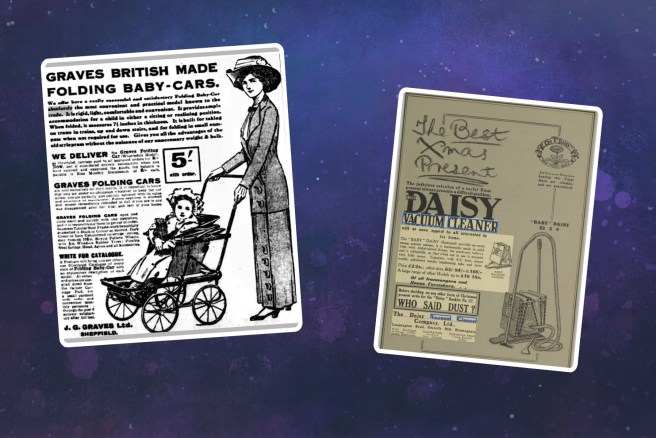
I discovered advertisements for a folding baby car (pushchair/stroller) priced five shillings and a vacuum cleaner priced forty-two shillings. (In context, a housemaid might earn twenty shillings per week.)
This is what gets my imagination going. Were ordinary people worried about suffragette attacks? Or irritated? Did they lap up the celebrity news and discuss what the rich ladies wore to the wedding?
The German dentist spy was captured in a sting operation and sentenced to five years’ hard labour. But what happened to him when World War One broke out? And what happened to the man who informed on him (who was also German but loyal to Britain)?
What does a maid wielding a vacuum cleaner that’s worth two to four weeks of her wages think of something that might put her out of a job?
How does a woman in the medical profession who desperately wants the vote feel about a suffragette bombing campaign that might kill someone?
And finally – what happened to the person who thought a vacuum cleaner was a perfect Christmas gift in 1912? I know what would happen to anyone who gave me one now…
Words copyright (c) 2023 Paula Harmon. Not to be used without the author’s specific consent. Advert for baby car from Daily Citizen (Manchester) 26th April 1913 and advert for vacuum cleaner from Illustrated London News 30th November 1912.
What follows is a tale of woe with a hint of mystery.
To begin with, the woe. Current affairs being what they are, this is very small beer, but all the same, I’m sure at least one of you will sympathise.
One day in February, I charged up my MacBook, then went to make it cup of tea to brace myself for the process of ensuring that all the latest versions of my manuscripts had been saved and backed up securely.
When I came back, the MacBook was an ex-MacBook. (If you don’t get that reference, perhaps I’m too old and too British.) Was every file and photograph I wanted on i-cloud? No. (I appreciate this is down to operator error, but it was frustrating all the same.)
Lots of wailing and gnashing of teeth followed. Making a long story relatively short, the computer chap in town couldn’t help, a young man with his baseball cap on backwards in the Apple Store couldn’t help and I was left with the option to send it off to an organisation in the States who can sometimes retrieve data when this sort of thing happens. (Apparently, the motherboard had gone peculiar – I know that feeling.)
I held out the hope that somehow the tech equivalent of a poke around with a screwdriver and blowing the fluff out would do the trick, but deep down I knew it wouldn’t. After a few days someone rang me from California to explain at length what they’d need to do. I work with enough tech teams for my heart to sink as he spoke. They quoted $3000, so I declined and they sent it back.
By now, I had Miss Lucy Had A Baby going round in my head. In the version I learned, the key verse (which seems to have been softened up since) went: ‘“Dead,” said the doctor. “Dead,” said the nurse. “Dead,” said the lady with the alligator purse.’
In my head, it was replaced less elegantly with ‘“Dead,” said the local chap. “Dead,” said the Apple guy. “Dead,” said the techie under Californian skies.
The only upside was that I’d bought a Windows laptop shortly before as a sort of extra backup, although I hadn’t got around to copying documents across (it was to have been another task for the day the MacBook died). It took me about a month to retrieve crucial documents, convert them to the right format, update them, then save them securely in various places. It felt a lot longer than a month and I think I went through all seven stages of grief. I’ve been playing writing catch-up ever since.
One thing impacted of course, was passwords, which moves us onto the mystery.
Perhaps due to temporary insanity, realising that on top of the thirteen plus passwords I have for my office job, I had even more for the rest of my life, made me think of trying to get into a locked filing cabinet in a locked room behind a series of locked doors in a locked castle. And that reminded me of many years ago when I was deputy office manager, and the day when the office manager and I had to do a key audit and found something curious.
Due to the nature of our work, the rule was that no one person should be able to get to anything important alone. This meant for example, that one person would have a key to the safe where the cash tin was, but a different person would have a key to the tin itself, and someone with a key to get into the building (and thus likely to be in early and potentially on their own for a while) didn’t have a key to the safe etc. Other keys were kept in what we called a ‘key press’ and checked out and in during the day as necessary. As a small team, this was logistically complex.
Our office dated from the 1880s, but by the time I was working there, its lovely Victorian rooms had long since been Frankensteined. Late twentieth century utility office furniture pressed like unsavoury strangers up against elegant Edwardian index-card drawers and counters with Art Nouveau carvings.
Anyway, on this particular day, the office manager and I took everyone’s set of keys to check off against a massive list and then cross-referenced them to make sure that no one could commit fraud if they were inclined to. All the keys were less than twenty years old. Most were relatively small.
But my manager being nothing less than thorough, decided to go through cupboards, old and new, to check there weren’t any keys lurking anywhere, potentially hidden away for questionable purposes. The only set she found however, was old, clearly Victorian and massive. It was the sort of set that if you put it on a chatelaine, the lady who wore it would probably fall onto her face and not be able to get up again. No one had ever seen them before.
One of the keys looked large enough to knock an elephant out if necessary. It could have secured a dungeon. But while we had a storeroom in the basement which we called a dungeon, that was just because it was dark, damp and allegedly haunted, not because it had ever housed prisoners.
Fast forwarding three decades, my brain addled by trauma as I changed what felt like the millionth password, I remembered those Victorian keys and thought how much harder it would be to lose them than a modern set of keys or the same number of passwords. Also how much easier it would be to recognise a key with the twiddly bits in the middle as being for the cupboard under the stairs, than to recall the name of Great Aunt Ermintrude’s pet dragon to get into a website.
I wonder what happened to those keys. The manager locked them away because they were effectively government assets, because that’s how her mind works. I wanted to take them home and write stories about each one, because that’s how my mind works. But I didn’t because she was right and besides, it would have taken a handful of applications in triplicate before anyone let me have them, even if no one knew what they were for.
A few years later, the office shut, its work merged with another office’s and the building was sold off and turned into a restaurant.
And as I’ve written before, when the new owners took the building back to its former glory, a blocked up staircase leading down to the basement was discovered. I’d forgotten about the mysterious keys until recently but briefly wondered if they’d belonged to that, only there were far too many for one staircase, and actually, now I think about it – my manager swore she’d never come across them before the day of the key audit. So where had they been before that? And I never thought to ask what happened to those keys when the office closed.
Maybe they disappeared again for someone else to find one day.
After all, the new occupants think the basement’s haunted too.
Some truths are probably universal. Keys big or small or passwords: they’re all much the same. Perhaps in that building the ghost is eternally looking for their keys. And the keys are eternally playing hide and seek. It’s possible. It really was that sort of building.
Now – never mind all that. Just what was the name of Great Aunt Ermintrude’s dragon.
When we decorate the Christmas tree this year (some time this week), there will be something missing.
Several things in fact.
When my son started primary school aged four, there was a fundraising fair towards the end of the Christmas term, which included a stall selling decorations. I bought two for the children: each with a teddy-bear riding a rocking horse. One was behaving in a proper manner and the other was lying on its back being silly. I decided at that point that these would be the start of a collection for each of my children. The good teddy was for my daughter and the naughty teddy was for my son, because at the time this is precisely how both of them would have behaved when faced with a rocking horse or in fact in any situation you could think of. Nowadays however, I suspect my daughter would be standing in the saddle and my son (who has been sky-diving in his time) would be eyeing the rocking horse with deep suspicion.
Over the following eighteen years, we and the children’s grandparents added to the boxes. Every Christmas, the children would decide where their own decorations should go on the tree and put them there. The idea was that ultimately, when they had homes of their own, they’d have their own little box of decorations which would be a little bit of their ‘home-home’ that they’d be take with them to put on their own trees.
A couple of weeks ago, I handed my son’s box of decorations to him, because now – at last – he does have his own place. It felt like a bit of a watershed. The little boy who’d have caused havoc with a rocking horse, is now a young adult with a grown up job and the sort of tenancy that needs you to have a grown up job.
I’m not sure where the time has gone. Once – just over twenty-nine years ago – there was just me and my husband with an artificial Christmas tree that my in-laws had given us (it was then about ten years old) about to celebrate our first married Christmas.
I bought what were the latest tasteful 1990s decorations and spent ages placing them evenly, but my husband ‘wrecked’ the effect by adding some multi-coloured lights which clashed completely as I’d made the tree ‘too serious and sensible’. (This sort of summed our differences in personality at marriage which is to some extent which is why a good many people thought we’d never get past that first Christmas, let alone our first year.)
Then years passed and there were first three of us and then four of us, with the same old tree. Apart from a few rather expensive (for a mum of two small children working part-time) baubles I bought out of social embarrassment (long story), the decoration collection grew steadily more eclectic. When they were being randomly placed by little hands, all attempts at symmetry, co-ordination (and to some extent taste) went out of the window and never came back. By Christmas Eve everything would be done, and all four of us would be waiting for the grandparents to arrive.
This Christmas it’s all change again. There will be the same old tree (now nearly forty years of age and still going strong), but there will be just two of us decorating it, and this year, even the children and my son’s partner won’t arrive until Christmas Eve only an hour or so before the grandparents. It’s one of the oddest things to get our heads round: the children coming home almost as if they’re guests. (The novelty wears off quite quickly as they revert straight back into the nest in baby-bird mode – ‘Feed me! Feed me!’ while bickering and playing video games and leaving doors open despite the cost of heating.)
I didn’t think to take a photograph of my son’s box before I handed it over. The picture below is of my daughter’s. She has technically left home too, but she’s still living in her student digs with a lot of other people, so it’s not quite her own place yet and she’s not ready to take the box away with her.
Perhaps it’s time for me and my husband to start making our own little collection of special decorations to replace the ones that are in the children’s boxes.
But I don’t think I’ll waste time worrying if they’re tasteful or in vogue, or co-ordinate. I’ll just embrace the joyous, colourful silliness of Christmas decorating – that bit of brightness in the miserable dark of midwinter. There’s enough to be worrying about in life – I’ve long learned that trying to be sensible really isn’t one that’s worth the effort.
A hollow clatter made Margaret look round. Juniper was batting a red and white glass ball towards the wall. She snatched it away and held it in her palm. ‘Mother gave this to me to put on the Christmas tree. Katherine had a blue one. I’d forgotten. How lovely.’
Fox had fallen silent but Margaret wasn’t paying attention. The bauble brought a sudden, sharp image of her mother: the face of a woman younger than Margaret was now, with much redder hair dressed in curls and ringlets. As the image faded, other memories took over: scents of lavender and cinnamon, pine and candles; the swish of a silk dress and the crackle of a winter fire; pine needles pricking as Margaret was lifted in warm arms to hang the glass ball in a Christmas tree’s branches.
‘Perhaps you should deal with the rest,’ said Fox. His face was pale. A bundle of letters tied in pink ribbon had risen to the top. ‘Who are these from? Or don’t I want to know?’
Margaret took the letters. ‘Honestly, Fox, look at their age and the address.’ Pink dye stained the envelopes where it had touched them. The paper was yellowed, the address her sister Katherine’s. ‘These are twelve years old. They were from someone called Joel Gifford. He was a doctor.’
‘Was?’
‘He died in Kimberley aged twenty-six.’
‘Oh,’ said Fox. ‘Kimberley, South Africa? Boer War?’
‘Yes. He was an army medic and he died during the siege.’ Margaret tried to picture Joel and failed. She had no photographs: just his letters and a memory of pleasant evenings in quiet restaurants. ‘We were friends.’
‘Just friends?’
Margaret touched the letters. ‘Perhaps if he’d lived it might have become something more, but he didn’t. These aren’t love letters. They’re descriptions of South Africa, his cases, his opinions and his responses to my ideas and attempts to get a good job. I haven’t looked at them for years.’ She put them on the floor. ‘I should have burnt them when I married Owen, but I didn’t. I suppose I should have done it when I fell in love with you, but I’d forgotten them. I’ll do it now.’
‘Why?’ Fox reached for her hand. ‘I still have Cynthia’s letters. I haven’t read those since 1896, but she’s part of who I am. Do you want me to burn those?’
‘Of course not, Fox! She was your wife.’
Fox returned Joel’s letters to the box, tucking the mantilla over the top. ‘Memories of people we loved are things we should keep. It’s the bad memories we should burn.’
They sat in silence, staring at the box. A movement alerted Margaret to Juniper reaching for the bauble again. ‘Good grief,’ she said. ‘This is rather maudlin. It’s quite unlike us.’
‘I’ve been away too long.’ Fox pulled her into a hug and kissed her slowly. ‘We need to stop tidying and get reacquainted. Then we’ll be in a fit state to start arguing again.’
[The Treacherous Dead will be published as an ebook on 29th December 2022. The paperback will be out sooner. The decoration may not be relevant, but it’s just possible the rest is…]
Words and photograph copyright 2022 by Paula Harmon. All rights belong to the author and material may not be copied without the author’s express permission.
It’s apple season and also, after ten days of being banned from cooking due to having covid, time for me to do some cooking ‘archaeology’!
I have a project in hand, adapting the sort of recipes my characters might eat, into something that’s easy to cook in a modern kitchen with modern ingredients, and mindful of modern tastes (specially not boiling vegetables and pasta forever, and being less likely to want to eat brains). So yesterday, I made a Roman/Victorian dinner and the recipes are below.
For recipes which Lucretia in the Murder Britannica series might eat, I refer to Apicius’s Roman Cookery Book (my copy is translated by Barbara Flower and Elisabeth Rosenbaum and published by Martino Publishing). My Latin is extremely rusty and the recipes themselves are more guidelines for someone who obviously knows what the normal methods are and another place I visit is the Tavola Mediterranea website where they have worked out ancient recipes from similar instruction and from which I’ve cooked some delicious food. It’s a fascinating website and well worth a visit.
For Margaret and Katherine of the Margaret Demeray and Caster & Fleet series, I use old cookery books, some facsimile, some original, with recipes that an ordinary woman of the late 19th/early 20th century might cook.
Of course their experiences would be quite different.
Lucretia is rich and thoroughly enjoys as much imported food she can get her hands on, but she hasn’t actually cooked anything herself since she was a very young girl, so would relegate any cooking to an enslaved person, or send an enslaved person to buy ready cooked delicacies from a street trader. A Roman era kitchen was small and full of earthenware. It might have looked like this. I imagined street stalls like the one in the image below (excavated in Pompeii) in the forum in Durnovaria, selling hot pastries, sizzling meat, hot spiced wine and cider in my books. Lucretia wouldn’t have had potatoes, tomatoes, sweet (bell) peppers, chillies etc – all of which we take for granted. But that’s not to say she didn’t like spicy food – there’s ample pepper and fragrant spices in most recipes. Modern tastes of course don’t particularly fancy seasoning food with fermented fish (garum) but you can use modern fish sauce (e.g. the sort for Thai cooking), soy sauce or just salt in its place.
Meanwhile Margaret and Katherine are both middle-class and while both have domestic help (Margaret’s only coming in a few days a week in books one and two), they can both cook – Margaret with significantly more enthusiasm than Katherine. They have kitchens that we’d recognise – with a gas stove and metal pans. A refrigerator is a luxury item, so certainly in the first two Margaret Demeray books, Margaret doesn’t have one, relying instead of a cool pantry and shopping more regularly for perishable goods. It’s perhaps no wonder that the cookery books of the time rely a lot on canned and dried goods like tomatoes and fruit, and are heavily egg and cheese based. Chicken, which we think of as cheap now, was a luxury in Edwardian times (and in fact my parents both considered it a special Sunday food until the 1960s), so recipes for meat dishes tend towards mutton and pork.
Margaret’s potential recipes look a lot more familiar than Lucretia’s and include curries and pasta dishes and vegetarian cuisine. But you can’t rely on them for timings – half an hour to cook spaghetti? (Was it a different construction then, or did Edwardians just not trust it?) And there’s advice which both agrees and conflicts modern ideas: cook potatoes with skin on but don’t cook vegetables too rapidly or you’ll spoil their colour.
So going back to yesterday’s Sunday dinner. I experimented on my family with an adaptation of a Roman recipe for main course and a Victorian recipe for dessert. One which Lucretia might have ordered someone make for her and one which even Katherine could cook herself. NB – the pork dish is a good use of leftovers from a pork roast! They were both delicious and went down a treat.
And without further ado, here are the recipes:
PORK WITH MATIAN GRANNY SMITH APPLES
Adapted from Minutal Matianum by Apicius as translated by Barbara Flower and Elisabeth Rosenbaum
500 g (1lb) cooked pork, chopped into large chunks ½ cup chicken stock
1½ tablespoons fish sauce* 2 large firm eating apples, peeled, cored and diced 3 teaspoons coarsely ground black pepper 3 teaspoons ground cumin 3 teaspoons ground coriander
Handful of fresh mint leaves 2 garlic cloves 1/3 – ½ cup white vinegar 2 tablespoons honey ¼ cup pomegranate molasses 1 teaspoon cracked pepper for garnish
*(I used the sort you use for Thai cooking but you could use soy sauce or just season with salt to taste.)
METHOD
Heat oil.
Saute pork mince till brown, add leeks and coriander.
Add chopped cooked pork.
Add stock and 1 tablespoon of fish sauce and warm through.
Add chopped apples.
Pound together in a pestle or blend: pepper, cumin, coriander, fresh mint, garlic and add this to the pan.
Mix vinegar, honey, pomegranate molasses and remainder of the fish sauce in a cup and add that.
Heat through and thicken with cornflour or beurre manié.
Serve with barley (Roman) or rice (borderline Roman) or potatoes (not Roman at all). I also served it with peas into which I’d mixed crispy bacon and spring onions (scallions).
APPLE HEDGEHOG
(For a version which looks more like a hedgehog and includes another ingredient, check out Mrs Crocombe’s demonstration here.)
Serves 6
INGREDIENTS
1 kg/ 2lb Cooking Apples (about 5)
75g, 3 oz sugar
2 egg whites.
Two handfuls of slices almonds
A few raisins or sultanas or currants
A glacé cherry
METHOD
Preheat an oven to 180°C or 350°F or gas 4.
Peel, quarter and core the apples, put in a saucepan with a little water and 25 g/1oz sugar. Heat gently until just cooked (although if you overcook them a little, as I did, it’s not the end of the world. You just want them to retain some structure and not be mush).
Put into an ovenproof dish and shape into a sort of hedgehog (a large mound of apples, with a smaller bit at the front for a head.
While it’s cooling somewhat, whisk the egg whites into soft peaks, then fold in the remaining sugar.
Cover the apples with the meringue mixture and decorate the ‘body’ part with flaked almonds.
Put in the oven for about 20 minutes till the meringue is golden and the almonds just a little brown (keep an eye on it to make sure the almonds don’t burn).
Decorate the face with a glacé cherry for a nose and raisins/sultanas/currants for eyes.
Words and photographs* copyright 2022 by Paula Harmon. All rights belong to the author and material may not be copied without the author’s express permission.
When I was a teenager, in the days before mobile phones (or at least before anyone normal had one) and emails and social media, I started filling a postcard album.
To start with, I added postcards from schoolfriends, relations and my penfriend in Germany, who sent them from holidays taken in places as exotically distant from each other as the Isle of Wight to the Island of Zakynthos. Later, as a student, I added arty postcards bought from the likes of the shop called Athena (anyone remember Athena?).
And then, of course, I left university and left home and left the postcard album behind with my parents with the majority of the books I’d loved as a child and teenager.
Eventually, my parents downsized from a fair-sized three-bedroomed semi-detached house to a small two-bedroomed bungalow. Even Dad realised that taking everything would be like trying to pour a jeroboam of champagne into a sherry glass. He asked if I’d mind him getting rid of my old books and like a fool I said no. Somehow though, the long-forgotten postcard album survived and went off with my parents in a large box along with some photographs going back to at least 1910 where my grandmother sat with her sisters, resplendent in auburn ringlets and starched pinafores.
My father only got rid of a fraction of the stuff he needed to before they’d moved and originally shoved what he could into the attic of the little bungalow. When the loft was insulated however, there wasn’t room and the contents were scattered in true hoarder fashion around the place. Inexplicably, various things which didn’t matter were inside the bungalow, while some irreplaceable things were put in an outside shed. I have no idea why. But that’s where they went.
I didn’t realise this until 2013, my mother, now widowed, moved from the bungalow to an even smaller place near me and I had to go through the agonising process of reducing her belongings.
At some point in the time they’d lived in the bungalow, a hole formed in the roof of the shed. This is not something you want in South Wales, unless you want things to be rain-damaged.
The cine film my grandfather had taken of my father as a child (for example looking at planes on what was then a little airfield called Heathrow) and later films my father had taken of me and my sister as children, were destroyed by water. Maybe something could have been salvaged, but my mother had thrown them out before I knew anything about it. However there I was, on the last day before she had to move, trying to clear out what was left in the shed feeling despair. Among all the water-damaged things that should have been kept safe and dry, I found photographs that could not be salvaged and my old, forgotten postcard album with its pages all stuck together. They had to go.
Fast forward to 2018, by which time I’d forgotten the album if not the photographs, when I was researching for the Caster and Fleet series, in which Katherine Demeray is an 1890s Victorian typist.
Procrastinating, I looked at a lovely old desk I have and thought how nice it would look with an old typewriter on top, even if I’d be too feeble to actually use it. I did an online search and found exactly what I was looking for… only it was well outside my budget for impulse buys.
Well within my budget, however, was a sweet postcard with a female typist on it.
It felt serendipitous and inspiring, so I bought it and later asked a local writer friend Helen Baggott (author of ‘Posted in the Past’ and ‘Second Delivery’) who researches old postcards, if she had any tips. (To find out the fascinating stories Helen has unearthed and about her books, visit her blog here.) It might be hard, she told me, since the date was obscured and the recipient had been at a ‘care of’ address. So… I propped the postcard up on the bookshelf and decided it was a project for another day .
Fast forward once more to this year. I was trying to visualise the sort of postcard which might have been sent in 1912 to Katherine’s younger sister Margaret by her friend Maude during the third book in the series, so I did another search. A lovely postcard of an Edwardian woman with a horse tempted me, but coming from the US, with shipping trebling the overall cost, it was well outside my budget. Then I found something similar in the UK, originally posted to someone living in the next county to where I live now. This time, I decided not only would I purchase it, but discovering that you can still get postcard albums, I bought one of those too.
A few evenings later, I put the postcard of the typist with the missing year and the postcard of the horsewoman from 1910 into their new album. Then, I decided to do a little digging just to see whether I could glean anything about the recipients of the postcards at all. Since I subscribe to both an ancestry site and the British Newspaper Archives, I thought that between them, I might find something out. And I sort of did!
I anticipated that the one with the Edwardian horsewoman and clear postmark of 1910 might be easiest, but it has so far proved hard to get very far. From the 1901 and 1911 censuses, I could work out who the recipient was likely to have been, but I haven’t so far established what might have happened to her before or after it was sent. She was, I think, either Lilian or Florence Stone (the writing makes it hard to know if it’s an L or an F), one of two sisters then in their early twenties, but after that I drew a blank except for a possible date of death many many years later of someone with the same name.
But the one with the typist and obscured date has proved unexpectedly more serendipitous than I’d imagined it could do.
After some squinting at the writing to work out what both the recipient and the person she was staying with were called, followed by a lot of rooting in censuses, birth and marriage records of people with the unusual to me (but apparently not in Yorkshire) name Dungworth, I worked that the recipient of the postcard was likely to be a Dorothy Dungworth born in Yorkshire who, at whatever date the card was sent, was staying with her maternal aunt in Kent.
A little more rooting in the 1939 register, revealed someone with the right name and of the right age (then 40), living in Cardiff and registered as a journalist. Was it the same person? In the 1901 census, Dorothy’s father was recorded as a cycle maker (?). In 1911, her widowed mother was recorded as head of the household, earning her living as a stay maker. Could a girl from a humble background in Yorkshire really end up as a journalist in Cardiff?
This is where the British Newspaper Archives came into their own. It seemed as if Dorothy had started her writing career by having a fairy story printed in a Yorkshire paper while still in her teens during the First World War. Was this perhaps how she helped her widowed mother with the household finances? Perhaps she was already out of school and working for the paper.
Ultimately, it seemed she did indeed settle in South Wales and wrote for various papers from the late 1920s, throughout World War II and beyond, winning awards and writing about subjects from women’s and workers’ rights to archaeology.
That evening digging about in records was a good deal more fun than watching the TV or scrolling through social media. But it was exhausting. I haven’t managed to find time or energy to do any more digging since, but I will.
However, the really curious coincidence is this. In the second Margaret Demeray book Death in the Last Reel, which I wrote after buying the postcard, but before I even thought about finding out about it, one of the characters is a girl from a humble background who wants to be a writer and starts by having a fairy story printed in the local newspaper.
I don’t know why that particular character came into being (she came fully formed and remains very vivid to me), any more than I really know why any of my characters do. I don’t know why she wanted to be a writer (although it helped with the plot of course), and I certainly don’t know why it was a fairy story that she had published.
The postcard to Dorothy Dungworth was watching over me while I pondered, plotted and wrote that book. Did something of her, whose story I didn’t even know then, filter through some creative ether?
It seems unlikely of course, but I do know something – I intend to find out more about Dorothy. And one way or another, I think she’ll end up the inspiration for a new character.
I think she might even deserve a book of her own. What do you think?
(Oh and if you know anything about either Lilian/Florence Stone or Dorothy Dungworth – let me know!)
Words copyright 2022 by Paula Harmon. All rights belong to the author and material may not be copied without the author’s express permission.
‘Girls must be partners and comrades rather than dolls.’
‘Their pork is excellent… but they do not find it necessary to burn the house down for each joint.’
‘The well-dressed man has an unpleasant shock in store for him.’
‘Returning from the city, they discovered the house lit up and a man lying in bed.’
‘Most of the processes are of course, familiar to real Colonists, gipsies, and the better class of tramps and poachers.’
Are these from any of my works in progress? Not yet.
Are they story prompts? Not specifically.
These are actually sentences from real newspaper articles published in British newspapers between 1910 and 1912.
Researching is like entering a rabbit warren (or indeed a certain Swedish furniture store) mistakenly expecting a speedy exit, then finding yourself with something you never knew you wanted.
I first discovered the British Newspaper Archives when I was trying to find a report of a real event for Death in the Last Reel. I was feeling pretty pleased when I found what I was looking for, then spotted something on the same page which fitted into the story too. It may look totally coincidental in the novel but really wasn’t. A newspaper that day really did have two things that Margaret would be concerned about next right to each other on the page.
It then occurred to me that some of the minutiae of life might be easier to find out this way. For example – how much prize money might be offered for a short story in 1912? I’d put £5 in my early draft and someone said ‘That would have been nearly half a year’s wages for a maid. Surely it’s too much.’ Accepting that as a good point and looking for something accurate, I searched the archives again and found a short story competition at the right sort of time, with a top prize of … £5. Wages and the value of things then and now can’t be directly correlated. But £5 was a princely sum and well worth winning.
When I’m not book researching, I’m digging into my family history and there was a mystery I wanted to solve for myself, so I used the website to see what I could find. While I discovered some things that were anticipated and tragic, I found other things that were rather sweet. I also found a crime.
When my grandfather was about six, his home was burgled. The burglars stole £18 3s 4d but were pursued by a constable as they tried to get away, whereupon they launched an attack on him with the jemmy and a stick and left him injured as they escaped. The constable was found and hospitalised. The burglars were caught, charged and brought to court. I haven’t quite found out what their sentence was yet, even though the crime was reported in several papers.
But like the page with the factory fire and the spy, it’s not just one headline on the page that fascinates.
In the tabloid forerunner the London Illustrated News, ‘Alleged Burglars Attack a Constable’ (an article which includes the word ‘burglariously’) is perhaps one of the milder incidents reported on 13th May 1911. It nestles in the middle of: ‘Appalling Tragedy at Asylum’, ‘Sensational Scene at a Theatre’, ‘Fatal Affray at Limehouse’, ‘Savage Murder of a Yorkshire Gamekeeper’. At the bottom of the page is an advertisement for Dr Patterson’s Famous Female Pills (which corrects all disorders of females where other remedies have failed).
Four days earlier, The Halesworth Times and East Suffolk Advertiser, reporting the same thing has a rather different approach. ‘Constable’s Fight with Burglars’ comes after ‘Bride but no Bridegroom, £500 damages for Jilted Widow’, which itself comes under an instalment of the story ‘A Miscreant’s Wife’ by Lillias Campbell Davidson and before headlines such as ‘A Modish and Becoming Coiffure’, ‘Cooking a Village’*, ‘Interviewing a Ghost’ and ‘Girl Leads Rebels’ among others, before a section for children. At the top of the page is an advertisement for Dr Williams’ Pink Pills (which can tackle a strong man’s unexpected collapse). *No that’s not a typo.
I sometimes worry that I have a lot of odd things happening in my books, and then I consider real life and feel I’m not trying hard enough.
Anyway, if you want to know what the quotations at the top relate to, without further ado, here is a brief explanation of each quotation.
Oxford Journal 10th August 1910 – an answer to a question about exactly who Girl Guides were supposed to guide. Turns out it’s husbands and/or Empire. The sentence quoted above is the last that perhaps wouldn’t exasperate a modern woman who doesn’t consider matrimony or colonising someone else’s country her life goal. Rather chillingly, given the date, one useful thing Girl Guides would learn was how to find a wounded soldier on a battlefield if necessary and then treat his injuries.
Pall Mall Gazette 18 May 1912 – a description of the fairly new and fashionable Chinese Restaurant off Piccadilly. It’s in a number of newspapers and describes authentic and interesting sounding Chinese food which clearly baffled yet delighted the diners (and yes the restaurant supplied porcelain chopsticks but also offered knives and forks).
Daily Mirror 3rd May 1912. An article entitled, ‘The Most Envied Men… Those who bought their clothes before London’s Tailors’ Strike’ goes on to give the awful fact that ‘It is likely that in the next few months, possibly, he will have to wear garments of last year’s choice…’
Christchurch Times, 26 October 1912. No it’s not a re-enactment of Goldilocks. Two ladies returned from an evening out in Glasgow to find an inebriated burglar, who’d collected all their jewellery together, but then decided to have a nap.
Pall Mall Gazette 18 May 1912 again – a review of a book called ‘In Camp and Kitchen’ by Lucy H Yates. (No, I didn’t realise there was a class system for poachers either.)
Were they what you expected? Or had you thought it was something else entirely? Do tell!
Method: Combine as desired. Try to keep grease spots and crumbs off the book.
VariatIon:
Ingredients: A historical recipe, unfamiliar ingredients, time, and a mixing bowl.
Method: Follow recipes wondering if they’ll work. Eat the result whatever it turns out like. Don’t worry too much about crumbs and grease spots because they’re a badge of honour on a cookbook.
My interest in what people in ‘olden days’ might have eaten started when I was about nine and read a book called ‘The Gauntlet’ by Ronald Welch. In it, a modern boy is transported back to the Middle Ages and lives as a nobleman’s son in Carreg Cennen castle. At one point, someone brings in a dish of meatballs and there on the page was the recipe for how they were made. It somehow brought the scene alive, not simply to imagine them ‘doing a Henry VIII’ (as my aunt used to say, meaning to eat with ones fingers and chucking bones onto the rush-covered floor for the dogs to munch) but visualising the cook, sweating in the kitchen, preparing something I could actually cook myself one day.
Roll on a few years and as a writer of historical fiction, one of the things I like to research is what people might have eaten and how they might have managed their lives. Below, you can see a selection of my historical cookbooks (original, facsimile, translated).
You might think it’s hard to work out for Lucretia and her fellows in the Murder Britannica books but fortunately, not only are there translations of Apicius’s Cookbook but Farrell Monaco works out a modern version of those recipes and shares them on https://tavolamediterranea.com/ under Edible Archaeology. I’ve cooked a few of them myself for Sunday dinners and very nice they are too.
It’s easier for the Caster and Fleet and Margaret Demeray books, because if all else fails, there’s Mrs Beeton. I bought my copy a very long time ago from a shop in the Forest of Dean which specialised in secondhand/antique cooking utensils and books. This edition is from the early 1930s though, so wanting to be sure that I had a better idea of what women who had to do their own cooking or at least help with it might have cooked, I sought other books.
‘The Women’s Suffrage Cookery Book’ (facsimile) is interesting, as the recipes were sent in by ordinary women to be compiled into a book which not only would raise money but would suggest things a busy campaigning woman could cook and eat in a short time. They are all very simple, easy, and mostly cheap, nutritious and generally appealing even to modern tastes (maybe eating brains isn’t). There’s a vegetarian section and a sick room section and also practical hints and tips. ‘The Best Way’ book (original) gives pages of simple, flavoursome recipes and explains how to deal with anything from cleaning brass to baby care. I can imagine Margaret and Katherine referring to both of these, although only Margaret can cook well.
Even though ‘Indian Cookery’ (original and pristine, so not a real cook’s book) dates from 1861. It would have been thirty plus years old by the time the Caster and Fleet and Liz Hedgecock’s Maisie Frobisher mysteries take place, but it’s perhaps possible that in a wealthy household like Connie’s or Maisie’s cook the cook would have had one as Indian cuisine was already very popular in Britain and Maisie has been to India. It was written by Richard Terry, chef de cuisine at the Oriental Club, what is referred to as the first Indian restaurant in London. I’m sure there were already others, run by Indian people with authentic recipes, but were perhaps not appreciated by well-off white British people at that time. The recipes in the book are all called ‘curry’ of course and doubtless are/were unrecognisable to anyone from India. There’s reference to a curry powder blend, the recipe for which is provided and a curry paste which isn’t, perhaps because the author sold it and wanted to keep the ingredients secret. Due to the British Raj, Indian food caught on (and was Anglicised) very quickly and has never looked back, though hopefully nowadays, there’s more authenticity and respect. For a fascinating if sobering article about the early British fascination with Indian cuisine, check out https://www.atlasobscura.com/articles/curry-in-colonial-india
Although ‘Indian Cookery’ itself might not have been on the kitchen bookshelf of the average middle class woman like Margaret in the 1910s, don’t let anyone tell you that ‘foreign food’ like pasta, rice and all this spice is a modern thing.
There are plenty of all of them in the Suffrage Cookbook, Mrs Beeton and ‘The Best Way’ which might have been. Cayenne, curry powder, chillies, curry paste, rice and pasta are all mentioned throughout. The Suffrage Cookbook includes a vegetarian version of babotie (spelled boboté) using a meat substitute called protose. Babotie is a spiced South African dish we often eat at home (meat version) and the recipe I follow is fairly similar. Apart from a slightly worrying recipe for ‘the kind of macaroni called spaghetti’ which boils it for half an hour otherwise, everything is very edible even if the recipes are sometimes a little vague as to method.
I also have a copy of ‘A Plain Cookery Book for the Working Classes’ first published in 1852, which aimed to help people on a limited budget cook nutritiously. This is a suggestion of what should be in a basic kitchen:
A cooking stove (with oven and with or without boiler)
A three gallon boiling pot
A one gallon saucepan with lid
A two quart ditto
A potato steamer
A frying pan
A twelve gallon copper for washing or brewing (or presumably both though not at the same time)
A gridiron (griddle/girdle/bakestone)
A mash tub
Two cooling tubs (or an old wine or beer cask cut into two would be cheaper and do the same)
The total cost for all this was apparently £6/12/4 – six pounds, twelve shillings and fourpence. To put this in context, even a clerk might be lucky to earn one pound a week and someone further down the social scale a lot less. The author (chief cook to Queen Victoria) suggests that if the reader doesn’t have enough savings to buy these, then they should save up. How long would that have taken given that your £1 per week also had to pay for rent and food? Having doubtless depressed the average working class wife and told her she must keep everything clean, the author next suggests a Sunday dinner for a family of ten with leftovers for the next day of boiled beef with cabbage and potatoes with suet pudding or dumplings. He says it will cost perhaps three shillings (and to note that small children only really need the dumplings). On a wage of £1 a six day working week, three shillings would have been one day’s wages. I imagine the leftovers may have lasted more than one day. You only need to read ‘A Christmas Carol’ or ‘A Tree Grows in Brooklyn’ to get an idea of how hard things could be . (Sadly they still are, and it’s good to know there are resources for cooking on a very limited budget, https://cookingonabootstrap.com/category/recipes-food/ being one.)
Going back to my research, of course, just reading the recipes is no good, I like to try them too. Yesterday, I had a historical baking afternoon.
I made some Richmond Maids of Honour Tarts (bottom right on the plate), which have a history going back to Henry VIII’s time. The original recipe (which allegedly once involved a maid being locked up) is a closely guarded secret (though I assume she’s been let out by now). So I used this one by Delia Smith.
As April 25th was Anzac Day, (which commemorates the Australian and New Zealand soldiers who lost their lives in the Gallipoli campaign on 25th April 1915) I also made some Anzac biscuits (top). The recipe I followed to avoid having to choose between NZ or Aussie recipes was my gran’s and you can see it below (and a photograph of the original in her writing).
How did it go? The tarts, while looking nothing like Delia’s are delicious. I used ready rolled puff pastry which I put in a patty pan and ended up with 12 tarts and a small amount of leftover filling. The Anzac biscuits, are delicious too, even though I had to use granulated instead of brown sugar (I’d run out and went to the shop to get some and of course forgot and came out with something else entirely as you do). The barley biscuits dough possibly needed more water as the dough was quite dry, but the end result is very good, a little like an oatcake biscuit. I drizzled them with maple syrup and the cheeses are Mantego, Cheddar and Philadelphia.
What’s on the menu today? Well, I have some cod and a Roman recipe book. What about Patella Lucretianam? It’s a cod recipe with herbs and spring onions. I have all of those. And according to the book, ‘Lucretius has yet to be identified.’ What if it wasn’t a Lucretius? What if a certain Lucretia inspired the recipe and Apicius wrote it down wrong? Mmm. It seems a bit bland for Lucretia. Now what’s in the fridge that’ll go with cod and onions really well? Aha! Chorizo. I can pretend it’s spicy Lucanian sausage. That’ll be right up Lucretia’s street.
Now where’s my pinny?
Granny D’s Anzac biscuits
1 cup flour
1 cup rolled oats
1 tsp bicarbonate of soda
1 cup brown sugar
1 cup desiccated coconut
1 tablespoon hot water
125g margarine
2 tablespoons golden syrup (black treacle may be used)
Method
Preheat oven to Gas mark 4; 180°C; 350°F
Heat the margarine and syrup gently together.
Mix all dry ingredients together, except bicarbonate.
Pour well stirred margarine and syrup into the dried ingredients.
Add the bicarbonate mixed with water.
Mix all together.
Make into walnut sized balls, put onto biscuit tray well spaced.
Bake for about 15 minutes.
Reverse trays on shelves after 5 mins, turning trays for even cook.
These are more gooey if slightly undercooked.
Words and photograph copyright 2022 by Paula Harmon. All rights belong to the author and material may not be copied without the author’s express permission.
One was definitely some sort of leg joint, the other, which had snapped, was harder to distinguish. ‘I assume they’re not human,’ I said, dubiously.
For the record, we weren’t on an archaeological dig, but clearing a part of the garden which was once thought of as a bit of No Man’s land between us and the house behind, until the house behind wanted to do some building work and everyone looked at their deeds and realised the No Man’s land was actually ours.
Equally for the record, I’m not talking massive country estates or old manor houses here. Our house is an average sort of house and the oldest bits of it are from the 1950s, prior to which acres and acres of land around us, now covered in houses, was farmland. But the boundaries for our house are so inexplicably and unnecessarily complicated, the solicitor spent two hours explaining them to us when we bought the house.
No one in their right mind would call me a natural, enthusiastic or good (or even adequate) gardener but there’s something about doing battle with hidden roots, identifying what to keep and what to dig up, and nurturing the new things I’ve planted, that helps my mind do much the same to any plot problem. What do I need to remove that’s killing the thing I need to live? What needs more care? What looks like a weed but is in fact something useful and precious? Or vice versa. So I’ve been enjoying putting my back into something different over the last couple of weeks, to help straighten things out creatively in my subconscious.
I’ve found working on the current ‘work in progress’ hard, because it’s part of a series set in the run up to World War I and naturally, right now, it’s impossible to ignore the parallels between the tensions in the 1910s and what’s happening in 2022. I consequently decided a while ago, to change to a slightly different tack – removing most of the international sabre-rattling and worse that were the background to a plot set in 1913 because it felt far too much like what is going on just now.
But of course this put me back and meant removing perhaps thirty thousand hard-written words. It also meant I needed to review the backdrop to my story, which is now what on the surface appears to be a slightly calmer 1912.
Maybe this was unnecessary (and the excised work won’t be wasted) but it feels right to me.
But it’s not all bad. Whatever the era, for most people, most of the time, while the things to worry about range widely from impending international crises to what to have for dinner, for most people, most of the time, the latter is higher up the list of importance, largely because it’s easier to control. Otherwise, at the point when the crisis directly impacts on us, we would not have the mental or physical resources to handle it.
I’m reminded of the letters that my grandfather wrote to my grandmother during WWII which I ‘inherited’. He was in his forties and working in a reserved occupation in central London during the day and a Home Guard at night. My grandfather stayed in the family home in London, while my grandmother took my father (then about two) to live with relations in the countryside. (My mother’s family did something similar, but that’s another story.) My grandfather wrote to my grandmother about all sorts of things. He rarely mentioned the war at all. This stops me from trying and cram every significant historical event into a book, because at any given time, people don’t always realise which events are significant and often give many of them more than a passing thought or moment of interest.
In the period covered by the book I’m working on, the enquiry into the sinking of the Titanic has just begun and over five hundred households in Southampton are mourning a family member due to the disaster. The latest in a series of major strikes across the country is one by East End garment workers. Meanwhile, the Royal Flying Corps has started up as a branch of the armed forces and warplanes are being constructed. Suffragettes are stepping up the militancy of their campaign for the vote. So far, so gloomy.
On the plus side the National Insurance Act is about to be passed, which will ultimately put an end to the need for workhouses. And on the ‘moving forward if nothing else’ side, the Home Rule Bill has been passed in the Commons as a stepping stone towards Ireland’s long-awaited independence.
On the plus plus side, the Stockholm Olympics are on, and Britain wins ten golds, fifteen silver and sixteen bronze. British female athletes win medals in tennis, diving and swimming.
And on the plain ridiculous front, one of the Olympiad events is Tug-of-War, in which only two teams competed. A team of Stockholm police from the host nation Sweden are up against a British team comprising London police (five from the City of London Police and six from ‘K’ (Stepney) division of the Metropolitan Police). The game ends when the British team succumb to exhaustion and sit down, thereby conceding defeat.
In the book, my characters are ordinary people whose lives are trundling along peacefully (with the possible exception of Fox’s life) until something happens to derail them.
Some of them – Margaret Demeray and Fox in particular of course – are more informed than others. Some characters are more reliable and honest than others. Many read about current things in the paper and then largely forget them. Others don’t read about them at all. People get up, go about their daily duties, go to bed. Some lose someone or something. Some grieve. Some fight. Some heal. Some commit crime. Others solve crime. They fall in love, they bring up families, they laugh and play. They all wonder what’s for dinner.
(Not all the same people are doing all those things at once of course. That would be very exhausting.)
While most of the ‘events of 1912’ above will have a mention in the book, only a few will have a personal significance to any of the characters. The key thing will be that someone, somewhere is dead before their time and Margaret and Fox need to find out why and do something about it.
I’m sometimes asked why I enjoy writing and reading murder-mysteries when I’m naturally a peaceful sort of person. The answer is that I think there is something in the psyche of most of us that enjoys reading something where we can face our fears in a fictional format and see justice to some extent being done. To me, that perhaps explains murder-mysteries’ popularity and certainly explains why I like reading and writing them. Why historical murder mysteries? That’s a whole other subject.
So it was helpful to root through these thoughts as I dug up weeds and brambles and endured the stings of nettles on my hands and arms. (No, I didn’t save any nettles to make soup and yes my arms are still tingling.)
But none of the thinking got No Man’s land cleared.
I threw another long, unidentified and unwanted root into the composting bag, while my husband contemplated the bones.
‘I don’t think these are human,’ he said, scanning me from head to foot and clearly doing a mental comparison of what might have be a femur in his hand and my (rather short) leg. ‘But I gather there was a piggery here once, and pigs will eat anything. Who knows? Mwhahahaha!’
‘It’s no good offering that to me as a plot suggestion,’ I said. ‘It’s been done.’
‘Meh,’ said my husband, chucking what was hopefully nothing more sinister than someone’s dog’s long lost treasure on the pile of non compostable stuff.
‘Why can’t we find something useful that might earn us some money?’ I complained. ‘Like an Anglo-Saxon hoard of gold coins? Or a Roman mosaic?’
‘I don’t fancy digging that deep,’ he muttered. ‘And you never will, you slacker. Come on – get back to nettle-pulling or there’s no wine for you later.’
So I did.
Words copyright 2022 by Paula Harmon. All rights belong to the author and material may not be copied without the author’s express permission. Image from Pixabay.(No, it’s not my garden!)