Sanctuary in Art?

I’ve often said that messing with art helps me de-stress and since perhaps you can tell from my previous blog post that the last few months have been stressful, you might wonder if I’ve been following my own advice?

The answer is: ish.

Every year Liz Hedgecock and I do a challenge for Lent, and this year we decided to try mixed media art. Unlike Liz who is a much better artist, and more disciplined, I apply the same approach to learning art as to learning most things: that is, I fiddle until I’ve figured it out, or something’s exploded.

This year, I wanted to experiment with a combination of watercolour, acrylic, fine liners, markers, and modelling paste. As I didn’t have modelling paste, I wondered if I could make some using stuff from home. Thanks to an internet ‘recipe’ I produced a sort of gloop using cornflour (cornstarch) and PVA glue. Did it work? Nope. So I bought some and started again.

It was well into Lent before I got going, and then I worked on it for thirty minutes a day until it was as finished as it was going to be.

Even though it’s not quite what’s in my head, and only one of the hares (yes, they’re supposed to be hares) looks like a hare (ish), the process was happy and positive, largely because I was enjoying messing with the colours, and experimenting without overthinking what I was doing. I think I might do it again to see if I can get closer to what I envisioned.

So that was April.

Some time in May I saw some prompts for a sketching challenge based on finding positivity in nature.

As a lonely, bullied child, I would find my peace, reassurance and grounding in the local woods or by the local river. There I discovered comfort in being part of something so big, that my problems seemed small, hidden in a beauty which made the ugliness of school life recede. Although I don’t do that sort of wandering as much as I should now, I do have a lovely garden in which the writing shed hides surrounded by greenery.

So with that in mind, I decided to create something from the first prompt, which was ‘Sanctuary’.

Time went by and I couldn’t even find half hour an to do anything, but after work on a particularly stressful day, I took some art stuff and a glass of wine down to the writing shed aiming to start a small simple watercolour painting.

However when I arrived at the shed, I set out my small selection of brushes, a little bottle of water and my glass of wine, but couldn’t find the little pallet of watercolour paints that I could’ve sworn I’d put in my bag. I went back to the house but couldn’t find them anywhere, so gave up, and using watercolour pencils instead, did what I could, periodically dipping brushes and pencils in my wine instead of the water (which doesn’t improve the flavour). By now, however, I was mentally in the wrong zone and don’t really know what I’m doing with watercolour pencils.

I was aiming for an image of myself in the writing shed being creative and happy as seen through the branches of our rather overgrown cherry tree.

This is what I ended up with.

Me, stuck in a birdcage in the middle of a jungle.

(Naturally as soon as I got back in the house, I found the little watercolour palette disguising itself against the black background of the basket which I called sac magique, in which I cart things around sometimes.)

I gave up trying for a bit.

Then a couple of weeks ago, my husband and I spent a few days in the Languedoc. I needed a break from writing and editing, but not creativity. So I took my travelling sketching kit.

My husband and I, despite both being city born, are country mice by nature, and usually rent places in the countryside. But this time, we stayed in a place with a balcony overlooking Place Carnot in Carcassonne. We enjoyed people watching and listening to the buzz of conversation from below, and wandering the area. Wherever we went I sketched little scenes from what I saw in front of me.

It was so freeing making myself capture something as best as I could quickly without working out composition or what the picture was trying to say. That’s not to say there wasn’t a story – or couldn’t be a story – behind each one, but I was simply having fun and resting my mind.

Last week turned out a good deal more intense than I anticipated when I wrote the previous blog, however everything on my rationalised to-do list got done, albeit a day behind schedule.

So afterwards, I thought, ‘Now I’m feeling calm, if tired, I’m going to the shed to try my sanctuary painting again’ and I did.

The result is below.

You can make of it what you will.

I showed photos of both ‘Sanctuary’ paintings to my oldest child’s partner, without any context.

He said ‘Pretty colours and shapes’ about the first until he spotted someone inside at which point he said ‘Ah – a gilded cage. Pretty, but a cage all the same.’ He then looked at the other one, still no context. He said ‘The water droplet makes me think of freedom, free flowing. It seems peaceful. It’s a place of rest and safety not a cage.’

Now, it’s true that he has a psychology degree, but at this particular moment, he was squinting at my small phone in bright sun while drinking cocktails, and despite being very short-sighted, hadn’t brought his glasses. So his assessment possibly has the psychological robustness of a ‘What sort of boy will make my ideal partner’ quiz in a teenage girl’s magazine.

But I like it and I’m sticking with it.

What do you think?

All words and pictures copyright (c) 2025 Paula Harmon. None must be reproduced without express permission or credit. No permission is given for any to be used to train artificial intelligence.

All Change Please

This is a virtual hug for anyone who’s been in a state of utter overwhelm.

And it’s an apology in the unlikely event that anyone out there has missed my random ramblings.

I had heaps of things I intended to blog about after I posted the last on 4th November 2024. Then my mother was offered the chance to move from an upstairs maisonette to a ground floor maisonette and while it was something we wanted to happen, it was somehow the trigger for my life to spiral down an Alice in Wonderland style rabbit hole, passing paint pots, books, carpets, laptops and online forms, without ever seeming to land.

The problem wasn’t the move itself, but the time-frame. Everything I had to organise, including redecorating and recarpeting the new place, had to take place between mid November and mid December. Fair play to local firms: the carpet people, a decorator and a removal company all stepped up and made it happen.

And after twelve years, Mum had finally decided she was ready to part with some of the stuff she’d brought with her when she left the place she’d lived with Dad. So cue days of decluttering while also packing. (A blog post in itself.)

In the midst of this, Liz and I published Death in a Dinner Jacket (the last, so far, of the Booker & Fitch series), and I was supposed to be publicising A Justified Death (book 5 in the Margaret Demeray series), while trying to finish work on the final (so far) Margaret Demeray Book.

On the personal front, my day job part-time project role was finally coming to an end and I had to decide whether to apply for another internal role or let the HR gods decide where to redeploy me (went for the former), and I needed to plan for a family Christmas – catering for seven people for four days at least.

Generally, I don’t mind change as I have a low boredom threshold, but not when there’s too much all at once. Six plus months later, I’m still traumatised by those packed (sorry) weeks of house moving – made worse by two days of heavy snow – and then Christmas itself, which was lovely except for my back deciding to ‘go’ after all the box-lugging just when I needed to do a lot of standing in the kitchen.

It really didn’t help that it was midwinter too, when the short dark days add (if you suffer with Seasonal Affective Disorder as I do to some extent) an extra layer of gloom and general fog.

I thought I’d manage to get a grip in January, then February, then… you get the picture. At work, my former team disbanded at the end of March – much emotion all round as we were very close – and I started a new job on 1st April. As that was a Tuesday, it was a very odd week.

It wasn’t until May that I started to feel back on top of things a bit, but between my last blog post and now, the following have somehow happened and looking back, I’m not quite sure how:

  • DP Publishers took on the publishing of the Margaret series apart from the audiobooks. They have republished all the ebooks with new covers, and will ultimately republish all the paperbacks with new covers.
  • I finished the sixth Margaret book and handed it off to DP. It will come out hopefully on 18th September and be available for pre-order hopefully from 16th July – and I will actually do a post about it, because in theory, book six is the last in the series unless of course, readers want more (tell me if you’re one of them in the comments)!
  • I moved all my audiobooks from exclusivity with Amazon/Audible and i-Tunes to a wider range of audiobook outlets, and just to let you know that the first three Margaret audiobooks are on 60% reduction until tomorrow (10th June 2025) at Kobo, LibroFM, GooglePlay and Nook. Madeleine Brolly, my narrator, is currently working on Murder Saturnalia. If you want to know about my audiobooks then check them out here.
  • I started writing a new mystery series set in the 1920s – not Margaret related at all – and somewhat inspired by one of the postcards in Postcard Whisperers.
  • Liz and I finished the first book in a COMPLETELY new project – a cozy romcom set in a world just like ours, only in which there’s also some magic. We had HUGE fun writing it and really missed the characters when it was finished. Needless to say, I miss the dragons the most. One in particular. More info soon and out hopefully this summer.
  • And finally, I decided to publish a book which has been finished and waiting for me to do something with it for a very long time. It’s called The Incomer and will be out on 1st July. Again, this is something completely different – a world like this one with paranormal elements, albeit not cozy. I’ll write separately about it soon because there’s something of a story behind the writing of it but perhaps a taster of the story rounds this blog off nicely. The main character’s world has overwhelmed her, so she’s moved to hide away as much as she can – but the locals have other ideas, and she has to fight back.

And so shall I.

I am still inundated with deadlines and pressures (some self-imposed) and as you no doubt are too, overwhelmed by helplessness in the face of current affairs. But I looked at my June ‘to do’ list yesterday, and after a moment of panic, broke it down into:

  • Must be done
  • Can wait
  • Outside my control

and re-wrote a manageable list which made me feel a whole lot better.

If you’re feeling like everything has got on top of you, I hope you can do the same.

After all, as someone once said in an office meeting (stopping the conversation dead for a few moments) ‘You have to eat the elephant in the corner a bit at a time’.

Words Copyright (c) 2025 Paula Harmon. Not to be used without the author’s express permission. in any way, including the training of Artificial Intelligence.  Image credit: ID 116632158 © Jozef Micic | Dreamstime.com

Risk

My first introduction to the horror which was Public Information Films was when I was aged between five and six.

One day, the police brought an Alsatian police dog to school. I was (and still am to some extent) scared of dogs, but this one was beautiful. The policemen seemed huge. They told us to be good and not to be afraid of the police. Then they said they’d show us what happened to criminals.

We went to the school fields and someone dressed in a stripy top and balaclava appeared from nowhere, snatched a bag and ran off. The policemen blew their whistles and shouted ‘Stop thief!’ to no avail. The beautiful Alsatian tensed and was released. It sped towards the ‘criminal’ who dodged and dived but was eventually brought down to the ground, his (well-padded) arm clasped in the jaws of the tail-wagging dog.

It was pretty impressive, though we weren’t sure whether we were being told that the police would protect us, or that crime would be a bad career choice.

Afterwards in the classroom we were shown a film about strangers. It featured a little girl accepting a lift with a strange man in a brown car and ending up locked in the cupboard under the stairs with his shadow getting closer. It was absolutely terrifying.

I hope that no child in that classroom had any idea what threat that little girl faced other than death, but we all sensed it was very bad. Then, as if we weren’t traumatised enough, the teacher said that when she’d been six, a friend and the friend’s brother disappeared and were eventually found buried in a sandpit.

I can honestly say that I’ve never felt the same about sandpits nor brown cars since.

If the point of this exercise was to make us wary of strangers, it certainly worked for me. A year or so later I got lost and walked for miles before eventually deciding I had to ask for help. As a perfectly nice man drove me home to hand over to my frantic mother, I was engulfed not only in fear but also in guilt. I had disobeyed the ‘not talking to strangers’ rule.

But as for other Public Information Films? Mmm.

Children’s television was awash with warnings about what lurked in the world to kill or maim us.

Perhaps this was because we were one of the last generations of children in the UK to roam fairly freely – often chucked out on a summer morning to play and not expected home till tea-time (with maybe a brief lunch in the middle). Well before the age of twelve, we went without parents to Saturday morning cinema, sweet and comic shopping, or to play in whatever our environment offered us.

Tufty the Squirrel warned us about road safety.  Charley the Cat warned us about other dangers. I was fond of Tufty, even if he had some very stupid friends. Charley sort of annoyed me, possibly because I was older by then and less inclined to want to be bossed about by a cartoon animal.

The animated ones were quite mild really except perhaps for one about playing in old fridges. I never saw a fridge that wasn’t in a kitchen doing its normal job, but after seeing that short film I was vaguely terrified that if I came across one which had been dumped I might suddenly be overwhelmed with temptation, climb inside and get suffocated.

Live action public information films were much scarier. In the same vein as the one about the little girl and the stranger with the brown car, The Spirit of the Water told you what awaited any unwary child who fell into a river or lake. Then there were the risks of playing frisbee near electricity pylons or mucking about on a railway which really were just plain common sense.

I’m not entirely sure any of those films would be made for children under twelve nowadays. They’re three minutes of horror.

Did they really make a difference to us? I’m not sure they did.

Despite playing in woodland, ‘caves’, a river and for a while an unsecured building site, and despite taking all sorts of very stupid risks (though not with the railway) my generation of children in my particular village survived. I’m sure that playing unsupervised helped us learn to assess risk in a way that can’t be learned any other way. Just because none of the children in my village were badly hurt (though one got close) doesn’t mean that others weren’t. Of course they were and we all knew it.

But deep down, that film I watched about the little girl has never gone away, and I think it has always been the fear of abduction which weighed heaviest with me as with many people.

For the record, that’s not because I think it’s more likely now than it was in the past. Any quick piece of research will reveal child abductions going back centuries.

So why does it remain a fear when the risk is much lower than injury from playing by a road or river?

Is that because injury from play or normal activities is a natural and acceptable risk, but abduction as an offence against nature: an abnormal, unpredictable evil event that should never happen?

I think it is.

Did I allow my children to play unsupervised like I did? Not really. Roads are busier and the local river runs faster. And I also know that some of the greatest risks they faced and still face are online. My daughter and a friend played in the brook of a nearby hamlet a few times but otherwise my children’s outside play without parents was via Cub and Scout Camps.

Do I regret that for them? I’m really torn between yes and no. What do you think?

Words Copyright (c) 2024 Paula Harmon. Not to be used without the author’s express permission. Image credit: ID 13589617 | Playing Rope Swing © Dan Otten | Dreamstime.com

Gears Looking at You

This blog is dedicated to my great friend Val Portelli who, for reasons beyond her control, has sadly had to relinquish her faithful car. In sympathy, I’m looking back to some of the more memorable vehicles in my life and hoping to raise a smile on her face.

(Just for the record before I continue, in case you’re a phisher of any kind, the following is of no use whatsoever for getting at any of my passwords.)

The first vehicle in my life was a small fiat. My parents drove to Scotland in it when I was a baby to introduce me to my Scottish great-aunts (numerous and mostly scary). In those days before child restraints I travelled in my carry-cot on the back seat. My father always said that I’d eaten the carry-cot by the time we arrived. My mother, slightly more prosaically says that I chewed the straps a bit. I have no recollection of the car, her name, that particular journey or munching on plastic, so I can’t tell you what’s true. I like Dad’s version, but suspect Mum’s is true.

The first vehicle I recall was a motorcaravan. I called her ‘Daddy Car’. I have many happy memories of New Forest holidays in her. In my head, the sun always shone, but then I was a small child. It’s the opposite of being a teenager when memories of time spent with parents tend to be under a permanent cloud of gloom. My mother has since said that those glorious balmy holidays were spent in October, and photos show us playing ball wrapped up in winter coats, but to me they’ll always be golden.

After that, there was a Skoda. Whether she had a name or not, I can’t recall. In fact the only reason I remember her at all was that I was just about old enough to understand the news on the radio. Or at least, I understood that there was violent trouble in all sorts of places around the world. (My father did not comprehend the concept of shielding small children from that sort of thing.) One of the places in turmoil was Czechoslovakia and I was a little concerned that it was around the corner. Dad reassured me, saying it was a long way away but was where the car was from. I sort of imagined she’d escaped the trouble to live safely with us and was very glad for her.

Following the Skoda was a series of Rovers, my father going through a flush period at the time. This coincided with me being vaguely Viking obsessed and I loved the logo of the longship on the steering wheel. The Rovers (whose names I can’t recall either) pulled caravans to take us on holidays. This was a brief period of luxury, although it coincided with a period of wearing short skirts and short shorts. There’s nothing quite like a long car journey from Berkshire to Cornwall with your legs sticking to leather seats. And at the time, the road network wasn’t quite what it is now, the journey being via narrow country roads, singing songs and trying to make a monarch from pub signs: King’s Head, King’s Arms, King’s Seat. There were never any legs and not enough queens, but it kept us occupied.

Cars were mostly driven by dads where I lived. Only a few mums could drive at all, and those who could rarely had a car of their own. But during this brief period of flushness, Dad bought one for Mum. It was small, black, very old, seatbelt-less, musty and somewhat reminiscent of an Edwardian maiden aunt. An Austin perhaps?

Her indicators were little orange bakelite ‘ears’ that popped out of the side of the car if Mum wanted to tell anyone she was turning. The only time I recall her driving it was when she collected me from junior school after a fainting episode. Perhaps she was too embarrassed.

When the flush period came to an abrupt end, the next car was a Triumph. She was named Weena by my sister after a character in the film ‘The Time Machine’ (equally too scary for little girls, but that was Dad for you).

Weena had no concept of running for more than a few miles without breaking down. Her exhaust pipe would drop off at regular intervals (three times crossing the English/Scots border), her head gasket would blow, the back windows would partially drop whenever it was raining and/or cold and periodically her windscreen wipers would stop working. This was problematic as we did a lot of travelling but we always felt Weena wasn’t doing it on purpose, she was just absent-minded.

One particularly horrible journey going home from Reading to South Wales in an unexpected snowstorm Dad followed the barrier on the central reservation as the only thing he could see and Mum periodically wound down her window, leaning out and prodding the wipers into action. My sister and I huddled in the back, freezing from the draught coming from our windows and now and again, hers.

After Weena, Dad bought his one and only brand-new car. She and every subsequent vehicle was efficient and economical and hardly ever broke down. Somehow they were never named. And with one exception, I never named my own afterwards either.

In the intervening years I thought that maybe naming cars was an out-of-date thing, until I met a friend who still does it, and then my daughter had her first car and named it immediately. And all of those cars are/were perfectly efficient and economical.

So perhaps it boils down to personality. And maybe that’s a lesson in life: don’t worry about being perfect, concentrate on making memories and being your own unique self.

I don’t know what happened some of the old girls Dad or Mum drove when they were sold, but I like to think that Val’s car is now trundling towards a sunset she never needs to reach on a beautiful highway along with Mum’s ancient Austin, Weena the ditzy Triumph and Daddy Car the motor caravan, being unique, making adventures, having fun, being herself.

Words (c) Paula Harmon 2024. Not to be used without the author’s express permission. Image credit: ID 140885884 © Mpagina | Dreamstime.com

Of Corset’s Fun

I was a little girl who felt as if she’d been born into the wrong era. This particularly applied to clothes. I longed for elegant colours, long, flouncy skirts, bodices, frilled petticoats and lacy gloves. I just knew that wearing them, I could swish down a sweeping staircase. (Important note – I wanted to live in a former age whilst also being rich.)

Alas, when I was a little girl fashion meant flares, bold day-glo polyester, tie-dye, A-line mini-dresses, jeans with patches on them, shiny boots, floppy hats if hats at all. Even if we’d had a sweeping staircase rather than the usual sort, one can’t swish down a staircase in any of that.

My first memories of dressing up was for school or Sunday school plays. Apart from a lovely Olde Englishe costume my mother made for me to wear in my role as an Olde Englishe Villager (I have no idea what the play was), most of what I had to wear ranged from unromantic to ridiculous, especially the rabbit costume. My sister meanwhile got to be a fairy or angel.

At home, we dressed up in Mum’s clothes from the late fifties– a full scratchy starched petticoat, silk covered dancing stilletos, a dirndl, a beautiful silk Chinese cheongsam which had originally been below Mum’s knees but then later tragically hacked off in the sixties to mini skirt level. We also annexed her wedding dress, the tiara that went with it, a hand-sewn Victorian cotton petticoat and a Victorian Paisley shawl. I’m not sure what we were trying to be, but we liked to think it was regal.

When I was about nine or ten, a much richer and slightly older cousin sent me some old party dresses. They were just up my street, made of pastel taffeta with sashes and flouncy skirts, but they definitely belonged to a different social set to the one which was inviting me to birthday parties and expecting me to wear something a good deal more fashionable and a lot less soppy.

Undismayed and ignoring my sister’s embarrassment I wore the dresses to church where I tried to look Victorian despite the modern hymns and bright surroundings. Then I asked my arty grandmother to paint me wearing one and make me look Victorian. She normally painted landscapes and hated painting people, so wasn’t too happy about it, and also unexpectedly commented ‘Goodness, I never knew your eyes were brown. I always thought they were green.’

Both of us hated the end result. She’d captured something of my day-dreaming self but hadn’t managed to make me look remotely Victorian. I looked like a 1970s girl playing dress-up with greeny-muddy eyes that were slightly cross (yes, she’d managed to capture my emerging resting b*tch face.) The portrait was surreptitiously put into the attic after a month and eventually disposed of by my mother. I hope it was painted over and isn’t haunting anyone (or isn’t haunting anyone despite being painted over).

My dad also liked dressing up. His go to costume was that of a tramp (hobo). I have no idea why. He was normally very smart and rarely without a tie, jacket or hat. (He never received the memo about the sixties and seventies.) Maybe it was the contrast.

When he discovered Science Fiction conventions, he embraced early Cosplay with joy. At the only one I was dragged to, I had to endure watching him and Mum parade dressed as the two main characters from a short-lived TV series called Kinvig in which Dad was the eponymous  hero – owner of a run-down electrical repair shop and Mum as a beautiful alien. I had thankfully left home by the time he dressed up as Ming the Merciless and painted his whole (mostly but not entirely) bald head green.

At uni, slim and young but still deluded, I’d go to fancy dress things as Cleopatra (plenty of excuse for all that eyeliner and cheap costume made from a sheet) or a black cat (more eyeliner and a slinky black dress). It was a few years after that when the photo of me as Miss Muffet below was taken. It was nearly the last time I went to a fancy dress party, my outfit constructed from a bridesmaid dress and my then boyfriend’s spider legs from stuffed tights.

Shortly afterwards (but not as a result), the spider and I broke up. A year or so after that, I met my husband who doesn’t do dressing up at all, except for the time when we went to a murder mystery dinner.

Husband had to be a smart playboy, so he just had to wear his wedding suit and best tie and drink wine in a rich man manner. So he was happy. I so wanted to be the glamorous elegant rich character or at least the slinky femme fatale character, but no, luck of the draw meant I was the girl from the wrong side of the tracks wearing most of the contents of my make-up bag plastered on my face and a garish blouse probably visible from space.

And that was that. Would I ever get to play dress up again?

Well… I now give talks at fairly regular intervals. They’re about the inspiration behind my books in the main – the real women, real events, weird and wonderful facts that I uncover when I’m researching. One of them ‘Dressed for Detection’ is about how Victorian and Edwardian women did while wearing what they wore.

The first time I gave this talk (I will be giving it again on Saturday 5th October 2024), it was at a fashion museum where I was surrounded by authentic clothes from the era I was talking about. I had a bit of a think and …

Was this a chance to dress up in elegant Edwardian clothes? Was it also a chance to rekindle my neglected sewing skills which used to give me so much pleasure (and buy some gadgets inspired by the Great British Sewing Bee)?

What do you think?

Words and images copyright (c) Paula Harmon 2024. Not to be used without the author’s express permission.

Home is Where …

How do you define ‘home’?

Some sixteen years after I left the family home to create my own, my parents moved to a bungalow in another village. I never lived there, but when I visited, I’d say something like ‘I’m going home to Mum and Dad’ because somehow they themselves were synonymous with the concept of home. I mentioned this to a friend recently and she thought I was mad. But then she probably does anyway.

My husband’s parents still live in the house where he grew up. If we’re visiting them, we might refer to it as his ‘home home’ as opposed to ‘home’ which is where we live.

I have a complicated psychological relationship with the house I grew up in. I loathed it the whole time I lived there (eight to eighteen) because it represented being uprooted from a place I yearned for so much it eventually became a fiction of itself.

Nevertheless, that house was ‘home home’ until my parents moved out. Now it’s just somewhere I once lived.

There’s a concept of what ‘home’ should be, just as there is an idea of ‘family’ or ‘parent’ or ‘Christmas’ should be. For many people those concepts are hollow shells. They ought to be a happy things, yet aren’t. I’m lucky in that for me, they always mostly been happy and still are.

As an author, I think of my characters’ homes a good deal, because I feel it frames them. Some of the following I’ve explored in my books, some I plan to. What have I missed?

  • Can a character feel at home if they hate the house but love the person/people in it?
  • Can a character feel at home if they hate the person/people in it but love the house?
  • Can a character feel at home anywhere if they’re rootless and/or running from the past?
  • Can a character make a home in a new place if some of the people around them don’t want them there?

In Mr Rosenblum’s List by Natasha Solomons (alternative title: Mr Rosenblum Dreams in English), Jack and Sadie Rosenblum are refugees who flee Germany in 1937 for London where they are given a book of instructions on how to assimilate. Jack is determined to follow it so that he can blend in, leave the past behind and become an English gentleman in a new home. Sadie doesn’t want to forget her lost home, her lost family, or submerge who she is. When Jack moves them to post-war Dorset to build a golf course, she is even less happy, especially as the locals have mixed views on German Jews living in their village. Among other things, the book explores a concept of home. Will it forever be somewhere Sadie has lost and can’t replace? Can it be the place Jack has moved them to even if they have to fight to be accepted? Or can they create something else? Set not far from where I live, and inspired by the author’s grandparents, it’s an interesting (and often funny) read.

I have friends with hundreds of years of ancestors buried in their local graveyards. I sometimes feel sad that those friends have roots that I don’t.

I’m a mixture of Scottish, English and Irish with a few odds and ends chucked in. All of my ancestors over the last two hundred years had itchy feet. It would take years to work out where I ‘come’ from and visit everyone’s graves. While I might feel a little rootless, the greater feeling is a sense of freedom.

I’m not tied. I’m not obligated to tradition. I don’t have to follow my ancestors in their beliefs or lifestyle. I’ve been free to change and adapt and grow without feeling I’m betraying anything or anyone.

I wonder if my itchy feet ancestors felt the same?

One great-great-grandfather chose to leave not only a country but a community behind for a new life in England. I know he was valued by his new community and loved by his new family. Did he yearn for the previous place: its scenery, its language, its familiarity? Or was he happy creating a new home in London?

My Scottish grandmother moved shortly after marriage from Glasgow to Herefordshire and then Greater London. Surprisingly, for someone born and brought up in a city, she preferred Herefordshire and never quite reconciled herself to London. She spent two periods of time during WWII in rural Scotland, along with (among others) my mother then returned to London. Eventually she moved to Wiltshire. Where was home for her? I don’t know. How she felt about Herefordshire is the only personal information she ever shared with me.

Home is certainly not a geographical location to me. Largely it’s close family and close friends. But it’s also something else because ‘home’ needn’t mean people.

When I lived alone, my flat was no less ‘home’ because I was on my own there most of the time and was, to some extent, very lonely. I loved going ‘home’ to that flat. I loved living to my own rhythm with my few belongings and my sunny kitchen.

Home is being myself. I don’t have to put on a front, or attempt to be extroverted. Lucky enough to have family and friends who accept me as I am, I can express or discuss my thoughts or frustrations or doubts or faith without fear of judgment even if the other person doesn’t understand or agree.

If I’m alone, I can enjoy my own company, pottering about in silence without music or radio, listening to garden or weather noises, letting my thoughts wander, being creative.

For me ultimately ‘home’ is feeling safe.

In a world which seems to be currently insane, perhaps it’s worth remembering that for the vast, vast majority of people a safe home is fundamentally all they want. Surely that’s something everyone has a right to.

What about you? What does ‘home’ mean to you?

Copyright (c) 2024 Paula Harmon. Words not to be reproduced without the author’s express permission. Image credit ID 39788971 © Passengerz | Dreamstime.com

Mirror Selves

In the last few months, life has been busy, hence getting out of the habit of blogging.

I’ve been working on A Justified Death (Margaret Demeray 5), and with Liz on Death in a Dinner Jacket (Booker and Fitch book 6). Both are now available for pre-order. That’s on top of a day job which is pretty trying (apply your knowledge of British understatement here); adult child wrangling; elderly parent/in-law wrangling; sad news from friends; talks; current global affairs.

Perhaps because I’m smouldering a bit at the edges, my eyes were recently drawn to a list of suggestions to counteract burnout. One took me right back to being six years old and Trixie and Trina:

Escape through the mirror and swap places with your mirror self.

Perhaps a year or so before I was six, my father read me an unabridged version of Alice Through The Looking-Glass and I loved it. To a girl who hated trousers and climbed trees in skirts; who got into trouble for backchat; who talked to animals, Alice was a kindred spirit, a role model and an inspiration.

Do we need trousers to have adventures? No! We can do it in frilly dresses.

Here’s a talking rabbit asking us to follow him. Let’s go!

Here’s a looking-glass we can step through. Let’s do it!

If I could have followed Alice through that mirror, I would have.

Perhaps that’s why I met/invented Trixie and Trina.

I’d recently moved school and my friend-making skills were terrible, so to begin with I was lonely and the target of older boys who’d threaten me, chase me and call me names. I reported it, but the teachers gave the standard response of the time: ‘Just keep away from them’.

I tried. I found a place to hide away: a corner by a glass door which was slightly shadowed, so I could see my reflection. In the absence of any other friend, I named my mirror self Trixie and my physical self Trina (or maybe the other way round). I decided we were twins who’d been forcibly separated and were stuck on either side of the reflection, desperate to rejoin each other.

We’d chat about bullies and loneliness and how we could be reunited. At least I think we did. I can’t really remember more than the names and sitting there talking to my reflection.

Eventually the bullies found me – clearly proving them right about how weird I was – and yanked me up by my anorak hood, nearly strangling me. I like to think a teacher spotted it and they were punished but can’t recall that either. I just knew it wasn’t safe to hide out of sight any more.

I started to make friends… and then after a couple of years moved schools again, which is another story. For a while, illogically, I felt guilty that I’d never gone back to visit Trixie/Trina before I left, that I never said goodbye. I half wondered if she remained trapped. Or if I had. After all, who’s to say which of us was stuck behind a reflection?

At nine years old, in a different place entirely, I forgot her and became fascinated by looking for ways into other worlds through the countryside near my new home. This was probably partly inspired Alan Garner’s books, but I like to think was partly instinctive as my ancestry comes chiefly from (in alphabetical not percentage order) Eire, England, Scotland and Wales.

It isn’t a good idea to cross into the realms of the Sidhe/Elves/Seelie/Tylwyth Teg nor to let them cross into ours. That’s why there are festivals and traditions around solstices and equinoxes, and an eerie edge to dawn and dusk when the wall between worlds is thin and the danger to humans is highest. But I didn’t realise that then.

Well before I heard of quantum physics, I sensed another world was just out of reach and all I had to do was find a way in. Was this because there really are other universes running alongside ours and I somehow knew it instinctively, or because I wanted to escape my reality? I don’t know, but I looked in the woods and the river for another couple of years without thinking of looking in mirrors instead.

By thirteen, the main ‘other’ world I yearned for was adulthood where I’d be in control, and mirrors were only for despairing over what I looked like in. While waiting for magical adulthood, I created alternative universes in my head and wrote about them: time-slips, fairy courts, aliens, ghosts. Of course, adult life didn’t turn out quite as controllable as I’d expected and I wish I still had the face and figure I used to about, but what teenager realises they’ll ever feel like that?

Then last week, when I was looking for something cheerful to counteract global politics, and read about avoiding burn-out by swapping places with one’s mirror self, I suddenly remembered Trixie/Trina and wondered what would happen if I sought her out to exchange realities.

When the bullies hauled her away from her side of the glass what happened next? I wondered. Is her world better or worse? Has she changed or stayed the same?

I remembered her as a small thin six year old with blonde hair, scabby knees and an anxious, serious, worried expression.

Now presumably, she’d be middle-aged, plump, greying with a pragmatic smile and sense of her own ridiculousness.

But what if she was no longer be my exact reflection but a different person after all these years of separation?

What if she were no longer there at all?

I looked at the news again, then the list of suggestions, then back at the news. We live in a world where everything – not just me – seems to be burning out.

If I could climb onto a mantelpiece and enter a mirror and risk what was on the other side of the reflection, I thought, would I?

Would you?

(Actually, if you do it, can you pull me up? I’m not sure my knees could manage climbing onto a mantlepiece any more.)

Words copyright (c) 2024 Paula Harmon. All rights reserved. Not to be copied or used without express permission.

Image credit: https://commons.wikimedia.org/wiki/File:Through_the_looking_glass_and_what_Alice_found_there_(1897)_(14779323804).jpg

Writing In The Wild

‘The girl stared at Jenny with cold blue eyes and…’ ‘Dear Karen, I don’t like…’ ‘a shape so dark and stealthy…’ ‘something moves in the still …’ ‘tympanist hits his drums with two sticks so…’ ‘Leçon onze – un lapin = …’ ‘Heat of room 20°, heat of ice 0°’

These are on the back pages of a notebook I had when I was twelve. In the front is a novel I wrote around the same time. In the back, as you can see – all sorts of stuff.

The cover has long gone, but I suspect this was a school notebook hence the little bits about Music, French and Science. I doubt the school intended me to write stories in it. But there you go – it was paper, I had ideas, what’s an aspiring novelist to do?

Apart from the finished novel (a searing tale of a quest against dangerous odds, magic, romance), there are scraps of sentimental poetic drivel, and the start of another novel, including blurb and chapter headings. There are also various drawings of characters and animals.

But I was twelve. So I confess that one page is entirely dedicated to the fact that X loves Y next to a drawing of two stick figures under a love heart with the word ‘censorded’ across them, and a variation in X’s handwriting of ‘Paula loves Z’. X was my best friend and definitely wasn’t in love with Y, and though I was in love with Z, the closest he’d ever got to realising I existed was to pick up and hand over stuff that I’d knocked off my desk in clumsy agitation at his proximity as he passed.

Both the finished novel and the planned one sum up me aged twelve. I was naïve and immature. My stories were an amalgam of the sorts of supernatural/paranormal older children’s books I was still reading and themes of adolescent angst, bereavement, threat, and of course a bit of romance. (In my books the hero wouldn’t just hand over the stuff and go back to his desk, but gaze into the heroine’s eyes and fall in love.)

But whatever my lack of maturity and sophistication, and despite being generally shy and lacking in confidence, I clearly wasn’t shy about being seen writing stories at the back of notebooks when the lesson got boring and the teacher wasn’t looking. At that point in my life, if you’d asked me what I intended to be when I grew up, I’d have said ‘writer’ and no one would have questioned it.

I admit that even into adult life, while probably not so upfront about it, I’d still find moments of boredom in the office to scribble ideas and scenes on bits of paper now and again.

Properly writing in public though? When I started up in earnest again in 2015, I was still travelling a lot with work and consequently wrote large amounts of stuff on trains, oblivious to who was nearby. Once I thought I was alone in an empty carriage, writing a murderous scene and suddenly a voice from behind said ‘ooh!’ and made me jump out of my skin as I turned to find someone reading from between the headrests behind me.

Nowadays I find it a lot harder. I’m not sure whether that’s because the trains are busier, I’m more tired, or older, or what. But it’s rare that I write anywhere other than indoors in private. I struggle to write with certain noises in the background: songs (I start singing along in my head which interrupts my flow), chatter (I find myself listening in), teenagers playing video games (I mean…). My son (to stop me shouting at him for loudly playing the video games) put me onto https://mynoise.net/. Now, if there’s too much extraneous noise when I’m writing, I listen to Rain on a Tent, Irish Sea or – believe it or not – Train and Railroad Sound. It helps me disappear into my own world where I find it easier to focus on writing.

But the other week, for long complicated reasons largely involving an inadequate bus service, I went with my husband to a nearby town where he was meeting a friend, and went somewhere else with my laptop to work while they caught up.

I thought the library would be a good place to write. But the only free table was by an automatic door which opened every two minutes with a sound like Ivor the Engine’s ‘pssht-coom’. It was also full of surprisingly noisy pensioners and I didn’t feel like putting the headphones on when I was sitting by a door in case one of them came up behind me with evil intent when I couldn’t hear them.

I next went to a chain coffee shop and tried that. But pop music was blaring and it too was full of noisy pensioners. This time I did put the headphones on, but even with the volume ramped up I could still hear the two pensioners who sat down next to me and started a loud conversation.

Finally, I went to an old coaching inn. It’s very nice. A lovely setting to write historical fiction plus they served cream teas.

Two ladies had a laden cake stand and sat by the fire talking quietly. On another table, three ladies were drinking wine, one talking incessantly at the top of her voice. Music was playing, but it was fairly innocuous (and was turned off after the loud lady left.)

I gave my order then put my headphones on and drowned out Ms Noisy with train sounds. No one paid me any attention except to bring tea and scones with jam and clotted cream. I typed away happily for over an hour. Will I do the same again? Maybe. I might pick somewhere else though.

When it was time to go, the young waiter overcharged me. He’d seemed rather vague the whole time – admittedly it probably isn’t the most exciting job but even so. It took a lot of explanation to get him to understand how he’d done it (a simple enough mistake but a mistake none the less). Eventually he went for a manager who agreed that I was right. Throughout this, the young man kept calling me ‘my love’. I’m sure he was trying to be friendly, but I doubt he’d have done this to someone his own age and it made me feel like I was his granny. (All right, so I’m old enough to be his granny, but I don’t yet feel old enough to admit it.)

It was annoying to the point where I felt like picking up the carrot cake and squashing it in his face. In fact, the last time I was at that coaching inn, it was with my own gran, and she might have done that if he’d tried it on her.

But I’m a writer, so I have my own type of revenge.

I included him as a very minor character in a scene I was writing. A lot less messy, and somehow more satisfying. I doubt he’ll ever realise, but if he does he ought to be glad. I write murder mysteries. The character based on him might not have made it out of that scene alive.

So if you see any writers writing in the wild – be nice to them. You don’t know what they’ll do if they put you in their book.

Mwahahaha.

Copyright (c) 2024 Words and Picture Paula Harmon – not to be used without the author’s express permission.

Tales of a Country(ish) Mouse

Although I was born in London, I’ve lived in small towns and villages since the age of eighteen months and consider myself a sort of country mouse. Of course, I’ll never be a ‘local’ since I don’t at least three generations of family in the graveyard.

I have no idea therefore what it’s like to live in a city. Would people really step over you while you expired on the pavement (which was my mother’s view when she married Dad and moved into inner London)? Do city dwellers ever notice anything their neighbours do? Most importantly, are there any handy wisewomen in an inner city ready to do the necessary?

At sixteen, when I lived in a village and went to school in a nearby town, I developed a wart on my knee and was very distressed, as it was obviously going to ruin my chances of ever getting a boyfriend.

I was distressed enough to consider consulting one of the girls at school, whose mother was rumoured to be a wisewoman. Allegedly she could remove warts by the time-honoured method of putting a steak on it, then burying the steak at midnight at full moon.

99% of me doubted that (a) this would work and (b) anyone would spend a small fortune on steak for supernatural purposes. It wasn’t a rich area, and I could imagine locals offering her a slice of Spam maybe, but steak was/is rather too expensive and delicious to waste on ‘a rounded excrescence’.

Anyway I had no money, and doubted my parents would give any some for vain magical purposes. Furthermore, the girl lived in another village entirely and the buses stopped running after 9.30 p.m., so how would I get myself, the wart and the steak to her for midnight?

Fortunately for me and my love life, one day I was late for the bus, tripped over the kerb in my hurry and fell flat on my face moments before it arrived. I limped aboard, waved my pass and sat down only to realise that the wart had been knocked off. It never grew back.

Ten years later I was living in a completely different place. This was a small town rather than a village, and the wisewomen were rumoured to hang out in specific parts of a forest a few miles away. However I do sometimes wonder.

One day I was driving to work and had a minor accident. (Minor for me – I only had a whiplash injury, not so minor for the car which was my sister’s and had to be written off – I think she still holds this against me.) I was five miles from home and ten miles from the wisewoman forest. Nevertheless, about a week later after the neck brace had come off, the milk lady (doorstep deliverer of pre-ordered milk and eggs) came round for that week’s money. Now bear in mind that the dairy was in a village in a different direction again.

‘Good evening,’ she said. ‘Heard you had an accident in [name of village] last week. You OK?’

Pre social media and mobiles for anyone but the rich, how did she know?

When we married, my husband came to live in that town with me. As a lifetime city dweller, he rather scathingly referred to it as a one-horse-chicken town or an S-bend with chip shops. I got fed up with this (it was an S-bend with chip shops, plus Indian and Chinese takeaways duh) and was highly amused when some family genealogy discovered that a quarter of his ancestors originated five miles from this one-horse-chicken-town (broadly in the direction of the wisewomen’s wood) and had been buried in that graveyard for about fifty generations before one of them had enough and moved to the ‘big’ city (Gloucester) and their descendants to bigger places.

After about eleven years, the opportunity came up to move to a different county entirely, and we looked on this as a sort of adventure. I initially found it very difficult adventure but that’s another story – let’s stick to the nice stuff which by far outweighed the hard stuff.

My husband rented on his own in a village for a few months till the end of the summer term when the children and I joined him. We lived there while we sold one house and bought another. Until we turned up, I don’t think my husband had really seen anyone in the village because he was working long hours several miles away and came back to us at weekends, but literally moments after I moved in with the children we had a series of visitors.

The first was a lady from the Women’s Institute armed with home-grown vegetables and jam, inviting me to join the group. The second was a retired vicar inviting us to church and the children to Sunday School. The third was someone with information about things on at the village hall. It was rather heart-warming, but there was a tiny bit of me that worried that we’d moved into an episode of ‘Midsummer Murders’ and wondered whether we were going to be victims or witnesses.

By the time we moved again, just before Christmas, into our (hopefully) forever home, it was teeming with rain, the house was freezing and our washing machine packed in. Although it was upsetting at the time, it was the kindness of virtual strangers – people I’d known for a total of three months – who chipped in to help with laundry, emergency child minding, endless coffee/tea/cake, plants, school lifts and most importantly friendship while we adapted.

Country life is also entertaining. Would the following happen in a city? You’ll have to tell me.

Several years ago, old, yellow, disintegrating bones appeared poking through the grass outside the parish church. They were reported to the police and a young PC turned up and spoke to the church secretary.

‘We’ll have to get a pathologist and the coroner and who knows what,’ he said. ‘I mean it could be a murder.’

‘Unlikely though possible,’ she said. ‘But you’re hardly going to catch the murderer now.’

‘How do you know? They’re human bones!’

‘Yes, but look behind you – it’s the church. Look round – it’s the church yard. Those sticking up stones with writing on date 1790 and 1801 are – oddly enough – gravestones. No one has been buried here for two hundred years and those bones are very very old. I’ve no idea how they’ve got to the surface but…’

‘Oh. Yeah. Well. It’s protocol innit.’

A couple of weekends ago, I met a friend for lunch in yet another country town. He’s recently moved away but this was the town he originated from and he was back visiting family.

He was running late because he was walking into town in the rain, and while waiting I was engaged in conversation by an elderly man at a nearby table who wanted to know where I was from and if I’d travelled by bus.

Being me, I started feeling guilty about the fact that I’d driven there, even though the bus service is generally terrible. Then the man listed all the main buildings and businesses he could think of in my town and asked if they still existed.

I informed him that a café was now an optician and an Italian restaurant was now a Gurkha restaurant and was totally blank about somewhere I’d never heard of. He seemed to view this as my fault. I think he was about to move on to how many of my ancestors were in my local graveyard – and be disgusted when I said none that I knew of – when thankfully my friend turned up.

Afterwards, I offered my friend a lift back to his family’s house (as it was still raining) and we walked back to the carpark via an upmarket supermarket because I needed to pick up a few things. He said ‘Do you know, I lived here most of my life, yet I never recognise anyone in the street.’

I said, ‘Do you know, I never come here without meeting at least one person who seems to be the result of three hundred years of inbreeding. Present company excepted.’

‘It’s not really that bad,’ he said with an unconvincing chuckle.

We then went to an upmarket supermarket and waited in the basket only queue. An oldish man came up to me and more or less shouted in my face ‘Where’s the tea?’

I said ‘Er… I don’t know but there’s the coffee [pointing] Maybe it’s there.’

‘OK,’ he said, then stabbed a finger at a small crate that was nearby waiting for staff to unload things onto shelves. It had a banana on top of it alongside a packet of biscuits. ‘See that banana?’

‘Er yes.’

‘That’s my banana. Don’t let anyone touch it. If anyone touches my banana I’m gonna, I’m gonna… no I can’t tell you what I’m gonna do. You’re a lady.’

‘Er OK.’

He wandered off and I said to my friend ‘I rest my case’ and then went to be served.

Now bearing in mind this is an upmarket supermarket, where one might expect superlative customer service, the woman behind the till, like the Tar Baby, she said nothing. She simply stared as if waiting me to mindread. I waved my loyalty card under the scanner and waited for her to say something to confirm it had worked.

She said nothing.

‘Has it scanned?’ I said.

She nodded slowly and deeply and then with the sigh of someone who’d been asked to ladle sand with a sieve, scanned my two items of shopping then waited for me to mindread again. No ‘That’ll be £2.78’. No ‘Card or cash?’

She said nothing.

So I waved my bank card, feeling somewhat unnerved. She pressed a few buttons and eventually the payment went through. Then with evident disgust at having to utter, she barked ‘Receipt?’

I said no, walked out, turned to my friend and said ‘I rest my case again.’

OK OK. So as far as I can establish, my Scottish ancestors lived in a tiny area for generations before one of them got fed up and moved to a big city (Glasgow) and met someone doing the same from a different tiny area. I am also still totally confused about my Kent ancestors, who probably also swilled round in the same area until it was absorbed by London. So what with that subconscious knowledge and what I’ve learned over years of living in small towns, I’ve long decided not to do anything dubious, as there’s a reasonable chance that everyone in a ten mile radius will know about it within ten seconds – possibly before I even realise I’ve done it.

So I think back to my mother talking about her loneliness, aged twenty-three, moving to North London when she was newly married, feeling as if she could die in the street and no one would care and I felt very grateful.

I know that if I collapsed in my town, not only would people care but everyone in a ten mile radius would know before the police did and post it on social media.

And for the record, just in case I develop a wart again, I know where a wisewoman is too! (Although she’s most likely to tell me to get a grip and have a glass of something nice and forget the wart, than ask me to waste a steak or spoil a midnight walk at full moon. Plus she’s vegetarian and I’m not sure it would work with tofu. Then again, I haven’t actually asked her…)

Copyright Words (c) 2024 Paula Harmon. Not to be used without the author’s express permission. Image: Illustration 185276076 © Galyna Novykova | Dreamstime.com

Yes But How Much Is True?

The other evening my husband went out cycling. Yes, it’s November. Yes it was dark. But he and his friends do this weekly after work whenever they can. At nine-thirty, it started to pour with rain as forecast. At ten p.m., just as he returned, the whole town had a power cut.

I heard with relief (since he’s the only one of the cycling group who hasn’t broken a bone on one of these jaunts) the screech of our garage door and went to look out for him, shining my phone torch into the rainy darkness.

My drenched husband said it was like being guided into the house by Florence Nightingale.

My nursing skills boil down to ‘here’s a kiss and an aspirin and/or a plaster and/or a blanket and/or soup and I’m sure you’re fine really’, so this was the first time I’ve been likened to any medical professional let alone a nursing heroine, and got me thinking.

Did Florence Nightingale really did carry a lamp? Or was this a myth long since debunked along with Napoleon being short and Marie Antoinette saying ‘Let them eat cake’? (He wasn’t and she didn’t, and for other historical myths click here.)

At a talk a while ago I was asked if I was ever tempted to write a novel based on a real character. So far my answer is no.

The first reason why I haven’t is that doing so is complex and can be controversial.

With real historical people a novel can only capture the elements of their life that the author wants to focus on, and since real lives don’t follow a story arc, or narrative pattern, real events might have to be moved about or omitted. Then readers complain about inaccuracy or bias.

Going back to Florence, yes she did have a lamp, but surely the nurses working for her in that Crimean hospital carried them too? Yet the image of the Lady with the Lamp popularised by the Times, and Longfellow’s poem ‘Santa Filomena’ turned Florence Nightingale into a celebrity. In the 1970s, I was taught that she was the only pioneering nurse in the Crimean War. But in the 2010s, my children were taught about Jamaican born Mary Seacole who was also there nursing injured soldiers, but without government support or newspaper fame presumably because of views on her race (which may have been a factor in my not learning about her sooner too).

And while Florence radically transformed nursing and reformed the running of hospitals, she was also a firm believer in the right of British Empire colonisers to interfere with the culture of the native people, because Western beliefs and customs were superior and ‘correct’.

Anyone novelising her life would have to include this. Yet there would still be those readers who’d say the focus of a novel should only be on the positive, and anything negative should be brushed under the carpet on the grounds that Florence ‘was a product of her generation’. She was, of course, but there were people of her own race/nationality in the same generation who thought it was wrong, and the native peoples suffering were also of her generation. Do they not deserve a voice? Whatever interpretation you put on it, leaving negative things out surely means the fictionalisation doesn’t reflect the real person at all.

My second reason is that I like to use my imagination.

All my historical books are set in a real historical setting. The Margaret Demeray series also includes or refers to real events and people. ‘Death In The Last Reel’ includes the Siege of Sidney Street and Winston Churchill (film footage here); ‘The Treacherous Dead’ refers back to the Boer War, Emily Hobhouse and ‘Breaker’ Morant. The forthcoming ‘Dying To be Heard’ has my (fictional) characters witnessing the real actions of militant suffragette Emily Davison at the 1913 Epsom Derby (film footage here)

But I like to dig about in the British Newspaper Archives for less well-known things to provide a flavour of the times, because the third reason I prefer to create fictional characters is that I want to imagine ordinary people like my ancestors and perhaps yours, put them in extraordinary situations and see what happens next.

The rich and famous have plenty of books and films written about them. Let’s see what an ordinary person might do.

In 1913, the newspapers headlines were mostly about suffragette militancy and the Balkan crisis. But there was frivolous celebrity news including the Royal Wedding of a German princess – the last time European monarchs met in peace, and before many monarchies disappeared forever. (Not that anyone knew that then.) I also found reference to a moving picture ‘comedy’ about hot-headed suffragettes in which one (played by an actor in drag) was ‘hilariously’ force-fed champagne; a German dentist in Portsmouth who turned out to be a spy (both getting a brief mention in ‘Dying To Be Heard’into the book); and something I’m keeping back for book five.

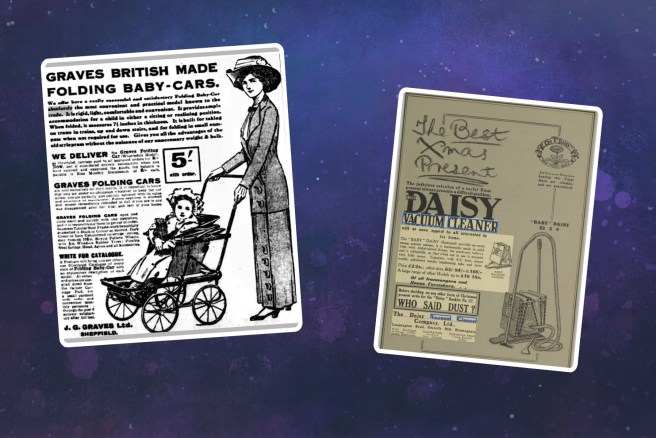
I discovered advertisements for a folding baby car (pushchair/stroller) priced five shillings and a vacuum cleaner priced forty-two shillings. (In context, a housemaid might earn twenty shillings per week.)

This is what gets my imagination going. Were ordinary people worried about suffragette attacks? Or irritated? Did they lap up the celebrity news and discuss what the rich ladies wore to the wedding?

The German dentist spy was captured in a sting operation and sentenced to five years’ hard labour. But what happened to him when World War One broke out? And what happened to the man who informed on him (who was also German but loyal to Britain)?

What does a maid wielding a vacuum cleaner that’s worth two to four weeks of her wages think of something that might put her out of a job?

How does a woman in the medical profession who desperately wants the vote feel about a suffragette bombing campaign that might kill someone?

And finally – what happened to the person who thought a vacuum cleaner was a perfect Christmas gift in 1912? I know what would happen to anyone who gave me one now…

Words copyright (c) 2023 Paula Harmon. Not to be used without the author’s specific consent. Advert for baby car from Daily Citizen (Manchester) 26th April 1913 and advert for vacuum cleaner from Illustrated London News 30th November 1912.