Shelf Life

The other day when I needed rice wine vinegar for a recipe, I discovered the use by date of ours had expired seven years ago. For the record, we probably hadn’t used it 2018, but it did prove that we need a cupboard audit.

No one has ever accused me of being a tidy person, but I try to be organised in the kitchen. Unfortunately I’m constantly undermined by my husband who thinks it’s a waste of time and thinks the fact that I have the spices in the spice cupboard in alphabetical order hysterical. There’s a sort of running battle because he puts things where he sees a space and then of course the chief chef (e.g. me) can’t find them and remonstrates and he rolls his eyes etc etc etc.

Use by/Best Before dates of course are somewhat new. Our parents and grandparents used their noses and brains. Admittedly, until forty years ago, the variety of things we take for granted weren’t as easily available (or a desire to cook several different cuisines), and my grandmothers having endured ten years of the Depression followed by thirteen or so years of rationing, were both very frugal. and unlikely to buy things they weren’t going to use.

They both cooked good plain British cooking (yes it’s a thing) with fresh ingredients. One grandmother also made macaroni dishes and the other also made curry. One baked her own bread. The other made the thinnest ever crêpes suzettes.

In contrast, I store ingredients for recipes from Jamaica to Malaysia, from France to South Africa, often bought on a whim. Periodically I realise a ‘best before’ is rapidly approaching and adjust what I was planning to cook accordingly.

There are things in the cupboard whose dates we’d never check: treacle, golden syrup and marmite. It’s hard to see how any of them could go off, and I suspect the treacle may outlast me.

On the other hand, there’s a tin of Confit de Canard which my husband bought in France in 1993 which was put in a cupboard when we got home and subsequently forgotten. The use by date was 2001 and we’ve moved twice since then, bringing the tin with us because we feel guilty about throwing it away. My husband swears it’ll still be fine. He’s probably right, but I’m not taking the risk and said he can eat it on his own and if necessary clear up afterwards. So far, he hasn’t tried to prove his own theory.

So it’s obvious that things on kitchen and fridges shelves have a life span. Is the same true of things on other shelves?

Books for example.

For irrelevant reasons, I recently tidied the bookshelves in my daughter’s room. It includes the books she left behind when she moved away, plus a few she adds when she comes to visit. It covers her reading life from age ten to nowadays plus art books, Spanish dictionaries and the Modern History textbooks she never returned to school.

I extracted the latter to sneak back somehow, noting with depression that (a) her Modern History course ended with the 1980s Cold War when I was a teenager doing a Modern History course which ended with the 1950s Korean War and (b) it’s all repeating itself. Again.

Then I put her novels in alphabetical order by author. This resulted in a bit of a bonkers mix. Monica Ali’s adult novel ‘Brick Lane’ nestles against Frank Cottrell Boyce’s middle grade novel ‘Cosmic’ which nestles against Malorie Blackman’s young adult novel ‘Checkmate’ etc.

A collage of bits of my own bookcases are below. I know that I’m fortunate to have all these books and the space to have them by the way, but that aside, if you can’t abide things out of order, you may need to brace yourself before looking closely.

Different shelves are supposed to have different functions: research, general novels, the ‘I have a literature degree honest’ shelf, general non-fiction books, and of course cookbooks. But not everything is where it should be. I like to think that part of the reason for that is because books like to wander about when I’m not looking, but I have to admit, most of it is just me being lazy.

Some of the books are new, some second-hand, some from my childhood, some gifted at various times in adult life. Some were once my father’s, some once belonged to his aunt. I think the oldest book is from the 1850s (a volume of recipes) and possibly after that an 1890s children’s book which was my great aunt’s. Some books are other people’s – borrowed, lent or left behind by one of my children or their partners until they have space for them.

Hard as it is to believe (and please don’t tell the ghost of my father if you meet him in a second-hand bookstore), I do periodically reduce my collection, but it’s never an easy task. With the exception of ‘Jude the Obscure’ and ‘The Noodle Maker’ both of which I was more than happy to get rid of, I feel like I’m giving away a kitten for adoption when I donate books to charity shops etc, hoping desperately that each will be cared for properly in its new home.

In ‘The Unpleasantness at the Belloma Club’ by Dorothy L Sayers, Lord Peter Wimsey describes books as lobster shells. His theory is that as you grow and change, you’ll discard them and replace them with something else.

For me, I think that’s true of the art I’d display, but it’s not for books I own.

There are perhaps some I’ll never read again, but I keep them because they hold memories. These were read to me by my father. That was once on my grandmother’s (very tidy) bookshelf with the blue glass jar of humbugs on top. And these, like songs on the radio, recall a point in time and just looking at them will bring memories and emotions back.

Like my daughter, I’ve kept books from childhood which I periodically read and enjoy every bit as much as I ever did.

So no, I don’t agree with Lord Peter Wimsey on this occasion.

Maybe rice wine vinegar and Confit de Canard have a shelf life.

But for me at least, books don’t.

What do you think?

Words and image copyright (c) Paula Harmon 2025. These are not to be used without the author’s express permission including for the purposes of training artificial intelligence (generative AI).

How, What, When – Techniques

I’m often asked four things:

1.     How long does it take to write a book?

2.     How do Liz and I co-write without killing each other?

3.     Re historical mysteries, does research come before plot or vice versa?

4.     When do I find time to write?

The simple answers are:

1.     The first draft of a 50,000 word book written with Liz is usually completed within a month. The first draft of a 90,000 book I write alone takes at least three months.

2.     We co-write without killing each other partly because we live too far apart to pop round and have a scrap.

3.     Historical accuracy is essential but ultimately it’s the character’s personal battles (and perhaps interaction with real events) which drives the plot.

4.     Theoretically between 9am and 2pm on days when I’m not doing the day job.

In more detail:

Liz and I are developing an online session on co-writing for the near future, so please keep an eye on the Hints, Tips and Masterclasses tab on this website to see when this will be available. But what I can share here is that one of the reasons why it’s quicker for me and Liz to write quickly is that we plot the books in minute detail in advance – a process more natural to Liz than I – and diarise a specific window of time to write in.

My own books are typically longer and I don’t plot in as much detail. I am not a pantster (someone who just starts with an idea and no idea of where they’re going till they get there). I know the character’s challenges, the main plot points, the middle and the end. I usually plot tightly up to the mid-point after which it’s a lot more vague. I aim to write at least one chapter a day, five days a week if I can. This theoretically takes seven weeks, but sometimes longer. While detailed plotting for co-writing makes my teeth itch, not being 100% sure what’s happening between chapter twenty and thirty-seven of my own books keeps me awake at night – I’m not joking. I almost always end up with a first draft that’s 40,000 words longer than it should be, so I have to revise the whole shebang, often moving or ditching whole segments. Sometimes those ditched segments (often ones I most enjoyed writing) get reused. Occasionally they are gone for good. Eventually it’s ready for the editor after which I will have more revisions. End to end, the whole thing (with various breaks) can take the best part of nine months.

Do I think one technique is better than another? No. What works well for me and Liz together, doesn’t work for me alone. I’ve tried it but still go off at a tangent. Maybe one day. I actually enjoy the revision more than the first draft. It’s where I start to ‘find’ the story.

As regards historical research: the historical context may be a backdrop or a major factor depending on the book. So for example, The Case of the Black Tulips is set in a world in which Katherine has a job meaning she travels alone, and Connie is sent out without an escort, meaning they meet each other and start investigating against a general backdrop of late Victorian fog, hansom cabs, music halls etc etc. The Treacherous Dead and Dying to be Heard on the other hand, are set against real events that occurred in 1912 and 1913 (and also 1900). It’s Margaret’s reaction to them which drives the plot.

Caster & Fleet are in 1890s London when opportunities for young women were expanding and when improvements in communications, transport and education were changing the world rapidly. We made use of that, but we didn’t tie anything to any specific historical event therefore what they’re dealing with is more important than who’s Prime Minister etc.

Likewise the Murder Britannica series is set in the late second century Britannia. There are a lot of political shenanigans going on and the emperor is, frankly, insane, but Rome is a long way off. Lucretia and Tryssa feel broadly safe straddling Roman and Celtic life, going with the flow to keep on the right side of the invaders but otherwise more interested in what’s happening right in front of them as it’s more ‘real’ to them than a distant emperor who thinks he’s Hercules.

The Margaret books are slightly different, because the backdrop is an essential part of the plot. Six books will cover the period June 1910 to August 1914. Threading through are: the build up to World War One; anarchist and revolutionaries; people arrested for spying in Britain and Germany; the fight for Irish independence; conflict in the Balkans; industrial unrest; the drive of the labour movement calling for safer working practices; increasingly militant suffragette activity.

I research real newspapers of the day to see what Margaret might be faced with every morning in terms of current affairs. The likelihood is that she’d read about suffragette activity and ‘the Irish question’ on the front page, but have to turn into the depths of the paper for anything on spying and war-mongering manoeuvres in mainland Europe. Was this deliberate on the part of the media – keeping people worried about the things the status quo wanted them to worry about and oblivious to other things that might ultimately be more problematic? Mmm.

But like most of us, Margaret is no different to Katherine aand Connie or Lucretia and Tryssa, and current affairs are not at the top of her things to worry about.  More often than not, she’s concerned about being a good wife/mother/sister/daughter/friend/pathologist (not necessarily in that order), wondering about bills and deciding what’s for dinner.

Which reminds me: should I wake my husband up from his Sunday afternoon sleep since it’s his turn to cook, or turn the oven on myself? Is the washing dry? Who’s visiting this week and what shall we eat?

Which leads me to the real answer to question four: how do I have time to write? Sometimes I have no idea!

Words (c) 2024 copyright Paula Harmon. Not to be reproduced or used without the author’s express permission. Image credit: Illustration 164663778 © Rassco | Dreamstime.com

Yes But How Much Is True?

The other evening my husband went out cycling. Yes, it’s November. Yes it was dark. But he and his friends do this weekly after work whenever they can. At nine-thirty, it started to pour with rain as forecast. At ten p.m., just as he returned, the whole town had a power cut.

I heard with relief (since he’s the only one of the cycling group who hasn’t broken a bone on one of these jaunts) the screech of our garage door and went to look out for him, shining my phone torch into the rainy darkness.

My drenched husband said it was like being guided into the house by Florence Nightingale.

My nursing skills boil down to ‘here’s a kiss and an aspirin and/or a plaster and/or a blanket and/or soup and I’m sure you’re fine really’, so this was the first time I’ve been likened to any medical professional let alone a nursing heroine, and got me thinking.

Did Florence Nightingale really did carry a lamp? Or was this a myth long since debunked along with Napoleon being short and Marie Antoinette saying ‘Let them eat cake’? (He wasn’t and she didn’t, and for other historical myths click here.)

At a talk a while ago I was asked if I was ever tempted to write a novel based on a real character. So far my answer is no.

The first reason why I haven’t is that doing so is complex and can be controversial.

With real historical people a novel can only capture the elements of their life that the author wants to focus on, and since real lives don’t follow a story arc, or narrative pattern, real events might have to be moved about or omitted. Then readers complain about inaccuracy or bias.

Going back to Florence, yes she did have a lamp, but surely the nurses working for her in that Crimean hospital carried them too? Yet the image of the Lady with the Lamp popularised by the Times, and Longfellow’s poem ‘Santa Filomena’ turned Florence Nightingale into a celebrity. In the 1970s, I was taught that she was the only pioneering nurse in the Crimean War. But in the 2010s, my children were taught about Jamaican born Mary Seacole who was also there nursing injured soldiers, but without government support or newspaper fame presumably because of views on her race (which may have been a factor in my not learning about her sooner too).

And while Florence radically transformed nursing and reformed the running of hospitals, she was also a firm believer in the right of British Empire colonisers to interfere with the culture of the native people, because Western beliefs and customs were superior and ‘correct’.

Anyone novelising her life would have to include this. Yet there would still be those readers who’d say the focus of a novel should only be on the positive, and anything negative should be brushed under the carpet on the grounds that Florence ‘was a product of her generation’. She was, of course, but there were people of her own race/nationality in the same generation who thought it was wrong, and the native peoples suffering were also of her generation. Do they not deserve a voice? Whatever interpretation you put on it, leaving negative things out surely means the fictionalisation doesn’t reflect the real person at all.

My second reason is that I like to use my imagination.

All my historical books are set in a real historical setting. The Margaret Demeray series also includes or refers to real events and people. ‘Death In The Last Reel’ includes the Siege of Sidney Street and Winston Churchill (film footage here); ‘The Treacherous Dead’ refers back to the Boer War, Emily Hobhouse and ‘Breaker’ Morant. The forthcoming ‘Dying To be Heard’ has my (fictional) characters witnessing the real actions of militant suffragette Emily Davison at the 1913 Epsom Derby (film footage here)

But I like to dig about in the British Newspaper Archives for less well-known things to provide a flavour of the times, because the third reason I prefer to create fictional characters is that I want to imagine ordinary people like my ancestors and perhaps yours, put them in extraordinary situations and see what happens next.

The rich and famous have plenty of books and films written about them. Let’s see what an ordinary person might do.

In 1913, the newspapers headlines were mostly about suffragette militancy and the Balkan crisis. But there was frivolous celebrity news including the Royal Wedding of a German princess – the last time European monarchs met in peace, and before many monarchies disappeared forever. (Not that anyone knew that then.) I also found reference to a moving picture ‘comedy’ about hot-headed suffragettes in which one (played by an actor in drag) was ‘hilariously’ force-fed champagne; a German dentist in Portsmouth who turned out to be a spy (both getting a brief mention in ‘Dying To Be Heard’into the book); and something I’m keeping back for book five.

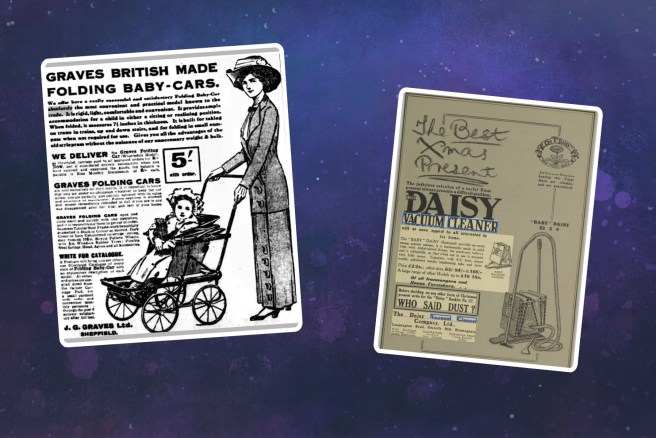
I discovered advertisements for a folding baby car (pushchair/stroller) priced five shillings and a vacuum cleaner priced forty-two shillings. (In context, a housemaid might earn twenty shillings per week.)

This is what gets my imagination going. Were ordinary people worried about suffragette attacks? Or irritated? Did they lap up the celebrity news and discuss what the rich ladies wore to the wedding?

The German dentist spy was captured in a sting operation and sentenced to five years’ hard labour. But what happened to him when World War One broke out? And what happened to the man who informed on him (who was also German but loyal to Britain)?

What does a maid wielding a vacuum cleaner that’s worth two to four weeks of her wages think of something that might put her out of a job?

How does a woman in the medical profession who desperately wants the vote feel about a suffragette bombing campaign that might kill someone?

And finally – what happened to the person who thought a vacuum cleaner was a perfect Christmas gift in 1912? I know what would happen to anyone who gave me one now…

Words copyright (c) 2023 Paula Harmon. Not to be used without the author’s specific consent. Advert for baby car from Daily Citizen (Manchester) 26th April 1913 and advert for vacuum cleaner from Illustrated London News 30th November 1912.

It’ll Come To Me In A Minute

When I was young, when my maternal grandmother addressed me, she would often go through my sister’s name, our cousin’s, her own sisters’, her nephew’s and my mother’s, until she got to Paula.

These days I do the same, swapping my son’s name for my husband’s (my excuse is that they start with the same letter), my daughter’s for my sister’s (my excuse is that they have similar personalities) and recently my brother-in-law’s for that of the mutual male friend’s who was hosting us all for dinner (my excuse is that they both have Scottish names… OK that’s no excuse).

Very occasionally I suffer from face-blindness. E.g. once in a blue moon, I don’t recognise someone even if I know them very well. This usually happens when I’m deep in thought and/or daydreaming.

I regularly suffer from name-blindness, which is possibly linked. This means I can look at someone I know very well, recognise them, know who they are, but absolutely blank their name. Completely. It’s just gone.

This particularly traumatic when I have to introduce people to each other and can only recall some random irrelevant fact in lieu of a name (‘This is M’s mum’ or ‘This is my friend who makes great cupcakes’ or ‘This is my friend, the wife of another friend who cycles with my husband’).

Perhaps it happens in social situations or introduction scenarios, because I find both very stressful and they take up most of my ‘pretending I’m confident and sociable’ resources. An article called Is This Normal? “I Can’t Remember Names or Faces.” | The Swaddle, give reasons for this phenomenon that make sense to me at least. But it doesn’t stop it from being mortifying.

What about my book characters’ names? After all, I invented the characters (shh – don’t tell them). I waded through lists of potential forenames for the right era, or unusual British surnames (I’ve managed to get five of these into my books so far), and even researched how common certain surnames were in certain parts of London in the 1881 census.

So are their names easier to recall? Nope. Apart from main characters, I quite often can’t remember what I’ve called some people after writing a book at all. Sometimes I can’t remember what they’re called while I’m writing it, because I’ve changed their name halfway through.

For example, in one of my more recent books I realised that I had five female characters with names starting M and about four with surnames starting T. One of the female characters was called Mary (which was the number one name for girls in England and Wales for decades if not centuries). I decided to change it to Lois and did a search and replace for Mary throughout the document, happily ‘accepting all’ without thinking. This resulted in a lot of action taking place in Loislebone, and someone providing a sumlois of information etc. One of the T surnames had to change but in my head, the character still has the original name, which means nine times out of ten, I have to dig about for what I changed it to when thinking of them.

To avoid this sort of thing, also avoid duplicating names within the same series, and to keep a series bible of background info on characters whether or not it would ever be used (birthdays, details of parents and children and pets etc), I called upon my clerical career and started a card index system.

Fortunately I didn’t need to buy anything. When my daughter was studying for her GCSEs, she asked me to get her some cards to help with revision and a storage box to put them in. She obviously inherited my tendency to create revision schemes but lose interest before actually doing anything, because there were plenty of blank cards for me to use.

Then I found another set of index cards in a drawer.

Only they weren’t blank, and they didn’t have random facts about English Literature or The Cold War or Spanish verbs or whatever else my daughter had been studying on them. They were written in my father’s writing and furthermore, they were the details of characters he’d written stories about!

I still have boxes of Dad’s writing – typed, handwritten in notebooks large and small and on floppy disk. I have one ready to edit, and others I remember him reading aloud to me when I was a child (including a science fiction novel which if he’d published at the time, would now be reality). I have no idea what I’m going to do with them all. But seeing those index cards so unexpectedly brought a moment of serendipity, surprise that I could read his writing for once and of course a pang of what’s called in Welsh hiraeth and in Portuguese saudade – missingness,  nostalgia, loving reminiscence.

I wish I could show Dad what I’ve written and help him do something with what he wrote. I can’t and he wouldn’t want me to fret that I can’t. But his characters’ index cards are now stored with mine as a reminder of the things he and I had in common: a love of storytelling, words, names, random facts and near illegible handwriting. And while I have no idea who Dad’s Janine Bex (below right) is, I do know that Roderick Demeray (below left) is based, with love, on Dad.

Maybe in some alternative universe, our characters hang out together and complain about us. ‘Look what she made me do!’ ‘Why would he call me that?’ ‘What’s going to happen to me next?’ ‘Why can’t she ever remember my name?’

After all, who’d blame them?

Words and pictures (c) Paula Harmon 2023, not to be used without the author’s express permission.

Best Served With Peacock

Still in a sort of limbo between writing projects, my plan for my three ‘free days’ last week (e.g. not doing the office job) was to:

  1. Draft outlines for three potential books, one being the magical one mentioned last week.
  2. Proof-listen to the audio book version of Murder Durnovaria.
  3. Start work in earnest on a recipe book I’ve been planning for a while.

For one reason and another, I only managed number three, and my long suffering (his words not mine) husband has been playing guinea pig again.

My first proper job involved working in a bookshop/coffeeshop. My then manager/friend/housemate, properly trained in catering college, was mesmerised by the way I cooked while muttering to myself, ‘I’ll bung some of that in, then throw in a bit of this and taste and see what happens’. She suggested I ought to write my recipes down and call it  ‘The Bung and Throw Cookbook’.

I never did of course, partly because I never measured anything, and it seemed like too much work to figure things out. Besides, after twelve months, I left to work in an office and never had the urge to return to a job in catering, Nevertheless at home, I continued making up and collecting recipes. For a good length of time, cooking was my main creative outlet, whether making something complex or simply trying to produce something quick and tasty from what happened to be in the cupboard or fridge. I still think it’s a wonderful way to relieve stress – as my mind has to leave troublesome things aside while it concentrates and creates.

Then I started writing historical fiction and wondered ‘what would my characters eat?’ as I explained here. From that point, I wondered if I could create a cookbook re-imagining what Lucretia (2nd Century), Katherine Demeray (1890s) and Margaret Demeray (1910s) might have eaten (that I might like to eat too).

The books I’m working with are The Roman Cookery Book which includes recipes from nearly two thousand years ago under the name of Apicius (translated and compiled by Katherine Rosenbaum and Barbara Flower), The Best Way published in 1909 and The Women’s Suffrage Cookery Book published in 1912.

It’s harder to re-imagine the food than you might think if you don’t know old recipe books, which are all written for people who fundamentally just needed ideas, not techniques. E.g. all three books are pretty much a forerunner of the ‘Bung and Throw Cookbook’ my friend suggested I wrote all those years go.

Would I eat any of the recipes? Yes (though not all).

Can I cook them easily from the information provided?  Well…

Working out recipes from The Roman Cookery Book is the hardest. Are all the herbs safe? (Or easily available?) What can I substitute for the ubiquitous garum (fermented anchovy paste)? How do I decipher some of the recipes? They mostly simply list ingredients and vague instructions without quantities or timings.

Some things are hard or undesirable to do: ‘cool in snow’, ‘remove the spines from your sea-urchin …’, ‘take your jellyfish …’, ‘best served with peacock’.

There are a lot of chicken recipes in the Roman book, but since until relatively recently a young (e.g. potentially tender) chicken was most valuable as an egg layer and hard to mass-produce, do they mean chicken or some other fowl?

The simplest way I’ve found to decipher some of them is following the wonderful Tavola Mediterranea website, but otherwise, I’m on my own.

The Suffrage Cookbook and The Best Way are more comprehensible to a modern cook. The ingredients can be easily bought (with the possible exception of brains which I don’t want to eat anyway). But some of the instructions are just as much ‘bung and throw’ as the Apicius book. ‘Enough of…’ ‘Some…’ ‘A bit…’ ‘The usual amount…’ There aren’t many chicken recipes but a fair amount for meat which is nowadays comparatively more expensive. There are more vegetarian and spicy recipes than people might think. Timings, when given, would turn most vegetables, pasta and rice into mush.

My idea is to take a selection of these recipes, work out the instructions and cook them as if Lucretia (or more likely her cook) or Katherine or Margaret would do with access to modern equipment (and less inclination to boil things for hours).

I’ve shared some deciphered recipes before here, and I’m ploughing ahead. It’ll be a long process, involving working the recipes out when necessary and then trying them on willing volunteers (mainly family).

On Saturday evening I cooked Chicken stuffed with Saccotosh (sic) for my husband and mother. Until recently, not being American, I’d honestly thought that ‘Succotash’ (along with sassafras) was a mock swearword made up by Looney Tunes, so it was interesting to find out what a British woman in 1912 – who obviously knew otherwise – had come up with.

The ingredient quantities are vague, the cooking instructions even more so. The main warning was ‘chicken should be sewn up to prevent the corn bursting out’. Anyway, I worked out what the missing details probably were, and without sewing anything or having the chicken explode, it proved delicious and was eaten to great appreciation.

On Sunday night, I made a Curry Pie. In terms of instructions, there’s sufficient filling information, but no explanation as to why it’s called pie when no pastry is referred to. But it does say to cook it in a pie-dish. So I sort of assumed the pastry and went for it. It was tasty too, but needs a bit more tweaking before I’m happy with it.

In the meantime, my husband remains the main recipient of all this experimentation. Do you think he’s insisting on cooking tonight to give me a rest, or because he’s worried that one day he’ll end up like the guy in the drawings below? Well, he’s going to make jambalaya using the leftover chicken from Saturday’s Succotash/Saccotosh recipe, so he can’t be too worried about my recipes.

Can he?

Words and pictures (c) Paula Harmon 2023, not to be used without the author’s express permission.

Tea and Trophies

According to an article, Dorset farm workers had eight meals a day: dewbit, breakfast, nuncheon, cruncheon, lunch, nammet, crammet and supper.

Admittedly, a Dorset farm worker probably needs more calories than a Dorset writer/office worker, and I’m generally happy with a mere three meals a day, but even so, I really want to know what they all consisted of and give them a go, possibly because I’m on a diet at the moment.

Dieting isn’t remotely new, as you can read in this article (hey – I have one vital statistic in common with the Venus de Milo! No, I’m not telling you which). It’s worth a read, if only to confirm that there’s nothing new under the sun, why William the Conqueror fell off his horse, and why you should never tighten a 16th century corset too much (assuming you have one on).

I enjoyed researching what my Roman era characters might have eaten. Recently, someone uncovered what looked like a painting of a pizza in Pompeii, even though tomatoes hadn’t reached Europe at that point. Farrell Monaco has created a recipe for what it might have been and when I’m eating bread again, I might give Adoreum: a recipe of a modern recreation of Pompeii’s flatbread a go.

My Victorian and Edwardian characters don’t seem to eat as well as my second century ones somehow. I suspect they’re too busy.

Margaret frequents suffragette tea-rooms one of which serves vegetarian food. Many suffragettes were keen vegetarians and some were teetotal. Margaret is neither but likes vegetarian food, only she’d never get it past Fox at home, so has to eat it while out. While Margaret is fictional (don’t tell her) suffragette tea-rooms weren’t.

Poor woman, I’m editing the fourth book at the moment and realise she only has one large meal and a sandwich over the space of about three months. I’m going to have to add at least an afternoon tea somewhere.

Afternoon tea as a tradition is not as old as you might think and nowadays it’s a treat rather than normal event for most of us. The closest we get at home is periodically having scones with cream and jam instead of a pudding on Sunday. (With reference to the jam first/cream first debate, living in Dorset and unsure if Dorset has ‘rules’, I do one half with jam first and the other with cream first, but my Welsh husband goes Devonian all the way.)

Which brings me onto scones versus biscuits. I read all the Laura Ingalls books as a child and while a little baffled by references to biscuits and gravy, had in my head a sort of oat biscuit smothered in the sort of rich, brown, meat/chicken gravy the British have with roast dinners.

Years later I mentioned it to a Texan friend who said ‘Oh no. A biscuit is a bit like a scone without sugar, and the gravy is milk gravy.’

I decided that the biscuits must be a bit like ‘cobblers’ (savoury scones cooked on top of stews) and have since worked out that the milk gravy is similar to what my mother would call white sauce. One day I hope to try them in the States, and in the meantime, when back eating carbs I might try and make some. If you have favourite recipes, I’d be delighted to see them.

Here’s a US article setting out some of the differences between UK scones and US biscuits – do you agree? The things I’d add are:

  • British scones can be savoury too. My normal recipe for cheese scones is here.
  • British people can argue for hours about how to pronounce ‘scone’ (does it rhyme with ‘gone’ or ‘phone’?). This is not a regional argument and I don’t think it’s a class one either. I think it’s just from family to family.
  • There is more than one biscuit in the UK (and they’re not all sweet) and we can debate/argue about the best type for even longer than how to pronounce ‘scone’. Scientists have even worked out which is best for dunking (I favour a ginger biscuit myself).
  • We can argue even longer about dinner and tea. Is dinner a lunchtime or evening meal? If you call the evening meal ‘dinner’, is ‘dinner’ exceptionally a lunchtime meal on Sundays and at Christmas? Is tea a mid-afternoon snack or an evening meal/either/both? It was raised within my team at work one day and continued, after work, in our WhatsApp group. Despite at least four of us coming from broadly the same part of the country, two born in roughly the same place and most of us coming from similar backgrounds, we still couldn’t agree.
  • And don’t get us started on what to call a simple bread roll (I call it a bread roll or bap for the record).

Since being told to lose weight, I risked my English and Scottish baking ancestors haunting me by doing some experimenting into low carb recipes for scones made with almond flour and coconut flour. Were they nice? They weren’t bad. Were they the same as the real thing? Not at all. Will I bake the real thing when I’ve lost some weight? You bet I will. Partly because I recently missed out on afternoon tea inadvertently.

In June, Liz Hedgecock and I met up for a couple of days in Bristol and Bath, as we celebrated Murder For Beginners being highly recommended in The Write Blend Awards and she gave me the trophy for the time-being. Despite my diet, we’d intended to go for afternoon tea, but in the end we were frankly too hot after clambering up and down hills being cultural in 30°C/86°F heat.

We even forgot to have the sparkling wine we’d planned, which shows how bad we are at celebrating.

Guess what’s on the agenda for the next time we meet apart from me giving the trophy back to Liz? Just see the left hand photo below for a clue in case you hadn’t guessed and in case you’re wondering, the silver-plate tea-pot next to the award was a wedding present of one of my Scottish great-grandmothers.

I gather she was a little terrifying, so she’s the one I fear may yet haunt me for making carb-free scones…

Words and photo of trophy (c) Paula Harmon 2023, not to be used without the author’s express permission. Photo of cakes etc 54345459 / Afternoon Tea Champagne © Magdanatka | Dreamstime.com

Apple Time in the Historical Experiment Kitchen

It’s apple season and also, after ten days of being banned from cooking due to having covid, time for me to do some cooking ‘archaeology’!

I have a project in hand, adapting the sort of recipes my characters might eat, into something that’s easy to cook in a modern kitchen with modern ingredients, and mindful of modern tastes (specially not boiling vegetables and pasta forever, and being less likely to want to eat brains). So yesterday, I made a Roman/Victorian dinner and the recipes are below.

For recipes which Lucretia in the Murder Britannica series might eat, I refer to Apicius’s Roman Cookery Book (my copy is translated by Barbara Flower and Elisabeth Rosenbaum and published by Martino Publishing). My Latin is extremely rusty and the recipes themselves are more guidelines for someone who obviously knows what the normal methods are and another place I visit is the Tavola Mediterranea website where they have worked out ancient recipes from similar instruction and from which I’ve cooked some delicious food. It’s a fascinating website and well worth a visit.

For Margaret and Katherine of the Margaret Demeray and Caster & Fleet series, I use old cookery books, some facsimile, some original, with recipes that an ordinary woman of the late 19th/early 20th century might cook.

Of course their experiences would be quite different. 

Lucretia is rich and thoroughly enjoys as much imported food she can get her hands on, but she hasn’t actually cooked anything herself since she was a very young girl, so would relegate any cooking to an enslaved person, or send an enslaved person to buy ready cooked delicacies from a street trader. A Roman era kitchen was small and full of earthenware. It might have looked like this. I imagined street stalls like the one in the image below (excavated in Pompeii) in the forum in Durnovaria, selling hot pastries, sizzling meat, hot spiced wine and cider in my books. Lucretia wouldn’t have had potatoes, tomatoes, sweet (bell) peppers, chillies etc – all of which we take for granted. But that’s not to say she didn’t like spicy food – there’s ample pepper and fragrant spices in most recipes. Modern tastes of course don’t particularly fancy seasoning food with fermented fish (garum) but you can use modern fish sauce (e.g. the sort for Thai cooking), soy sauce or just salt in its place.

Meanwhile Margaret and Katherine are both middle-class and while both have domestic help (Margaret’s only coming in a few days a week in books one and two), they can both cook – Margaret with significantly more enthusiasm than Katherine. They have kitchens that we’d recognise – with a gas stove and metal pans. A refrigerator is a luxury item, so certainly in the first two Margaret Demeray books, Margaret doesn’t have one, relying instead of a cool pantry and shopping more regularly for perishable goods. It’s perhaps no wonder that the cookery books of the time rely a lot on canned and dried goods like tomatoes and fruit, and are heavily egg and cheese based. Chicken, which we think of as cheap now, was a luxury in Edwardian times (and in fact my parents both considered it a special Sunday food until the 1960s), so recipes for meat dishes tend towards mutton and pork. 

Margaret’s potential recipes look a lot more familiar than Lucretia’s and include curries and pasta dishes and vegetarian cuisine. But you can’t rely on them for timings – half an hour to cook spaghetti? (Was it a different construction then, or did Edwardians just not trust it?) And there’s advice which both agrees and conflicts modern ideas: cook potatoes with skin on but don’t cook vegetables too rapidly or you’ll spoil their colour. 

So going back to yesterday’s Sunday dinner. I experimented on my family with an adaptation of a Roman recipe for main course and a Victorian recipe for dessert. One which Lucretia might have ordered someone make for her and one which even Katherine could cook herself. NB – the pork dish is a good use of leftovers from a pork roast! They were both delicious and went down a treat.

And without further ado, here are the recipes:

PORK WITH MATIAN GRANNY SMITH APPLES

Adapted from Minutal Matianum by Apicius as translated by Barbara Flower and Elisabeth Rosenbaum

Serves 6

INGREDIENTS

2 tablespoons olive oil
100g (4 oz) ground pork/pork mince 

3 leeks, cleaned and sliced

½ bunch chopped coriander 

500 g (1lb) cooked pork, chopped into large chunks
½ cup chicken stock 

1½ tablespoons fish sauce*
2 large firm eating apples, peeled, cored and diced
3 teaspoons coarsely ground black pepper
3 teaspoons ground cumin
3 teaspoons ground coriander

Handful of fresh mint leaves
2 garlic cloves
1/3 – ½ cup white vinegar
2 tablespoons honey
¼ cup pomegranate molasses
1 teaspoon cracked pepper for garnish

*(I used the sort you use for Thai cooking but you could use soy sauce or just season with salt to taste.)

METHOD

  1. Heat oil.
  2. Saute pork mince till brown, add leeks and coriander.
  3. Add chopped cooked pork.
  4. Add stock and 1 tablespoon of fish sauce and warm through.
  5. Add chopped apples.
  6. Pound together in a pestle or blend: pepper, cumin, coriander, fresh mint, garlic and add this to the pan.
  7. Mix vinegar, honey, pomegranate molasses and remainder of the fish sauce in a cup and add that.
  8. Heat through and thicken with cornflour or beurre manié.
  9. Serve with barley (Roman) or rice (borderline Roman) or potatoes (not Roman at all). I also served it with peas into which I’d mixed crispy bacon and spring onions (scallions).

APPLE HEDGEHOG

(For a version which looks more like a hedgehog and includes another ingredient, check out Mrs Crocombe’s demonstration here.)

Serves 6

INGREDIENTS

1 kg/ 2lb Cooking Apples (about 5)

75g, 3 oz sugar

2 egg whites.

Two handfuls of slices almonds

A few raisins or sultanas or currants

A glacé cherry

METHOD

  1. Preheat an oven to 180°C or 350°F or gas 4.
  2. Peel, quarter and core the apples, put in a saucepan with a little water and 25 g/1oz sugar. Heat gently until just cooked (although if you overcook them a little, as I did, it’s not the end of the world. You just want them to retain some structure and not be mush).
  3. Put into an ovenproof dish and shape into a sort of hedgehog (a large mound of apples, with a smaller bit at the front for a head.
  4. While it’s cooling somewhat, whisk the egg whites into soft peaks, then fold in the remaining sugar.
  5. Cover the apples with the meringue mixture and decorate the ‘body’ part with flaked almonds.
  6. Put in the oven for about 20 minutes till the meringue is golden and the almonds just a little brown (keep an eye on it to make sure the almonds don’t burn).
  7. Decorate the face with a glacé cherry for a nose and raisins/sultanas/currants for eyes.

Words and photographs* copyright 2022 by Paula Harmon. All rights belong to the author and material may not be copied without the author’s express permission.

*photograph of street kitchen in Pompeii Dietmar Rauscher https://www.dreamstime.com/thermopolium-pompeii-ancient-roman-street-food-kitchen-thermopolium-pompeii-ancient-roman-street-food-kitchen-serving-image184835561

Why Choose A Woman?

In March I was involved in a literary festival, both as an organiser and as a contributor. One of the things I did was to talk about suspense fiction with Helen Matthews and Katharine Johnson. At the end, we opened the floor to the audience. Here are some of the questions, and some of the answers I gave. Feel free to ask me more!

Why choose a woman as a main character in eras when women couldn’t do much? Wouldn’t a man’s life be more exciting?

Who says? Just because until fairly recently, history portrays women (if mentioned at all ) as weak, ineffectual, sentimental, irrational, puppets or playthings, the epitome of purity or full of evil intent, does that mean they really were? History may record queens who changed the destinies of whole countries for good or ill, but there were other women, whose names tend to be forgotten, who made strides in science and arts (see list below), many of these came from very humble beginnings. They climbed mountains and traversed deserts, unhindered by long skirts and corsets. They were private detectives, social reformers, physicians. Why don’t we hear about them from contemporary writers? Perhaps because the writers were mostly men. Maybe those men feared or reviled powerful women or perhaps just simply weren’t interested in writing adventures involving them. Weak? Ineffectual? Not a bit of it. I want to celebrate the sort of women who really existed – not especially important in the greater scheme of things but full of life, intelligence, spirit and determination – and give them something more exciting to do than wait for their menfolk to come home from an adventure.

Why did you decide to write about particular eras?

Partly there’s so much potential. By the late second century in Britain of the Murder Britannica series, the Britons in my books have a degree of political control, and are undoubtedly enjoying everything the Empire has to offer: new foods, easier trade routes, the chance for their sons to join the army and travel and come back with citizenship and wealth. The Empire isn’t as rotten as it will be, even if the Emperor is bonkers. And in Western Britain there’s a reasonable chance you can get away with a little more (and have some fun) if you keep your head down a little.

The late Victorian era of Caster and Fleet is one where women are starting to flex muscles of independence. Careers are starting to open up Nursing has become respectable. A university education (if not a degree) is possible. The bicycle has revolutionised the lives of anyone who can afford one and train travel is affordable for many, opening up the country to people whose ancestors had barely moved five miles for generations. So what does that mean for two young women who can maybe get away from chaperones long enough to investigate crime? Will they rise to the challenge or be held back by convention?

By the late Edwardian era of the Margaret Demeray series, things have moved on again, the old age pension, national insurance and paid holidays are being introduced. But the popular images of the times (often called the Golden Era), full of glamorous elegant clothes and bright parties and rapidly developing innovations like aeroplanes and cinema, contrast violently with a dark underbelly of misery and discord among the poor, the increasing militancy of the suffrage movement, discontent about immigration and working conditions, so there’s a lot to throw at a woman who’s neither rich nor poor, who knows rich people and works among poor people, who wants the vote and social reform but has to decide what price she’ll pay to get it.

Do you ever feel conflicted about what’s going on in an era you’re writing about?

Yes it’s difficult not to be anachronistic about things which sit uncomfortably.

Slavery. Slavery in Roman times was an economic normality – no one would have questioned it at all. It was not a matter of race, but of conquest and also occurred among many of the local peoples of the Empire whether the Romans were there or not. It was unfair and mostly cruel, and a slave was without any form of basic human rights. It was a different sort of slavery to the kind which we tend to think of now. If a slave was freed, there was no social barrier to getting on in life. It was quite possible (and happened) for the grandson of a freed slave to become Emperor regardless of ancestry. However it was still slavery.

The British Empire in the later books. The Caster & Fleet series is set at perhaps the Empire’s heyday, in the Margaret Demeray series, twenty years later, cracks are starting to show, but an average subject in Great Britain might not have noticed. British actions in the Boer War were internationally condemned though how much of this filtered down to the general public is uncertain. The Indian independence movement was gaining ground, and of course the Irish Question was still waiting for an answer. As a modern person, it’s impossible not to feel an abhorrence for the jingoism of the late 19th/early 20th century, lauding the glories of an Empire the wealth of which was built on the suffering of people from across its many nations and which treated native peoples as second or even third class citizens in their own countries. It’s also hard to stomach the way the British government played cat and mouse with the Irish people less than a hundred years after the potato famine had been so woefully handled and probably in living memory of some of the survivors. Margaret and her sister Katherine can see a lot of this for themselves, but it’s unlikely that they’d have viewed it with exactly the same disdain that I do nowadays.

Are your characters’ conflicts ones you recognise for yourself?

Lucretia’s aren’t. She’s stinking rich and I’m not sure she’d recognise an internal conflict unless it hit her on the head and robbed her of her money. She had one once, but she’s long buried it. Or maybe she had two… Tryssa perhaps – having to decide whether to tackle Lucretia and rake up old memories for the sake of the truth, and then having to decide whether or not to move away from the only home she’s known – I can relate to that.

Margaret’s situation is much more relatable. She’s a career woman who in the third book has also recently become a mother. Combining a job she wants to excel at with a family she loves and never quite feeling like she’s giving her best to either, is something I remember very well.

Which character is most like you?

As other authors will say, most of my characters contain aspects of myself. But in terms of who’s most like me, in personality Katherine probably is – she’s a coper whom everyone thinks is confidant but who actually isn’t and who wishes people noticed when she’s struggling. In terms of size, shape and looks, I’m like Lucretia – short, plump, middle-aged. On the other hand, Lucretia wears three inches of make-up and is completely self-deluded. Sometimes, I think it would be quite nice to be self-deluded! But I couldn’t be doing with the make-up.

If you’d been there, what questions would you have asked about my books?

Lesser known women of note

Artists:

Artemisia Gentileschi

19th Century British Female Artists

Sarah Biffin

Female Mathematicians

19th Century Female Mountaineers

Victorian Female Private Detectives

Female Scientists

Women in Medicine

Women Explorers

Women in the Civil Service

Words copyright 2022 by Paula Harmon. All rights belong to the author and material may not be copied without the author’s express permission. Image credit https://pixabay.com/vectors/woman-thinking-sitting-desk-41201/

Of Chopsticks, Tramps and Bandages

‘Girls must be partners and comrades rather than dolls.’ 

‘Their pork is excellent… but they do not find it necessary to burn the house down for each joint.’

‘The well-dressed man has an unpleasant shock in store for him.’

‘Returning from the city, they discovered the house lit up and a man lying in bed.’

‘Most of the processes are of course, familiar to real Colonists, gipsies, and the better class of tramps and poachers.’

Are these from any of my works in progress? Not yet.

Are they story prompts? Not specifically.

These are actually sentences from real newspaper articles published in British newspapers between 1910 and 1912. 

Researching is like entering a rabbit warren (or indeed a certain Swedish furniture store) mistakenly expecting a speedy exit, then finding yourself with something you never knew you wanted.

I first discovered the British Newspaper Archives when I was trying to find a report of a real event for Death in the Last Reel. I was feeling pretty pleased when I found what I was looking for, then spotted something on the same page which fitted into the story too. It may look totally coincidental in the novel but really wasn’t. A newspaper that day really did have two things that Margaret would be concerned about next right to each other on the page.

It then occurred to me that some of the minutiae of life might be easier to find out this way. For example – how much prize money might be offered for a short story in 1912? I’d put £5 in my early draft and someone said ‘That would have been nearly half a year’s wages for a maid. Surely it’s too much.’ Accepting that as a good point and looking for something accurate, I searched the archives again and found a short story competition at the right sort of time, with a top prize of … £5. Wages and the value of things then and now can’t be directly correlated. But £5 was a princely sum and well worth winning. 

When I’m not book researching, I’m digging into my family history and there was a mystery I wanted to solve for myself, so I used the website to see what I could find. While I discovered some things that were anticipated and tragic, I found other things that were rather sweet. I also found a crime. 

When my grandfather was about six, his home was burgled. The burglars stole £18 3s 4d but were pursued by a constable as they tried to get away, whereupon they launched an attack on him with the jemmy and a stick and left him injured as they escaped. The constable was found and hospitalised. The burglars were caught, charged and brought to court. I haven’t quite found out what their sentence was yet, even though the crime was reported in several papers.

But like the page with the factory fire and the spy, it’s not just one headline on the page that fascinates.

In the tabloid forerunner the London Illustrated News, ‘Alleged Burglars Attack a Constable’ (an article which includes the word ‘burglariously’) is perhaps one of the milder incidents reported on 13th May 1911. It nestles in the middle of: ‘Appalling Tragedy at Asylum’, ‘Sensational Scene at a Theatre’, ‘Fatal Affray at Limehouse’, ‘Savage Murder of a Yorkshire Gamekeeper’. At the bottom of the page is an advertisement for Dr Patterson’s Famous Female Pills (which corrects all disorders of females where other remedies have failed).

Four days earlier, The Halesworth Times and East Suffolk Advertiser, reporting the same thing has a rather different approach. ‘Constable’s Fight with Burglars’ comes after ‘Bride but no Bridegroom, £500 damages for Jilted Widow’, which itself comes under an instalment of the story ‘A Miscreant’s Wife’ by Lillias Campbell Davidson and before headlines such as ‘A Modish and Becoming Coiffure’, ‘Cooking a Village’*, ‘Interviewing a Ghost’ and ‘Girl Leads Rebels’ among others, before a section for children. At the top of the page is an advertisement for Dr Williams’ Pink Pills (which can tackle a strong man’s unexpected collapse). *No that’s not a typo.

I sometimes worry that I have a lot of odd things happening in my books, and then I consider real life and feel I’m not trying hard enough. 

Anyway, if you want to know what the quotations at the top relate to, without further ado, here is a brief explanation of each quotation. 

  1. Oxford Journal 10th August 1910 – an answer to a question about exactly who Girl Guides were supposed to guide. Turns out it’s husbands and/or Empire. The sentence quoted above is the last that perhaps wouldn’t exasperate a modern woman who doesn’t consider matrimony or colonising someone else’s country her life goal. Rather chillingly, given the date, one useful thing Girl Guides would learn was how to find a wounded soldier on a battlefield if necessary and then treat his injuries.
  2. Pall Mall Gazette 18 May 1912 – a description of the fairly new and fashionable Chinese Restaurant off Piccadilly. It’s in a number of newspapers and describes authentic and interesting sounding Chinese food which clearly baffled yet delighted the diners (and yes the restaurant supplied porcelain chopsticks but also offered knives and forks).
  3. Daily Mirror 3rd May 1912. An article entitled, ‘The Most Envied Men… Those who bought their clothes before London’s Tailors’ Strike’ goes on to give the awful fact that ‘It is likely that in the next few months, possibly, he will have to wear garments of last year’s choice…’
  4. Christchurch Times, 26 October 1912. No it’s not a re-enactment of Goldilocks. Two ladies returned from an evening out in Glasgow to find an inebriated burglar, who’d collected all their jewellery together, but then decided to have a nap.
  5. Pall Mall Gazette 18 May 1912 again – a review of a book called ‘In Camp and Kitchen’ by Lucy H Yates. (No, I didn’t realise there was a class system for poachers either.)

Were they what you expected? Or had you thought it was something else entirely? Do tell!

Words copyright 2022 by Paula Harmon. All rights belong to the author and material may not be copied without the author’s express permission. Image Credit: https://pixabay.com/photos/squirrel-rodent-newspaper-reading-6374731/

A Hint of Spices Past

Ingredients: a good book, time, tasty food.

Method: Combine as desired. Try to keep grease spots and crumbs off the book.

VariatIon:

Ingredients: A historical recipe, unfamiliar ingredients, time, and a mixing bowl. 

Method: Follow recipes wondering if they’ll work. Eat the result whatever it turns out like. Don’t worry too much about crumbs and grease spots because they’re a badge of honour on a cookbook.

My interest in what people in ‘olden days’ might have eaten started when I was about nine and read a book called ‘The Gauntlet’ by Ronald Welch. In it, a modern boy is transported back to the Middle Ages and lives as a nobleman’s son in Carreg Cennen castle. At one point, someone brings in a dish of meatballs and there on the page was the recipe for how they were made. It somehow brought the scene alive, not simply to imagine them ‘doing a Henry VIII’ (as my aunt used to say, meaning to eat with ones fingers and chucking bones onto the rush-covered floor for the dogs to munch) but visualising the cook, sweating in the kitchen, preparing something I could actually cook myself one day.

Roll on a few years and as a writer of historical fiction, one of the things I like to research is what people might have eaten and how they might have managed their lives. Below, you can see a selection of my historical cookbooks (original, facsimile, translated).

You might think it’s hard to work out for Lucretia and her fellows in the Murder Britannica books but fortunately, not only are there translations of Apicius’s Cookbook but Farrell Monaco works out a modern version of those recipes and shares them on https://tavolamediterranea.com/ under Edible Archaeology. I’ve cooked a few of them myself for Sunday dinners and very nice they are too. 

It’s easier for the Caster and Fleet and Margaret Demeray books, because if all else fails, there’s Mrs Beeton. I bought my copy a very long time ago from a shop in the Forest of Dean which specialised in secondhand/antique cooking utensils and books. This edition is from the early 1930s though, so wanting to be sure that I had a better idea of what women who had to do their own cooking or at least help with it might have cooked, I sought other books. 

‘The Women’s Suffrage Cookery Book’ (facsimile) is interesting, as the recipes were sent in by ordinary women to be compiled into a book which not only would raise money but would suggest things a busy campaigning woman could cook and eat in a short time. They are all very simple, easy, and mostly cheap, nutritious and generally appealing even to modern tastes (maybe eating brains isn’t). There’s a vegetarian section and a sick room section and also practical hints and tips. ‘The Best Way’ book (original) gives pages of simple, flavoursome recipes and explains how to deal with anything from cleaning brass to baby care. I can imagine Margaret and Katherine referring to both of these, although only Margaret can cook well. 

Even though ‘Indian Cookery’ (original and pristine, so not a real cook’s book) dates from 1861. It would have been thirty plus years old by the time the Caster and Fleet and Liz Hedgecock’s Maisie Frobisher mysteries take place, but it’s perhaps possible that in a wealthy household like Connie’s or Maisie’s cook the cook would have had one as Indian cuisine was already very popular in Britain and Maisie has been to India. It was written by Richard Terry, chef de cuisine at the Oriental Club, what is referred to as the first Indian restaurant in London. I’m sure there were already others, run by Indian people with authentic recipes, but were perhaps not appreciated by well-off white British people at that time. The recipes in the book are all called ‘curry’ of course and doubtless are/were unrecognisable to anyone from India. There’s reference to a curry powder blend, the recipe for which is provided and a curry paste which isn’t, perhaps because the author sold it and wanted to keep the ingredients secret. Due to the British Raj, Indian food caught on (and was Anglicised) very quickly and has never looked back, though hopefully nowadays, there’s more authenticity and respect. For a fascinating if sobering article about the early British fascination with Indian cuisine, check out https://www.atlasobscura.com/articles/curry-in-colonial-india

Although ‘Indian Cookery’ itself might not have been on the kitchen bookshelf of the average middle class woman like Margaret in the 1910s, don’t let anyone tell you that ‘foreign food’ like pasta, rice and all this spice is a modern thing. 

There are plenty of all of them in the Suffrage Cookbook, Mrs Beeton and ‘The Best Way’ which might have been. Cayenne, curry powder, chillies, curry paste, rice and pasta are all mentioned throughout. The Suffrage Cookbook includes a vegetarian version of babotie (spelled boboté) using a meat substitute called protose. Babotie is a spiced South African dish we often eat at home (meat version) and the recipe I follow is fairly similar. Apart from a slightly worrying recipe for ‘the kind of macaroni called spaghetti’ which boils it for half an hour otherwise, everything is very edible even if the recipes are sometimes a little vague as to method.

I also have a copy of ‘A Plain Cookery Book for the Working Classes’ first published in 1852, which aimed to help people on a limited budget cook nutritiously. This is a suggestion of what should be in a basic kitchen:

  • A cooking stove (with oven and with or without boiler)
  • A three gallon boiling pot
  • A one gallon saucepan with lid
  • A two quart ditto
  • A potato steamer
  • A frying pan
  • A twelve gallon copper for washing or brewing (or presumably both though not at the same time)
  • A gridiron (griddle/girdle/bakestone)
  • A mash tub
  • Two cooling tubs (or an old wine or beer cask cut into two would be cheaper and do the same)

The total cost for all this was apparently £6/12/4 – six pounds, twelve shillings and fourpence. To put this in context, even a clerk might be lucky to earn one pound a week and someone further down the social scale a lot less. The author (chief cook to Queen Victoria) suggests that if the reader doesn’t have enough savings to buy these, then they should save up. How long would that have taken given that your £1 per week also had to pay for rent and food? Having doubtless depressed the average working class wife and told her she must keep everything clean, the author next suggests a Sunday dinner for a family of ten with leftovers for the next day of boiled beef with cabbage and potatoes with suet pudding or dumplings. He says it will cost perhaps three shillings (and to note that small children only really need the dumplings). On a wage of £1 a six day working week, three shillings would have been one day’s wages. I imagine the leftovers may have lasted more than one day. You only need to read ‘A Christmas Carol’ or ‘A Tree Grows in Brooklyn’ to get an idea of how hard things could be . (Sadly they still are, and it’s good to know there are resources for cooking on a very limited budget, https://cookingonabootstrap.com/category/recipes-food/ being one.)

Going back to my research, of course, just reading the recipes is no good, I like to try them too. Yesterday, I had a historical baking afternoon. 

I made some Richmond Maids of Honour Tarts (bottom right on the plate), which have a history going back to Henry VIII’s time. The original recipe (which allegedly once involved a maid being locked up) is a closely guarded secret (though I assume she’s been let out by now). So I used this one by Delia Smith.

As April 25th was Anzac Day, (which commemorates the Australian and New Zealand soldiers who lost their lives in the Gallipoli campaign on 25th April 1915) I also made some Anzac biscuits (top). The recipe I followed to avoid having to choose between NZ or Aussie recipes was my gran’s and you can see it below (and a photograph of the original in her writing).

Finally I thought I’d go back to Roman times and make some barley biscuits with cheese and figs (left) from the Tavola Mediterrea site. 

How did it go? The tarts, while looking nothing like Delia’s are delicious. I used ready rolled puff pastry which I put in a patty pan and ended up with 12 tarts and a small amount of leftover filling. The Anzac biscuits, are delicious too, even though I had to use granulated instead of brown sugar (I’d run out and went to the shop to get some and of course forgot and came out with something else entirely as you do). The barley biscuits dough possibly needed more water as the dough was quite dry, but the end result is very good, a little like an oatcake biscuit. I drizzled them with maple syrup and the cheeses are Mantego, Cheddar and Philadelphia.

What’s on the menu today? Well, I have some cod and a Roman recipe book. What about Patella Lucretianam? It’s a cod recipe with herbs and spring onions. I have all of those. And according to the book, ‘Lucretius has yet to be identified.’ What if it wasn’t a Lucretius? What if a certain Lucretia inspired the recipe and Apicius wrote it down wrong? Mmm.  It seems a bit bland for Lucretia. Now what’s in the fridge that’ll go with cod and onions really well? Aha! Chorizo. I can pretend it’s spicy Lucanian sausage. That’ll be right up Lucretia’s street. 

Now where’s my pinny?

Granny D’s Anzac biscuits

1 cup flour

1 cup rolled oats

1 tsp bicarbonate of soda

1 cup brown sugar

1 cup desiccated coconut

1 tablespoon hot water

125g margarine

2 tablespoons golden syrup (black treacle may be used)

Method

  • Preheat oven to Gas mark 4; 180°C; 350°F
  • Heat the margarine and syrup gently together.
  • Mix all dry ingredients together, except bicarbonate.
  • Pour well stirred margarine and syrup into the dried ingredients.
  • Add the bicarbonate mixed with water.
  • Mix all together.
  • Make into walnut sized balls, put onto biscuit tray well spaced.
  • Bake for about 15 minutes.
  • Reverse trays on shelves after 5 mins, turning trays for even cook.
  • These are more gooey if slightly undercooked.

Words and photograph copyright 2022 by Paula Harmon. All rights belong to the author and material may not be copied without the author’s express permission.