I recently read an article by Jason McBride about the importance, and indeed joy, of keeping ‘ugly notebooks’. If you want to read it, here’s the link.
I have to say that I find Jason’s notebooks anything but ugly, which is more than can be said for mine, but that’s because I use mine in a different sort of way.
It’s hard to remember the first writing notebook I specifically bought, but I have a sneaky suspicion it’s still in a drawer or box somewhere, still untouched, because it was too pretty to write in.
I imagine I’d planned to simply write stories, novels and poems in some sort of logical fluid way. Perhaps the fact that I didn’t know where to start exactly meant that I left it pristine, and carried on writing on scraps of paper or cheaper notebooks instead, and even pressed school exercise books into play.
Below, you can see my Latin revision book, and a selection of other notebooks I used for probably fifteen years from mid teens on when I was trying to get something actually finished.
I bought the blue and green ring-binder aged seventeen, aiming to be organised, putting different things in different sections and moving stuff around as necessary. I took it to university, planning to finish a novel which had a potential publisher, although I never did and it’s still mostly in my head.
Anyone who knew me then thought my writing was bad, but people who know me now will surely attest that it was a lot better than it is now. The notebooks and the ring binder are full of stories, novel concepts and first chapters, all handwritten. But as you can see they’re also full of planning. I have absolutely zero idea who these characters are, or what any of the code in red means after all this time, but note to my long-suffering editor who sometimes thinks I have a loose idea of plotting, at least you can see I have always tried. I also, as you can see, sketched out my thoughts about what characters looked like.
There was then a sort of creative pause of nearly twenty years in which I drew and painted some, but wrote very very little, until a series of events got me going again.
After that, I started to use notebooks again. Some of those the second image were bought by me (just because) and some were gifts. If you’re someone who’s gifted me one and it’s not there, don’t worry, it’ll be somewhere in the house or writing shed, shielding its contents.
The thing is, I now use notebooks differently.
I find writing stories by hand very hard now. I can genuinely type faster. I find reading what I’ve written even harder. But I do sometimes take one to a writing course and do the exercises in it, and occasionally, I write poems or pen pictures by hand as it uses a different part of my creative mind.
As before, I use the notebooks for:
Plotting
Working out characters’ ages and interrelationships.
But now, I also use them for:
To do lists for the business of writing
Blue-sky thinking/brainstorming with myself when I’m stuck to work out what the problem is and how to overcome it.
Jotting down notes about things I mustn’t forget to include at some point, but not now.
Asking myself questions that I realise I need to answer when I’m editing ‘Where has X gone?’, ‘What did Y do exactly?’ or, as you can see, ‘When was Crippen exactly?’
Another person might use notebooks in some sort of order – one for each book, or for each time of mental activity, not starting a new one till an old one is full. But despite being quite sensible and usually organised, for some reason, I don’t. I pick up whichever notebook is closest when I’m thinking about something, or perhaps the one with a cover that ‘calls to me’ that particular day and use it.
There are minuses and pluses to this. It can take a while to find what I remember noting, but, it can also be a joy when I come across something I’d forgotten.
So yes, my notebooks (on the inside) are pretty ugly and would make very little sense to anyone else.
I rarely draw characters now (although you can see a red story-board for a possible promo video below). My sketches (of other things entirely) are chiefly in sketchbooks which I don’t think are ugly at all (even if the sketch didn’t work out).
Perhaps I should start something hybrid like others do, sticking in physical prompts – leaves, postcards, pictures – and responding in sketches or writing. It’s worth thinking about.
Of course, journals and diaries are something else. Below is a drawing I did for last year’s Inktober to the prompt ‘Journal’. I have a couple of old journals from my late teen/early twenties too which are something else altogether and probably need to be ‘lost’ before someone reads about my young adult angst. I’d much rather they were like my drawing.
But at the moment, I quite like my different books: my sketchbooks for an outlet of creativity with no particular purpose and my notebooks for effectively talking with myself as I work out the plots to my books.
What about you?
Words and images copyright (c) Paula Harmon 2025. These are not to be used without the author’s express permission including for the purposes of training artificial intelligence (AI).
A few years ago, a scene popped into my mind and I wrote it down. This happens quite a lot, and often these ‘snippets’ are just mental exercises which will never turn into anything. But this one was different.
In those five hundred words, a young woman with magical ability who’s suffering from unrequited love is asked to do something she’s not sure about and needs to decide whether to or not.
I knew the ‘snippet’ wanted to become a contemporary fantasy novel, but I also knew it wanted to be a romance. That was where I started to struggle. All my books have elements of romance in them to a lesser or greater degree, however I’d never written a straight romance and I didn’t really feel confident to try.
A year or so later Liz Hedgecock and I were talking about starting a new co-writing project to add to our others and began batting ideas about.
We both thought it would be nice to try a different genre, maybe fantasy, maybe romance, and we sat down with a large piece of paper and some post-its and jotted down ideas. At this point I mentioned my ‘snippet’ (which Liz had read) and wondered if it could be a prompt. Liz had already written some contemporary fantasy novels (The Magical Bookshop Series) and some rom-com novellas (Tales of Meadley), so had a much better idea than I did about how to proceed.
Several conversations later, we’d fleshed out the main characters and developed a skeleton plot and A Tale of Tea and Dragons was born.
As usual, we have taken a character each to feature in alternative chapters. This time however, one character is female and one is male, rather than both female. And the familiar (to me) plot beats of a murder mystery, have been replaced with the (new to me) plot beats of a romance.
In the end, with Liz’s expertise, we got there.
We had lots of fun writing A Tale of Tea and Dragons. Disappearing into it was a lovely contrast to current affairs.
It’s set in a world that’s ours yet not ours.
Some people have magic powers and some don’t. Some towns are ancient towns dripping in magic, others have no magic in them at all (I’m sure you can make your own list of which might be which). Both are populated by a mixture of magical and non-magical people.
Magical people may or may not have familiars (in this world they’re magical creatures who are part-protector, part-voice-of-conscience for the person they’re assigned to). Magical people will have a range of potential power which needs to be honed and trained – but are there enough skilled teachers left to help?
As it’s a modern world, it’s full of cynics.
Non-magical people from non-magical towns might visit magical towns for a kind of theme-park experience, but they may view magical people are viewed as at best charlatans and at worst suspect and needing to be kept under control. Magical people, especially in non-magical towns, may feel that they’re better hiding their abilities.
Against this background we start in Lulmouth Bay – an ancient magical town, but also a modern seaside resort.
Living there is Hannah, owner/manager of the teashop her grandmother left her along with more magical recipes than she’s prepared to use. She’s fed up, frustrated and pining for a man who keeps friend-zoning her.
Arriving from the extremely non-magical town of Mundingham is Max, magical but cynical, burnt from a failed romance. He’s also feeling trapped by his job, but he’s ready to get rich so he’s free.
Will either of them try to get what they want even when the cost may be too high?
Will anyone find love?
Come and visit us in Lulmouth Bay by clicking here – the sea’s warm, the tea’s sparking, and the magic’s lovely!
Words copyright (c) Paula Harmon 2025. Cover image created by German Creative 2025. These are not to be used without the authors’ express permission including for the purposes of training artificial intelligence (AI).
This was recorded a few weeks ago on a very hot day and I arrived flustered thinking I was late when in fact I was early! Once I calmed down though, this was a great interview. I had little prior knowledge of the questions, so this is all from the heart (and mind) and I didn’t even know some of it was there! (And no, I have no idea why I tend to stare at the ceiling while being video’d. I’ll have to stop that in case I ever become ‘A Lady Writer on the TV’!
The local women’s guild threatens to uncover what Rose is hiding. Who can she trust? Is it Sky who fears the guild? Or Rob who hates it?
As odd becomes sinister, Rose begins to wonder: does the Guild want them to leave…
or to die?
As a contemporary fantasy, ‘The Incomer’ may seem like a major diversion from murder mysteries, but if you’ve read some of my short stories, you’ll know that I have always had a fascination with the magical and mystical.
And while this book involves werewolves, shapeshifters and selkies (and a little romance), it is chiefly character driven as are all my books.
It is about what happens when people find themselves in an extraordinary situation. It is about brother and a sister coming to terms with and overcoming more than one grief. It is about fighting someone or something that is trying to destroy them. It’s about learning who you really are and starting again. And more importantly, perhaps, it’s about friendship.
I actually started it long before any of the characters in my other novels even popped into my head, and I thought you might like to know some of its background and how it reflects my writing – if not personal – journey. (Which, while it involves small towns, doesn’t – so far – involve werewolves, shapeshifters and selkies. As far as I know.)
Back in 2010, my husband gave me a laptop for my birthday. Up to that point, we’d shared a PC , but he knew how much I wanted to start writing again and this was his gift to make this happen.
I started a few stories, but one of those t I didn’t finish was called ‘Reverse’. It is now ‘The Incomer’.
It started much the same: Rose and her TV presenter brother Simon have moved to the Highlands to hide a secret. Simon has become a werewolf in an incident which killed Rose’s husband. There’s a possibility of a cure, but they need to keep their heads down for the time being.
Unfortunately no one will let them hide.
First Emmeline of the local women’s guild turns up, then a peculiar young woman called Sky who seems to fear Emmeline.
That’s as far as I got.
I realised that the story needed more space and I didn’t know what to do so it went in the cyber drawer and stayed there.
In 2016 I thought ‘Reverse’ might be a good project for Nanowrimo (a challenge to write a complete – if first draft – 50,000 novel in November). I got half way and… I can’t remember what got in the way at the time, but I stopped again.
Roll on five months. I’d taken leave from work to spend with my children during their Easter school holiday, but as teenagers they were more interested in hanging out with their friends (and of course, revising for that summer’s exams) than day trips with me.
I suddenly realised that I wasn’t remotely upset. On the contrary, I was ecstatic.
This was the first time for years when I’d have whole days to myself, to do what I wanted, without worrying about keeping other people entertained.
So I dusted off ‘Reverse’ and finished it. My husband came home from work on the Friday evening moments after I typed the last sentence.
It needed work and was way too long, but I was happy. In as much as I’d had a clue where it was heading in 2010, it had ended up somewhere much better.
The short story was going to be entirely about Simon and Sky with events seen through Rose’s eyes, with her in the background.
But as I wrote, Rose changed, and because she changed, so did the direction of the story.
The start is the same: Rose is a widow. She’s her brother’s PA and also his protector, because he’s not good at protecting himself. Simon is the extrovert celebrity. She is an introvert, perceived by others to be in his shadow.
But as I developed the story, Rose started pushing against other people’s perceptions and tackling the sinister things they’re facing by herself.
Suddenly the novel became as much about Rose and about her friendship with Sky as about anything else.
It wasn’t until I was reading the first chapter act to my writing group and discussing it afterwards, that it occurred to that Rose had changed, because I myself had changed.
When I started that short story in 2010, I was juggling a job and caring for primary school age children. I was lucky I found time to sit down at all let alone write. I wasn’t in the background in my job, yet I felt I was in my domestic life.
By 2017, my children were more independent. I was to, to a large extent, the good deal freer.
Also, I had joined a writers’ group, and ‘met’ writers on line. Many of these people are now my closest friends.
The creative side of me which had been stifled for a long time, was no longer in the shadows. I’d stopped worrying about trying to explain creative ideas, because I’d found a tribe who wouldn’t dismiss them as mad or stupid and laugh at me.
In fact, I had stopped being in the shadows and stopped letting life just happen. In the process, my characters had stopped being people who largely observe or suffer events, but instead take action even if their personality makes that hard.
Rose is still the introvert I imagined her to be. She is still a little shy. But she’ll fight for her brother, and she’ll fight for herself.
If I’ve whetted your appetite, you can pre-order the e-book here. It will come out on 1st July 2025. The paperback and hardback will be out on 30th June. Although there will be other books in the series, ‘The Incomer’ can be read as a standalone, so I hope you’ll give it a go.
And if you do, I hope you like it.
Words copyright (c) 2025 Paula Harmon. Image created using Canva. Book cover by 100covers.
2. How do Liz and I co-write without killing each other?
3. Re historical mysteries, does research come before plot or vice versa?
4. When do I find time to write?
The simple answers are:
1. The first draft of a 50,000 word book written with Liz is usually completed within a month. The first draft of a 90,000 book I write alone takes at least three months.
2. We co-write without killing each other partly because we live too far apart to pop round and have a scrap.
3. Historical accuracy is essential but ultimately it’s the character’s personal battles (and perhaps interaction with real events) which drives the plot.
4. Theoretically between 9am and 2pm on days when I’m not doing the day job.
In more detail:
Liz and I are developing an online session on co-writing for the near future, so please keep an eye on the Hints, Tips and Masterclasses tab on this website to see when this will be available. But what I can share here is that one of the reasons why it’s quicker for me and Liz to write quickly is that we plot the books in minute detail in advance – a process more natural to Liz than I – and diarise a specific window of time to write in.
My own books are typically longer and I don’t plot in as much detail. I am not a pantster (someone who just starts with an idea and no idea of where they’re going till they get there). I know the character’s challenges, the main plot points, the middle and the end. I usually plot tightly up to the mid-point after which it’s a lot more vague. I aim to write at least one chapter a day, five days a week if I can. This theoretically takes seven weeks, but sometimes longer. While detailed plotting for co-writing makes my teeth itch, not being 100% sure what’s happening between chapter twenty and thirty-seven of my own books keeps me awake at night – I’m not joking. I almost always end up with a first draft that’s 40,000 words longer than it should be, so I have to revise the whole shebang, often moving or ditching whole segments. Sometimes those ditched segments (often ones I most enjoyed writing) get reused. Occasionally they are gone for good. Eventually it’s ready for the editor after which I will have more revisions. End to end, the whole thing (with various breaks) can take the best part of nine months.
Do I think one technique is better than another? No. What works well for me and Liz together, doesn’t work for me alone. I’ve tried it but still go off at a tangent. Maybe one day. I actually enjoy the revision more than the first draft. It’s where I start to ‘find’ the story.
As regards historical research: the historical context may be a backdrop or a major factor depending on the book. So for example, The Case of the Black Tulips is set in a world in which Katherine has a job meaning she travels alone, and Connie is sent out without an escort, meaning they meet each other and start investigating against a general backdrop of late Victorian fog, hansom cabs, music halls etc etc. The Treacherous Dead and Dying to be Heard on the other hand, are set against real events that occurred in 1912 and 1913 (and also 1900). It’s Margaret’s reaction to them which drives the plot.
Caster & Fleet are in 1890s London when opportunities for young women were expanding and when improvements in communications, transport and education were changing the world rapidly. We made use of that, but we didn’t tie anything to any specific historical event therefore what they’re dealing with is more important than who’s Prime Minister etc.
Likewise the Murder Britannica series is set in the late second century Britannia. There are a lot of political shenanigans going on and the emperor is, frankly, insane, but Rome is a long way off. Lucretia and Tryssa feel broadly safe straddling Roman and Celtic life, going with the flow to keep on the right side of the invaders but otherwise more interested in what’s happening right in front of them as it’s more ‘real’ to them than a distant emperor who thinks he’s Hercules.
The Margaret books are slightly different, because the backdrop is an essential part of the plot. Six books will cover the period June 1910 to August 1914. Threading through are: the build up to World War One; anarchist and revolutionaries; people arrested for spying in Britain and Germany; the fight for Irish independence; conflict in the Balkans; industrial unrest; the drive of the labour movement calling for safer working practices; increasingly militant suffragette activity.
I research real newspapers of the day to see what Margaret might be faced with every morning in terms of current affairs. The likelihood is that she’d read about suffragette activity and ‘the Irish question’ on the front page, but have to turn into the depths of the paper for anything on spying and war-mongering manoeuvres in mainland Europe. Was this deliberate on the part of the media – keeping people worried about the things the status quo wanted them to worry about and oblivious to other things that might ultimately be more problematic? Mmm.
But like most of us, Margaret is no different to Katherine aand Connie or Lucretia and Tryssa, and current affairs are not at the top of her things to worry about. More often than not, she’s concerned about being a good wife/mother/sister/daughter/friend/pathologist (not necessarily in that order), wondering about bills and deciding what’s for dinner.
Which reminds me: should I wake my husband up from his Sunday afternoon sleep since it’s his turn to cook, or turn the oven on myself? Is the washing dry? Who’s visiting this week and what shall we eat?
Which leads me to the real answer to question four: how do I have time to write? Sometimes I have no idea!
‘The girl stared at Jenny with cold blue eyes and…’ ‘Dear Karen, I don’t like…’ ‘a shape so dark and stealthy…’ ‘somethingmoves in the still …’ ‘tympanist hits his drums with two sticks so…’ ‘Leçon onze – un lapin = …’ ‘Heat of room 20°, heat of ice 0°’
These are on the back pages of a notebook I had when I was twelve. In the front is a novel I wrote around the same time. In the back, as you can see – all sorts of stuff.
The cover has long gone, but I suspect this was a school notebook hence the little bits about Music, French and Science. I doubt the school intended me to write stories in it. But there you go – it was paper, I had ideas, what’s an aspiring novelist to do?
Apart from the finished novel (a searing tale of a quest against dangerous odds, magic, romance), there are scraps of sentimental poetic drivel, and the start of another novel, including blurb and chapter headings. There are also various drawings of characters and animals.
But I was twelve. So I confess that one page is entirely dedicated to the fact that X loves Y next to a drawing of two stick figures under a love heart with the word ‘censorded’ across them, and a variation in X’s handwriting of ‘Paula loves Z’. X was my best friend and definitely wasn’t in love with Y, and though I was in love with Z, the closest he’d ever got to realising I existed was to pick up and hand over stuff that I’d knocked off my desk in clumsy agitation at his proximity as he passed.
Both the finished novel and the planned one sum up me aged twelve. I was naïve and immature. My stories were an amalgam of the sorts of supernatural/paranormal older children’s books I was still reading and themes of adolescent angst, bereavement, threat, and of course a bit of romance. (In my books the hero wouldn’t just hand over the stuff and go back to his desk, but gaze into the heroine’s eyes and fall in love.)
But whatever my lack of maturity and sophistication, and despite being generally shy and lacking in confidence, I clearly wasn’t shy about being seen writing stories at the back of notebooks when the lesson got boring and the teacher wasn’t looking. At that point in my life, if you’d asked me what I intended to be when I grew up, I’d have said ‘writer’ and no one would have questioned it.
I admit that even into adult life, while probably not so upfront about it, I’d still find moments of boredom in the office to scribble ideas and scenes on bits of paper now and again.
Properly writing in public though? When I started up in earnest again in 2015, I was still travelling a lot with work and consequently wrote large amounts of stuff on trains, oblivious to who was nearby. Once I thought I was alone in an empty carriage, writing a murderous scene and suddenly a voice from behind said ‘ooh!’ and made me jump out of my skin as I turned to find someone reading from between the headrests behind me.
Nowadays I find it a lot harder. I’m not sure whether that’s because the trains are busier, I’m more tired, or older, or what. But it’s rare that I write anywhere other than indoors in private. I struggle to write with certain noises in the background: songs (I start singing along in my head which interrupts my flow), chatter (I find myself listening in), teenagers playing video games (I mean…). My son (to stop me shouting at him for loudly playing the video games) put me onto https://mynoise.net/. Now, if there’s too much extraneous noise when I’m writing, I listen to Rain on a Tent, Irish Sea or – believe it or not – Train and Railroad Sound. It helps me disappear into my own world where I find it easier to focus on writing.
But the other week, for long complicated reasons largely involving an inadequate bus service, I went with my husband to a nearby town where he was meeting a friend, and went somewhere else with my laptop to work while they caught up.
I thought the library would be a good place to write. But the only free table was by an automatic door which opened every two minutes with a sound like Ivor the Engine’s ‘pssht-coom’. It was also full of surprisingly noisy pensioners and I didn’t feel like putting the headphones on when I was sitting by a door in case one of them came up behind me with evil intent when I couldn’t hear them.
I next went to a chain coffee shop and tried that. But pop music was blaring and it too was full of noisy pensioners. This time I did put the headphones on, but even with the volume ramped up I could still hear the two pensioners who sat down next to me and started a loud conversation.
Finally, I went to an old coaching inn. It’s very nice. A lovely setting to write historical fiction plus they served cream teas.
Two ladies had a laden cake stand and sat by the fire talking quietly. On another table, three ladies were drinking wine, one talking incessantly at the top of her voice. Music was playing, but it was fairly innocuous (and was turned off after the loud lady left.)
I gave my order then put my headphones on and drowned out Ms Noisy with train sounds. No one paid me any attention except to bring tea and scones with jam and clotted cream. I typed away happily for over an hour. Will I do the same again? Maybe. I might pick somewhere else though.
When it was time to go, the young waiter overcharged me. He’d seemed rather vague the whole time – admittedly it probably isn’t the most exciting job but even so. It took a lot of explanation to get him to understand how he’d done it (a simple enough mistake but a mistake none the less). Eventually he went for a manager who agreed that I was right. Throughout this, the young man kept calling me ‘my love’. I’m sure he was trying to be friendly, but I doubt he’d have done this to someone his own age and it made me feel like I was his granny. (All right, so I’m old enough to be his granny, but I don’t yet feel old enough to admit it.)
It was annoying to the point where I felt like picking up the carrot cake and squashing it in his face. In fact, the last time I was at that coaching inn, it was with my own gran, and she might have done that if he’d tried it on her.
But I’m a writer, so I have my own type of revenge.
I included him as a very minor character in a scene I was writing. A lot less messy, and somehow more satisfying. I doubt he’ll ever realise, but if he does he ought to be glad. I write murder mysteries. The character based on him might not have made it out of that scene alive.
So if you see any writers writing in the wild – be nice to them. You don’t know what they’ll do if they put you in their book.
Mwahahaha.
Copyright (c) 2024 Words and Picture Paula Harmon – not to be used without the author’s express permission.
The other evening my husband went out cycling. Yes, it’s November. Yes it was dark. But he and his friends do this weekly after work whenever they can. At nine-thirty, it started to pour with rain as forecast. At ten p.m., just as he returned, the whole town had a power cut.
I heard with relief (since he’s the only one of the cycling group who hasn’t broken a bone on one of these jaunts) the screech of our garage door and went to look out for him, shining my phone torch into the rainy darkness.
My drenched husband said it was like being guided into the house by Florence Nightingale.
My nursing skills boil down to ‘here’s a kiss and an aspirin and/or a plaster and/or a blanket and/or soup and I’m sure you’re fine really’, so this was the first time I’ve been likened to any medical professional let alone a nursing heroine, and got me thinking.
Did Florence Nightingale really did carry a lamp? Or was this a myth long since debunked along with Napoleon being short and Marie Antoinette saying ‘Let them eat cake’? (He wasn’t and she didn’t, and for other historical myths click here.)
At a talk a while ago I was asked if I was ever tempted to write a novel based on a real character. So far my answer is no.
The first reason why I haven’t is that doing so is complex and can be controversial.
With real historical people a novel can only capture the elements of their life that the author wants to focus on, and since real lives don’t follow a story arc, or narrative pattern, real events might have to be moved about or omitted. Then readers complain about inaccuracy or bias.
Going back to Florence, yes she did have a lamp, but surely the nurses working for her in that Crimean hospital carried them too? Yet the image of the Lady with the Lamp popularised by the Times, and Longfellow’s poem ‘Santa Filomena’ turned Florence Nightingale into a celebrity. In the 1970s, I was taught that she was the only pioneering nurse in the Crimean War. But in the 2010s, my children were taught about Jamaican born Mary Seacole who was also there nursing injured soldiers, but without government support or newspaper fame presumably because of views on her race (which may have been a factor in my not learning about her sooner too).
And while Florence radically transformed nursing and reformed the running of hospitals, she was also a firm believer in the right of British Empire colonisers to interfere with the culture of the native people, because Western beliefs and customs were superior and ‘correct’.
Anyone novelising her life would have to include this. Yet there would still be those readers who’d say the focus of a novel should only be on the positive, and anything negative should be brushed under the carpet on the grounds that Florence ‘was a product of her generation’. She was, of course, but there were people of her own race/nationality in the same generation who thought it was wrong, and the native peoples suffering were also of her generation. Do they not deserve a voice? Whatever interpretation you put on it, leaving negative things out surely means the fictionalisation doesn’t reflect the real person at all.
My second reason is that I like to use my imagination.
All my historical books are set in a real historical setting. The Margaret Demeray series also includes or refers to real events and people. ‘Death In The Last Reel’ includes the Siege of Sidney Street and Winston Churchill (film footage here); ‘The Treacherous Dead’ refers back to the Boer War, Emily Hobhouse and ‘Breaker’ Morant. The forthcoming ‘Dying To be Heard’ has my (fictional) characters witnessing the real actions of militant suffragette Emily Davison at the 1913 Epsom Derby (film footage here)
But I like to dig about in the British Newspaper Archives for less well-known things to provide a flavour of the times, because the third reason I prefer to create fictional characters is that I want to imagine ordinary people like my ancestors and perhaps yours, put them in extraordinary situations and see what happens next.
The rich and famous have plenty of books and films written about them. Let’s see what an ordinary person might do.
In 1913, the newspapers headlines were mostly about suffragette militancy and the Balkan crisis. But there was frivolous celebrity news including the Royal Wedding of a German princess – the last time European monarchs met in peace, and before many monarchies disappeared forever. (Not that anyone knew that then.) I also found reference to a moving picture ‘comedy’ about hot-headed suffragettes in which one (played by an actor in drag) was ‘hilariously’ force-fed champagne; a German dentist in Portsmouth who turned out to be a spy (both getting a brief mention in ‘Dying To Be Heard’into the book); and something I’m keeping back for book five.
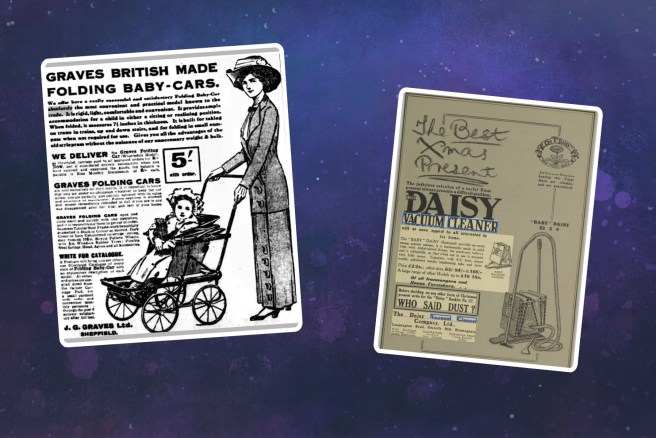
I discovered advertisements for a folding baby car (pushchair/stroller) priced five shillings and a vacuum cleaner priced forty-two shillings. (In context, a housemaid might earn twenty shillings per week.)
This is what gets my imagination going. Were ordinary people worried about suffragette attacks? Or irritated? Did they lap up the celebrity news and discuss what the rich ladies wore to the wedding?
The German dentist spy was captured in a sting operation and sentenced to five years’ hard labour. But what happened to him when World War One broke out? And what happened to the man who informed on him (who was also German but loyal to Britain)?
What does a maid wielding a vacuum cleaner that’s worth two to four weeks of her wages think of something that might put her out of a job?
How does a woman in the medical profession who desperately wants the vote feel about a suffragette bombing campaign that might kill someone?
And finally – what happened to the person who thought a vacuum cleaner was a perfect Christmas gift in 1912? I know what would happen to anyone who gave me one now…
Words copyright (c) 2023 Paula Harmon. Not to be used without the author’s specific consent. Advert for baby car from Daily Citizen (Manchester) 26th April 1913 and advert for vacuum cleaner from Illustrated London News 30th November 1912.
When I was young, when my maternal grandmother addressed me, she would often go through my sister’s name, our cousin’s, her own sisters’, her nephew’s and my mother’s, until she got to Paula.
These days I do the same, swapping my son’s name for my husband’s (my excuse is that they start with the same letter), my daughter’s for my sister’s (my excuse is that they have similar personalities) and recently my brother-in-law’s for that of the mutual male friend’s who was hosting us all for dinner (my excuse is that they both have Scottish names… OK that’s no excuse).
Very occasionally I suffer from face-blindness. E.g. once in a blue moon, I don’t recognise someone even if I know them very well. This usually happens when I’m deep in thought and/or daydreaming.
I regularly suffer from name-blindness, which is possibly linked. This means I can look at someone I know very well, recognise them, know who they are, but absolutely blank their name. Completely. It’s just gone.
This particularly traumatic when I have to introduce people to each other and can only recall some random irrelevant fact in lieu of a name (‘This is M’s mum’ or ‘This is my friend who makes great cupcakes’ or ‘This is my friend, the wife of another friend who cycles with my husband’).
Perhaps it happens in social situations or introduction scenarios, because I find both very stressful and they take up most of my ‘pretending I’m confident and sociable’ resources. An article called Is This Normal? “I Can’t Remember Names or Faces.” | The Swaddle, give reasons for this phenomenon that make sense to me at least. But it doesn’t stop it from being mortifying.
What about my book characters’ names? After all, I invented the characters (shh – don’t tell them). I waded through lists of potential forenames for the right era, or unusual British surnames (I’ve managed to get five of these into my books so far), and even researched how common certain surnames were in certain parts of London in the 1881 census.
So are their names easier to recall? Nope. Apart from main characters, I quite often can’t remember what I’ve called some people after writing a book at all. Sometimes I can’t remember what they’re called while I’m writing it, because I’ve changed their name halfway through.
For example, in one of my more recent books I realised that I had five female characters with names starting M and about four with surnames starting T. One of the female characters was called Mary (which was the number one name for girls in England and Wales for decades if not centuries). I decided to change it to Lois and did a search and replace for Mary throughout the document, happily ‘accepting all’ without thinking. This resulted in a lot of action taking place in Loislebone, and someone providing a sumlois of information etc. One of the T surnames had to change but in my head, the character still has the original name, which means nine times out of ten, I have to dig about for what I changed it to when thinking of them.
To avoid this sort of thing, also avoid duplicating names within the same series, and to keep a series bible of background info on characters whether or not it would ever be used (birthdays, details of parents and children and pets etc), I called upon my clerical career and started a card index system.
Fortunately I didn’t need to buy anything. When my daughter was studying for her GCSEs, she asked me to get her some cards to help with revision and a storage box to put them in. She obviously inherited my tendency to create revision schemes but lose interest before actually doing anything, because there were plenty of blank cards for me to use.
Then I found another set of index cards in a drawer.
Only they weren’t blank, and they didn’t have random facts about English Literature or The Cold War or Spanish verbs or whatever else my daughter had been studying on them. They were written in my father’s writing and furthermore, they were the details of characters he’d written stories about!
I still have boxes of Dad’s writing – typed, handwritten in notebooks large and small and on floppy disk. I have one ready to edit, and others I remember him reading aloud to me when I was a child (including a science fiction novel which if he’d published at the time, would now be reality). I have no idea what I’m going to do with them all. But seeing those index cards so unexpectedly brought a moment of serendipity, surprise that I could read his writing for once and of course a pang of what’s called in Welsh hiraeth and in Portuguese saudade – missingness, nostalgia, loving reminiscence.
I wish I could show Dad what I’ve written and help him do something with what he wrote. I can’t and he wouldn’t want me to fret that I can’t. But his characters’ index cards are now stored with mine as a reminder of the things he and I had in common: a love of storytelling, words, names, random facts and near illegible handwriting. And while I have no idea who Dad’s Janine Bex (below right) is, I do know that Roderick Demeray (below left) is based, with love, on Dad.
Maybe in some alternative universe, our characters hang out together and complain about us. ‘Look what she made me do!’ ‘Why would he call me that?’ ‘What’s going to happen to me next?’ ‘Why can’t she ever remember my name?’
After all, who’d blame them?
Words and pictures (c) Paula Harmon 2023, not to be used without the author’s express permission.
Am I alone in seeing stories everywhere? I can’t remember when I didn’t think ‘what’s their story?’, ‘what if X happened next?’, ‘why are they/is this/am I like this? What led them/it/me here?’
I dealt with long boring journeys by imagining the lives of the people we passed in the car, or what might be behind a high wall/hedge (lots of Cornish trips), or why a castle was in ruins. I coped with bullying by imagining situations in which I managed to express my feelings and the bullies changed their ways (biggest fiction exercise of my life). I enjoyed subjects where there was a story (English, History, RE), or patterns (Maths, Physics) or a challenge deciphering a pattern (Maths, Languages). If I’d spotted the stories in Geography and patterns in Chemistry, I might have enjoyed much them more than I did. If I’d been taught art differently, perhaps I’d have got to grips with that at school too. I stopped taking art at fourteen, in what was then called the Third Year, and is now called Year Nine, and in both eras called ‘Options Year’. This was when you study a million subjects at exactly the point of adolescence when you have become really truculent and know all adults are idiots, yet have to decide what you’re going to do for your first set of public exams (in my case, O levels). Long story short, I dropped art at fourteen.
Ever since I could create a word, I have been by nature a writer. But Liz Hedgecock has been encouraging me for some months to do art challenges with her giving me the chance to play catch-up on those art lessons I put to one side. I’ve found it really freeing, tapping into the part of me that writes short stories rather than novels. It’s a chance to try a narrative in a few lines rather than huge number of words. When she suggested we try Inktober, I was happy to give it a go. But when I looked at the prompts, I knew almost immediately that at my skill level I was definitely going to look for a ‘story’ for each one, not only to cover up my inadequate skills but to keep me motivated.
I think that largely Liz did the same, although with a different approach. You can see what Liz did here. But if you don’t follow me on Instagram – here is what I came up with and a summary of the background behind the stories that came into my head. to help me make sense of the prompts.
Dream, Spiders, Path, Dodge, Map
To start with I dug out a bottle of ink I’ve had forever and a lovely fancy glass ink dipping pen and did what I could with them.
I used the ink and pen for the first three and found myself sketching in a fluid, free-form way which tapped into my subconscious quite nicely.
As a vivid dreamer, it was hard to know where to stop for Dream. I included all my recurring dreams and nightmares but tried to make sure my bed was heading into happiness, even though I remembered too late that pictures should read left to right, not right to left. Ho hum.
I don’t like hurting Spiders, but prefer them at a distance, so looking at photos of them to draw from made me feel queasy. I decided to turn our treatment of them on its head which sort of coincided with our daughter (home for a break during peak house-spider season) talking to us through the Ring doorbell in a husky voice ‘Hello! I’m Simon the Spider. I just want to be friends. Please let me in.’
Path – the last I drew with ink and dipping pen for a bit, depicts me at some point in my life in my early twenties, deciding between the risky route of chasing my creative dreams where the dragons were (left) and the sensible career route (right). I picked the latter but am now in a position to go back to that fork in the path and change direction.
However, that’s not to say it’s all easy running and Dodge, the first one I drew with a fineliner (can’t remember why I changed, but it changed how the drawings turned out) has me trying to get to my happy place while being attacked by household duties, work/writing deadlines and to-do lists.
By the time I was drawing Map, I was away from home and had a mini art kit, so it was drawn with a fineliner and is perhaps the last one digging into my subconscious for all the things that prompt or hinder creativity. I wasn’t terribly happy with Map, but that’s how it goes. On the other hand I was an avid map drawer as a child, so it was good fun and I just wish I’d had a bigger piece of paper and fewer distractions.
Golden, Drop, Toad, Bounce, Fortune, Wander
A dragon was the first thing that sprung to mind for the prompt Golden. I went straight back to being six and the teacher reading from the Hobbit about Smaug the dragon in class, though my dragon of course is less murderous and mostly understood. I’ve always wanted to draw a dragon but thought I couldn’t, but I decided to give it a go anyway and found all those scales rather therapeutic to draw.
Drop – I regret to say that the word ‘drop’ just made me think of a running nose, so I had to do a bit of lateral thinking. I knew what I wanted to draw for Toad, so it seemed logical to draw what happened before… It nearly ended up with being a potion to turn a man back INTO a toad after a regretable spell. You’ll just have to decide whether it’s his fault for dabbling or the soup-maker has a naughty intent.
As for Bounce – I thought of the bounciest thing I could think of and tried not to remember the Spacehopper my father ran over when I was seven. I was very fond of it, and it never recovered. It gave my Dad a fright though.
Fortune was difficult for a number of reasons. I couldn’t think what to draw at all – or rather I could, but it was too complicated. It was difficult day at work and I wasn’t really in the mood that evening. I decided to go back to the ink and dipping pen and then regretted it. Everything went wrong! But what I was aiming for was the idea that there’s definitely a rich man in the seeker’s life but it’s at her expense. No idea if that comes across.
Wander was easier and is based on two photos of my daughter in different forests in different years, wondering which way to go next. (Bless her, my daughter ended up as an unwitting model and doesn’t look anything like the way I’ve portrayed her but I’m pleased that she’s braver at trying different routes than I was at the same age.)
Spicy, Rise, Castle, Dagger, Angel, Demon.
I could have drawn my husband’s numerous chilli plants for Spicy, or the contents of our spice cupboard, but of course ‘spicy’ has another meaning and I decided to have fun and go down that route as well! It took me four attempts to write ‘chipotle’. I could type it, but I couldn’t write it with a pen. This is one that I’m planning to do again and/or colour.
Likewise Rise – I suppose I could have saved this idea for Fire, but a phoenix rising with hope from disappointment and fear of failure seemed apt that particular day.
By the time I was drawing Castle, I was away from home again, and trying to deal with the intricacies of a real castle didn’t appeal. A sandcastle while more manageable felt a bit dull, so guess what – a story came to mind. My daughter loves octopuses and in a story world, one would come to her rescue if she needed it. (in reality she’d probably just biff anyone stomped on her sandcastle).
Despite writing murder mysteries which occasionally involve daggers etc, and despite thinking that daggers can be very beautiful and nearly drawing the one from Murder Dunovaria, the news being what it is, I didn’t fancy drawing a Dagger. The phrase ‘beating swords into ploughshares’ came to mind so I decided to draw (not very well as you can tell from my having to redraw the hammer) daggers being turned into doves.
The Angels in the nativity play come from the disappointment of never having been one as I described in Advent Calendar and also from remembering when my son was a shepherd in a nativity play aged five. He had his crook confiscated after rehearsals because he kept tripping up the primmest angel. When the day of the public performance came however, somehow he’d managed to get hold of a crook again and guess what he did? The primmest angel flat on her face as she walked down the aisle. He swore it was curiosity not malice but… I was the one dealing with her cross mum.
I didn’t want to draw a Demon for a number of reasons, so decided to do the sort of thing I’d have done at school and re-interpret the brief. So instead of demon, we have demonise. It was close to National Black Cat Day apparently, so that’s what I went for. Poor black cats. They don’t deserve the bad press. It’s time for them to fight back.
Away from home again with a simple art kit, I was wondering what on earth to do for Saddle, then remembered a story I had in Weird & Peculiar Tales, itself prompted by a dream, in which a hapless goblin cross breeds a werewolf with a chihuahua and went from there. (Admittedly my husband asked why I’d drawn a chicken being put on a dog, but hey.)
Plump coincided with the launch of Booker & Fitch omnibus of books 1-3 so here I am being plump (I’m plumper in real life) plumped down on plump cushions in Hazeby-on-Wyvern reading the book.
Frost was easy in theory, although I was in a very hot place at the time, so it was hard to imagine, and I found it hard to draw with black on white and wished I were home with black paper and white or silver pen, but I wasn’t. So here I am as a child, when I didn’t have a radiator in my bedroom with the view of mountains from my window obscured by frost as happened quite often.
Chains was a horse who was waiting, poor thing, to cart tourists around in a sort of cab in 30+ degrees Centigrade (86+ Fahrenheit). It didn’t seem too bothered, but it was happily chewing on the chain attaching it to a railing. I don’t think it was trying to get away, but it was hard not to imagine it (I would have been).
Scratchy – this is the cat we had when I was a little girl, scratching on a piece of wood which we’d brought back from the New Forest after a camping trip. Why? Because I’d spent several days pretending it was my motorbike (give me a break, I was about four or five years old) and I talked my dad round into bringing it home (Mum was not so keen). At home, the magic dispersed and it became the cat’s scratching post. But I like to think she was clever enough to know it was a motorbike really.
Shallow – again, I had something quite ‘deep’ in mind, but didn’t have the skills (or time) to draw it, so instead, here is a nod to all those summers when I (or later my children) thought they’d actually catch something in a rock pool but never did because the creatures were too clever to be caught.
And Celestial (by now I was back at home with black paper and silver pen) speaks for itself – or does it? All astronomists should look away, but there are the Pegasus and Draco constellations together (possibly unlikely) waiting for me to fly amongst them.
Dangerous, Remove, Beast, Sparkle, Massive, Rush, Fire
Finally we’re into the last week of October/Inktober. By now I was getting tired of working out what to draw, and was, once more, away for a couple of days (it really was that sort of month). By now, the prompts seems even harder to draw. Even though I’d taken photos to help me, it turned out they didn’t. So I had to dig down a bit.
For Dangerous, I remembered when my husband bought a Shun knife and kept telling me (the person who does most of the cooking), every time I cooked (e.g. generally) how sharp it was. One evening, while considering that he should be glad I wasn’t seeing how sharp it was on something other than onions, I rolled my eyes… and sliced into the end of my finger. Glad to say that it healed up fine. Sorry to say that onions aren’t improved by being pink. Will honestly say that my husband and I do not look this young although the expressions are broadly accurate.
Remove was tricky. I had a few ideas including someone removing hate from their heart and being ready to replace it with love, and someone pinching a piece of someone’s jigsaw just as they were about to finish it (sorry – that’s my brain – goes from sentimental to mischievous in the blink of an eye) and then remembered I was going to be drawing while on a train and I couldn’t face trying to draw a jigsaw. Something someone said made me think of masks or make-up and that’s what I decided to draw. I don’t wear much make-up and certainly haven’t worn this much for years, but am really fascinated by make-up artists’ skills and occasionally wonder if they could improve me. Sadly though, at the end of the day it would come off and the real me would be there underneath. The train-ride wasn’t exactly smooth and that’s my excuse for any errors (cough).
Beast was potentially as hard to draw as Demon, but by this point in the challenge, both Liz and I had decided that hands were ‘a beast’ to draw and so I went for the image above. In the pencil sketch I have the right number of finger joints. Somehow when drawing in fine liner, I added one in. This proves the point about drawing hands.
I knew from the outset that I wanted to draw my lovely daughter’s lovely eyes for Sparkle. I categorically didn’t do either the exercise or my daughter justice, but will definitely try it again. I was, by this point, really missing the opportunity to use watercolours or acrylics to add colour, or just use various pencils, but there you go. It’s all a learning curve and I’m glad I can do it without a teacher marking my efforts.
Massive was another where I didn’t quite know what to draw, then we passed a group of tourists queuing to have a birds of prey experience. The birds of prey looked as bored as the horse waiting to cart tourists around (though the temperature was more manageable where I was then). I wondered if they were thinking ‘why do the tourists get all the fun? What if we were big enough to carry them instead of the other way around?’
I had some photos of people on the underground to use as inspiration for Rush, but then thought back to when I was a child and spent time watching nature – the driven clouds, the busy insects, the running river, the the little creatures in the river marching about, oblivious (thankfully) to the adult world of being so head down rushing from A to B. Somewhen I stopped doing that, and am only just starting again.
Finally, for Fire, this is another from Weird & Peculiar Tales – or rather it’s what might happen one day. I have a sort of myth-story in there about when dragons and humans were friends – the humans providing friendship, the dragon providing warmth and protection. Then, because humans are involved, it all goes wrong. This is imagining a future which I think we’d all love – -when we stop fighting and pointing fingers and just sit down together and enjoy friendship and warmth.
So there you have it – a bit of my soul laid bare. As I said before, I’m proud of some of my drawings, not proud of others at all, may retry some, may not with others. But I had a go. It’s back to the writing now, but I’m not going to stop the art. I’m going to keep doing it. Tapping into that part of my brain that likes to tell a quick story and isn’t worrying about judgment feels like going back to a freer, less disciplined me. And that’s not a bad place to visit now and again.
Words and Images (c) Paula Harmon 2023 – not to be used without the author’s express consent.
Start work in earnest on a recipe book I’ve been planning for a while.
For one reason and another, I only managed number three, and my long suffering (his words not mine) husband has been playing guinea pig again.
My first proper job involved working in a bookshop/coffeeshop. My then manager/friend/housemate, properly trained in catering college, was mesmerised by the way I cooked while muttering to myself, ‘I’ll bung some of that in, then throw in a bit of this and taste and see what happens’. She suggested I ought to write my recipes down and call it ‘The Bung and Throw Cookbook’.
I never did of course, partly because I never measured anything, and it seemed like too much work to figure things out. Besides, after twelve months, I left to work in an office and never had the urge to return to a job in catering, Nevertheless at home, I continued making up and collecting recipes. For a good length of time, cooking was my main creative outlet, whether making something complex or simply trying to produce something quick and tasty from what happened to be in the cupboard or fridge. I still think it’s a wonderful way to relieve stress – as my mind has to leave troublesome things aside while it concentrates and creates.
Then I started writing historical fiction and wondered ‘what would my characters eat?’ as I explained here. From that point, I wondered if I could create a cookbook re-imagining what Lucretia (2nd Century), Katherine Demeray (1890s) and Margaret Demeray (1910s) might have eaten (that I might like to eat too).
The books I’m working with are The Roman Cookery Book which includes recipes from nearly two thousand years ago under the name of Apicius (translated and compiled by Katherine Rosenbaum and Barbara Flower), The Best Way published in 1909 and The Women’s Suffrage Cookery Book published in 1912.
It’s harder to re-imagine the food than you might think if you don’t know old recipe books, which are all written for people who fundamentally just needed ideas, not techniques. E.g. all three books are pretty much a forerunner of the ‘Bung and Throw Cookbook’ my friend suggested I wrote all those years go.
Would I eat any of the recipes? Yes (though not all).
Can I cook them easily from the information provided? Well…
Working out recipes from The Roman Cookery Book is the hardest. Are all the herbs safe? (Or easily available?) What can I substitute for the ubiquitous garum (fermented anchovy paste)? How do I decipher some of the recipes? They mostly simply list ingredients and vague instructions without quantities or timings.
Some things are hard or undesirable to do: ‘cool in snow’, ‘remove the spines from your sea-urchin …’, ‘take your jellyfish …’, ‘best served with peacock’.
There are a lot of chicken recipes in the Roman book, but since until relatively recently a young (e.g. potentially tender) chicken was most valuable as an egg layer and hard to mass-produce, do they mean chicken or some other fowl?
The simplest way I’ve found to decipher some of them is following the wonderful Tavola Mediterranea website, but otherwise, I’m on my own.
The Suffrage Cookbook and The Best Way are more comprehensible to a modern cook. The ingredients can be easily bought (with the possible exception of brains which I don’t want to eat anyway). But some of the instructions are just as much ‘bung and throw’ as the Apicius book. ‘Enough of…’ ‘Some…’ ‘A bit…’ ‘The usual amount…’ There aren’t many chicken recipes but a fair amount for meat which is nowadays comparatively more expensive. There are more vegetarian and spicy recipes than people might think. Timings, when given, would turn most vegetables, pasta and rice into mush.
My idea is to take a selection of these recipes, work out the instructions and cook them as if Lucretia (or more likely her cook) or Katherine or Margaret would do with access to modern equipment (and less inclination to boil things for hours).
I’ve shared some deciphered recipes before here, and I’m ploughing ahead. It’ll be a long process, involving working the recipes out when necessary and then trying them on willing volunteers (mainly family).
On Saturday evening I cooked Chicken stuffed with Saccotosh (sic) for my husband and mother. Until recently, not being American, I’d honestly thought that ‘Succotash’ (along with sassafras) was a mock swearword made up by Looney Tunes, so it was interesting to find out what a British woman in 1912 – who obviously knew otherwise – had come up with.
The ingredient quantities are vague, the cooking instructions even more so. The main warning was ‘chicken should be sewn up to prevent the corn bursting out’. Anyway, I worked out what the missing details probably were, and without sewing anything or having the chicken explode, it proved delicious and was eaten to great appreciation.
On Sunday night, I made a Curry Pie. In terms of instructions, there’s sufficient filling information, but no explanation as to why it’s called pie when no pastry is referred to. But it does say to cook it in a pie-dish. So I sort of assumed the pastry and went for it. It was tasty too, but needs a bit more tweaking before I’m happy with it.
In the meantime, my husband remains the main recipient of all this experimentation. Do you think he’s insisting on cooking tonight to give me a rest, or because he’s worried that one day he’ll end up like the guy in the drawings below? Well, he’s going to make jambalaya using the leftover chicken from Saturday’s Succotash/Saccotosh recipe, so he can’t be too worried about my recipes.
Can he?
Words and pictures (c) Paula Harmon 2023, not to be used without the author’s express permission.