Yes But How Much Is True?

The other evening my husband went out cycling. Yes, it’s November. Yes it was dark. But he and his friends do this weekly after work whenever they can. At nine-thirty, it started to pour with rain as forecast. At ten p.m., just as he returned, the whole town had a power cut.

I heard with relief (since he’s the only one of the cycling group who hasn’t broken a bone on one of these jaunts) the screech of our garage door and went to look out for him, shining my phone torch into the rainy darkness.

My drenched husband said it was like being guided into the house by Florence Nightingale.

My nursing skills boil down to ‘here’s a kiss and an aspirin and/or a plaster and/or a blanket and/or soup and I’m sure you’re fine really’, so this was the first time I’ve been likened to any medical professional let alone a nursing heroine, and got me thinking.

Did Florence Nightingale really did carry a lamp? Or was this a myth long since debunked along with Napoleon being short and Marie Antoinette saying ‘Let them eat cake’? (He wasn’t and she didn’t, and for other historical myths click here.)

At a talk a while ago I was asked if I was ever tempted to write a novel based on a real character. So far my answer is no.

The first reason why I haven’t is that doing so is complex and can be controversial.

With real historical people a novel can only capture the elements of their life that the author wants to focus on, and since real lives don’t follow a story arc, or narrative pattern, real events might have to be moved about or omitted. Then readers complain about inaccuracy or bias.

Going back to Florence, yes she did have a lamp, but surely the nurses working for her in that Crimean hospital carried them too? Yet the image of the Lady with the Lamp popularised by the Times, and Longfellow’s poem ‘Santa Filomena’ turned Florence Nightingale into a celebrity. In the 1970s, I was taught that she was the only pioneering nurse in the Crimean War. But in the 2010s, my children were taught about Jamaican born Mary Seacole who was also there nursing injured soldiers, but without government support or newspaper fame presumably because of views on her race (which may have been a factor in my not learning about her sooner too).

And while Florence radically transformed nursing and reformed the running of hospitals, she was also a firm believer in the right of British Empire colonisers to interfere with the culture of the native people, because Western beliefs and customs were superior and ‘correct’.

Anyone novelising her life would have to include this. Yet there would still be those readers who’d say the focus of a novel should only be on the positive, and anything negative should be brushed under the carpet on the grounds that Florence ‘was a product of her generation’. She was, of course, but there were people of her own race/nationality in the same generation who thought it was wrong, and the native peoples suffering were also of her generation. Do they not deserve a voice? Whatever interpretation you put on it, leaving negative things out surely means the fictionalisation doesn’t reflect the real person at all.

My second reason is that I like to use my imagination.

All my historical books are set in a real historical setting. The Margaret Demeray series also includes or refers to real events and people. ‘Death In The Last Reel’ includes the Siege of Sidney Street and Winston Churchill (film footage here); ‘The Treacherous Dead’ refers back to the Boer War, Emily Hobhouse and ‘Breaker’ Morant. The forthcoming ‘Dying To be Heard’ has my (fictional) characters witnessing the real actions of militant suffragette Emily Davison at the 1913 Epsom Derby (film footage here)

But I like to dig about in the British Newspaper Archives for less well-known things to provide a flavour of the times, because the third reason I prefer to create fictional characters is that I want to imagine ordinary people like my ancestors and perhaps yours, put them in extraordinary situations and see what happens next.

The rich and famous have plenty of books and films written about them. Let’s see what an ordinary person might do.

In 1913, the newspapers headlines were mostly about suffragette militancy and the Balkan crisis. But there was frivolous celebrity news including the Royal Wedding of a German princess – the last time European monarchs met in peace, and before many monarchies disappeared forever. (Not that anyone knew that then.) I also found reference to a moving picture ‘comedy’ about hot-headed suffragettes in which one (played by an actor in drag) was ‘hilariously’ force-fed champagne; a German dentist in Portsmouth who turned out to be a spy (both getting a brief mention in ‘Dying To Be Heard’into the book); and something I’m keeping back for book five.

I discovered advertisements for a folding baby car (pushchair/stroller) priced five shillings and a vacuum cleaner priced forty-two shillings. (In context, a housemaid might earn twenty shillings per week.)

This is what gets my imagination going. Were ordinary people worried about suffragette attacks? Or irritated? Did they lap up the celebrity news and discuss what the rich ladies wore to the wedding?

The German dentist spy was captured in a sting operation and sentenced to five years’ hard labour. But what happened to him when World War One broke out? And what happened to the man who informed on him (who was also German but loyal to Britain)?

What does a maid wielding a vacuum cleaner that’s worth two to four weeks of her wages think of something that might put her out of a job?

How does a woman in the medical profession who desperately wants the vote feel about a suffragette bombing campaign that might kill someone?

And finally – what happened to the person who thought a vacuum cleaner was a perfect Christmas gift in 1912? I know what would happen to anyone who gave me one now…
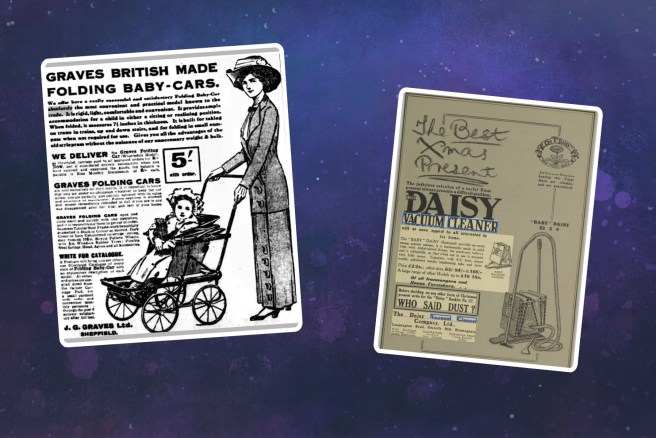
Words copyright (c) 2023 Paula Harmon. Not to be used without the author’s specific consent. Advert for baby car from Daily Citizen (Manchester) 26th April 1913 and advert for vacuum cleaner from Illustrated London News 30th November 1912.

A Novel Idea

Here’s a confession about a time when ‘the story’ was more important than common sense, logic or, in fact, the environment.

Sometimes I’m asked whether I have a preference in terms of what era I read about in historical fiction and whether it reflects on the eras I write about.

It’s hard to answer either.

The first books I read which could be termed historical fiction for children were set during the English Civil War between the “Roundheads” and “Cavaliers” or set in Elizabethan England. I loved books like ‘Cue for Treason’ where one of the protagonists was a girl who actually did things rather than just sit about watching boys have all the adventures. 

Then, around the age of nine or ten, I hit a heavy romantic/melodramatic phase around the time that children’s TV dramatised ‘A Little Princess’ in which a girl goes from riches to poverty and is kept in an attic by a wicked headmistress.

This was where my confession comes in.

I had entered the hinterlands of adolescence where I realised that my parents just didn’t understand me. I started a novel titled with those very words – an angst ridden drama involving a cruelly under-appreciated Victorian girl who… 

I didn’t get very far because I hadn’t quite worked out what she was going to actually do except whinge (although I daresay I’d planned a handsome young lad for her to fall in love with because he did understand and appreciate her and they’d ultimately marry). 

Instead I formulated a romantic plan less exhausting than writing a novel.

I might have been inspired by one of the old-fashioned Codd Neck bottles we’d dig up from time to time.

They were just begging to have a message put in them, if only they weren’t broken. And that’s where I got the idea.

I wrote a letter in the poshest English I could muster, in my fanciest handwriting with lots of curlicues, begging the recipient for help and asking them to rescue me from the attic in the castle where I was cruelly imprisoned. I dated it 1872, ripped the edges a little, stained the whole thing with tea to make it look old, rolled it up and put it in a normal glass bottle with a screw top (which I was saving to take back to the shop in exchange for enough small change to buy sweets and thus quite a sacrifice to the literary cause).

I then took the bottle to my secret place by the river, slipped it in and watched it bob downstream until it disappeared.

For a few days afterwards, I imagined the bottle getting into the larger river into which ‘mine’ fed and then out to sea and finally being picked up who knew where. It would be in the news! It would be a sensation! Who had the imprisoned girl been? Which castle? Had she ever escaped or was her skeleton still waiting in a dusty attic?

Then I was consumed by guilt. 

The thing I should have worried about – the fact that ‘my’ river was full of rocks and led to a waterfall and therefore the chances were high that the bottle might smash long before it got to the larger river, let alone the sea and someone might stand on it and get hurt – didn’t occur for years.

It also didn’t occur to me that even if it had been found intact, no one would think the message was genuine since the bottle, the handwriting and the felt-tip pen with which I’d written the letter were firmly late 20th century, not to mention the fact that it might seem suspicious that the ‘imprisoned’ girl had somehow managed to escape the attic to drop the bottle in a river and then presumably gone back to incarceration. 

What I did worry about for a week or so was that when it was found, a fruitless and expensive global search for a fictional little girl would commence for which I’d be wholly responsible.

When nothing happened I stopped worrying, but possibly as a direct consequence, I largely lost interest in romances about rich girls who were nothing like me and drifted towards books about average people who, whether historical or not, found themselves in extraordinary situations and had to manage with the resources at their disposal. 

And that, in partial answer to both original questions, explains what I’m really interested in reading and writing. 

It’s less about the era, even though I do have ones I gravitate towards. It’s more about what happens when an average sort of person – neither so poor, that they may as well take risks because they’ve nothing to lose nor so rich that they can do what they want and not worry about the consequences – has to tackle an extraordinary situation, when maybe they have to do it around the working day, family commitments, social expectations, financial constraint. Can they still have adventures? Can they still face peril? Can they still have fun?

Yes they can!

And when Liz Hedgecock got in touch (or did I get in touch with her?) and suggested co-writing a series set in Victorian London I jumped at the chance to prove it. 

We set about writing one book and the Caster and Fleet series then took over our lives because Katherine and Connie’s adventures were so much fun to write.

And in the first one, I finally got to write and deliver an anonymous letter. Only this time, it was in a much less risky way than I had aged nine or ten and it didn’t waste a bottle.

If you haven’t had the chance to read the Caster and Fleet series (six novels plus a novella) – the first three books are on special offer between Monday 28th June and Sunday 4th July 2021:

The Case of the Black Tulips is 99p/99c

The Case of the Runaway Client is £1.99/$1.99

The Case of the Deceased Clerk is £2.99/$2.99

And if you want to hear an abridged version of the first two chapters to give you a taster and also find out how Liz and I made friends and worked together on the series, here we are being interviewed about the books and their spin offs. 

Words copyright 2021 by Paula Harmon. All rights belong to the author and material may not be copied without the author’s express permission. Image credit

ID 201797590 © Chrissiecreative | Dreamstime.com

Byways, Rabbit Holes and Wrong (or maybe Right) Turns

Given the reading habits I formed as a child, it’s not too surprising I ended up writing historical mysteries, but I hadn’t really thought about the research required. Now I have an internet trail that includes purchasing cookbooks and books on poison, digging for mindfulness techniques and also whether the physical appearance of a murder victim could be mistaken for natural death. As I’ve been locked down with the same people for nearly a year, this could look dodgy. So far the police haven’t turned up. But I guess there’s still time.

I started this intending it to be about what influenced my writing of historical mysteries, but then it turned out that disappearing down a research rabbit hole unravelled a family mystery of my own and revealed a surprise.

When I was about seven, way before Horrible Histories were published, my father bought me a book called The Medieval Scene. Being a child, the best bits from my perspective were the gruesome details of trial by ordeal etc, but even the less gory elements encouraged my interest in history and I never really looked back. 

A year or so later, we moved relatively near to the ruined 13th Century Carreg Cennen Castle which we regularly visited. It was thrilling to look down into what was left of the dungeons and wonder who’d once been down there, why, and whether they survived. When I found a time-slip book set in Carreg Cennen called The Gauntlet, I read it over and over, lapping up the historical detail and contrasting it with the modern boy’s normal life. (It was rather dated then and more so now, but still a terrific read.) Avidly reading Geoffrey Trease, Henry Treece and Rosemary Sutcliff – I discovered that novels – if often rather male-centric – were a great way to absorb history without it being a dull reiteration of dates. Then as I reached my teens, I found historical fiction written for girls and about girls, which dealt with social issues too: Geraldine Symons books The Workhouse Child and Miss Rivers and Miss Bridges, then the Flambards series by K.M. Peyton.

I didn’t just love historical books. Once, I’d loved the mysteries in the also dated Famous Five and Secret Seven so it was a natural progression to Agatha Christie, Dorothy L Sayers and Ngaio Marsh. Of course, to me in the late 20th Century, their books were not just detective stories, they were also historical fiction, mostly set in an era when my grandparents had been young, in a world almost as alien as another planet, where a lots of people appeared to have servants, few people had telephones, letters and trains arrived regularly and on time (except where the plot demanded otherwise), telegrams were normal but inside bathrooms and private cars weren’t (unless you were rich).

Research, as I’ve said before and to mix a metaphor, is a rabbit warren of byways. Checking background information for the sequel to The Wrong Sort to Die last Monday, I was trying (and failing) to find out the exact location of the first International Women’s Day march in Switzerland on 19th March 1911 (it’s not terribly important but if you know – please get in touch). As I was searching, I became side-tracked by a truly awful disaster in New York on 25th March 1911: The Triangle Shirtwaist Factory Fire. As it’s the sort of thing which would have horrified my character Margaret, I wondered when it was first reported in Britain and started looking in the British Newspaper Archive. So far, the earliest reference I’ve found is in Sunday 26th March 1911’s Lloyds Weekly Paper

Naturally I then wandered down other alleys in the archive. Deciding to take a break from my book, I remembered once seeing a clip about my great-grandfather when doing some family research. Due to killing a laptop with a cup of tea in the interim, I’d lost the link. Now I looked again and found a report of the inquest into his death. I knew that he’d died as a result of drinking what I’d been led to believe had been disinfectant. I now found it was some kind of lotion intended for external use made from aconite. I’m not sure which it would be worse to die from, or to witness someone dying from as my great-grandmother must have done. I can only hope that my grandfather and his five siblings were either at school or work when it happened. Whether my great-grandfather drunk it deliberately or thought it was something else was undetermined. He certainly called for help. But suicide while of unsound mind was the verdict returned. None of this was a shock, as I already knew much of it, but reading the newspaper article brought the situation to life – a man plagued with money worries in deep despair and with what would now be termed as depression and a widow left with six children, who lost her husband and home and had to rely on family, friends and presumably the older two children for their livelihood. 

After this, I took one last turn in the research path (for this week at least), and went from sadness to surprise to delight. 

Now that I knew where it was, I googled the place where my great-grandparents had lived and I found the last thing I’d expected: a website dedicated to early cinema and a page called Straight Out of Whetstone about a 1916 film which was partly shot in their very town. If you know what you’re looking for, you can even very briefly see their house.

It’s a shame I can’t show any of this to my father, but I could show my sister and children. And now I can not only see Whetstone as my grandfather would have seen it as a child, but I can also see half the film that was shot there. If you want thrills and spills (if rather slow ones) here is the link to what’s left of ‘The Man with the Glass Eye’. 

It’s tragic that the film breaks off just as things are getting really exciting, so I’m now trying to find out what the rest of the story might have been…. Watch out rabbit hole – here I come.

Words copyright 2021 by Paula Harmon. All rights belong to the author and material may not be copied without the author’s express permission. Photograph 51997062 © Everett Collection Inc. | Dreamstime.com